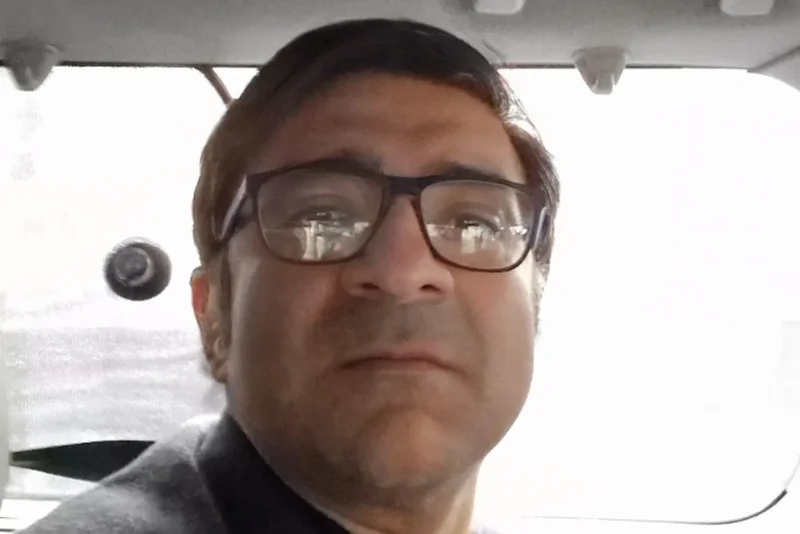
An engineer died of a brain bleed after trying for weeks to get help for his symptoms, but being misdiagnosed with sinusitis.
Shre Chatterjee spent almost two months trying to get medical help for his “sudden and severe” headache, but multiple health workers did not refer him to hospital for emergency care.
If they had done this, it was likely that the 44-year-old would have survived, a coroner has concluded.
Mr Chatterjee developed a severe headache on 14 August 2023 and sought treatment on multiple occasions.
From 16-23 August, he was seen by two doctors and an advanced care practitioner and diagnosed with probable sinusitis.
He was given medication, including diazepam to relax his neck muscles and amitriptyline for pain.
Over the following weeks, he attended physiotherapy and osteotherapy clinics and received a massage, which did not remove the pain.
On 4 September, he sent an email to his GP and booked an appointment for over a month later, on 6 October.
On 25 September, he called an out-of-hours doctor to report that his vision was so blurry that he could not drive, and was told to contact his GP as soon as possible.
On 1 October, Mr Chatterjee again spoke to an out-of-hours doctor, complaining of headache, memory loss, and blurred vision.
His 6 October GP appointment was cancelled as the doctor was unwell, and rescheduled for 10 October. That day, his wife called an ambulance for him after he was found to be breathless, but he was not taken to hospital as the GP appointment had been booked.
Mr Chatterjee was asleep when his GP called later that day, and his wife spoke to her instead. Mr Chatterjee was referred to neurology for further testing.
However, he vomited and was found unresponsive at home that same afternoon, and was taken to University Hospital Southampton, where CT imaging revealed a brain bleed.
He died at the hospital two days later, on 12 October 2023.
An inquest in Winchester, Hants, concluded in September 2025 that he had suffered a subdural haemmorrhage, a rare type of brain bleed for someone of his age.
A Prevention of Future Deaths report has now been published by the Area Coroner in Hampshire, Rosamund Rhodes-Kemp.
She said that there were multiple “missed opportunities” to refer Mr Chatterjee to emergency care.
She also raised concerns about doctors' inability to access direct booking systems with a patient's own GP in cases requiring face-to-face assessments, sparked by the fact that Mr Chatterjee was unable to see a doctor for 48 days after he first spoke with his GP.
It was confirmed that if he had been able to see a doctor sooner he “would have been diagnosed more swiftly and he was likely to have survived”.
Mr Rhodes-Kemp said: "During the course of the Inquest it became clear that whilst [out of hours]/111 doctors should be able to access direct booking with a patient’s own GP in cases requiring a face to face assessment, this facility is being blocked by some GP surgeries.
"This means that if a patient requires an urgent assessment the [out of hours] doctor can only refer them to contact the GP surgery, or direct to an Urgent Care Centre which is supposed to treat minor injuries and where they may still not be examined by a doctor and blood tests imaging are not available.
"In the deceased’s case despite numerous attempts to access a GP appointment he did not actually see a doctor from 23rd August 2023 until he was eventually admitted to hospital with a by then fatal brain bleed on 10th October 2023.
"It was agreed by witnesses that if a doctor had seen the deceased face to face sooner, particularly one who knew him, then the seriousness of his condition would have been diagnosed more swiftly and he was likely to have survived."
Ms Rhodes-Kemp sent her report to health organisation PHL Group and to 111 Out Of Hours, which have 56 days to respond.