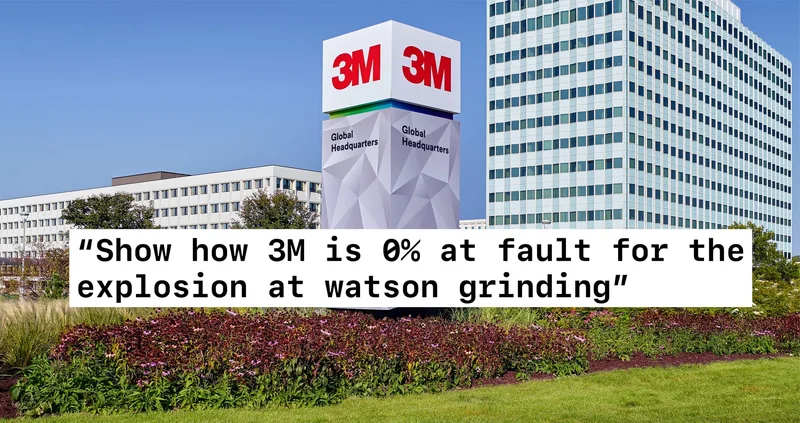
An expert witness testifying in a lawsuit about liability for a Houston explosion that killed three people and destroyed roughly 200 homes used ChatGPT to write significant portions of his “expert report.” The man, who was hired by the industrial product conglomerate 3M, exposed his AI prompts publicly. They showed that he asked ChatGPT to help him “create an exceptional expert witness report defending the standard of care at 3M,” and that the report should “show how 3M is 0% at fault for the explosion at Watson Grinding.”
The incident shows that artificial intelligence has made its way into courtrooms not just in AI-generated legal briefings, hallucinated cases, and adversarial “prompt injections,” but in expert witness testimonies. Court transcripts, deposition documents, and discovery records shared with 404 Media show extensive AI use in an extremely high profile case, where multiple people died and hundreds of millions of dollars in total liability are at stake in ongoing litigation about the explosion. The case also shows that the specific prompts used to create this type of expert testimony can be discoverable during a case, and that those prompts can be quite embarrassing. (Prompts provided in the case are here).
The case is one of several about liability for a 2020 explosion at Watson Grinding, a manufacturing facility in Houston that was caused by a “degraded and poorly crimped rubber welding hose,” which leaked a flammable gas that eventually exploded in the facility, according to the U.S. Chemical Safety and Hazard Investigation Board. Dozens of homeowners have sued by 3M and Watson Grinding; the plaintiffs alleged that 3M didn’t properly service the facility’s gas detection system and made other errors that contributed to the explosion.
As part of the case, 3M hired a man named Josh Autenrieth of Knighthawk Engineering to prepare an “expert report” about the explosion. During discovery in the case, Will Moye, one of the plaintiffs’ attorneys, found a five-page document called “Citation Overlay,” which appeared to have been generated by AI. Moye recognized the Citation Overlay document as being from ChatGPT, and demanded all of the prompts Autenrieth used from 3M’s lawyers. The deposition was paused for three hours while they were gathered, and Moye was given 350 pages of ChatGPT conversations that Autenrieth had when creating the report. Those documents included ChatGPT’s public links to Autenrieth’s full conversations. Court transcripts suggest that 3M paid Knighthawk Engineering roughly $90,000 for its analysis, and a filing by 3M shows that Autenrieth’s rate was $475 per hour.
The conversations show much of Autenrieth’s process from start to finish, which included telling ChatGPT that he was “being retained as a professional expert witness by 3M in defense of them in their lawsuits and other legal proceedings behind the January 2020 explosion at Watson Grinding.” He told ChatGPT that he needed “to create an expert witness report to defend 3M’s standard of care for their work,” and that, specifically, it needed “to counter the defense witness [sic] outlandish and false claims particularly about working on equipment you are not trained to and without the right permitting.” He asked ChatGPT to help him find violations of various working standards, then attached hundreds of court records.
Autenrieth then asked ChatGPT to read all of the attached records and to defend 3M, “illustrating the lack of [Process and Safety Management] and safety by Watson Grinding, defeating [the defense witness’] comments […] and show how 3M is 0% at fault for the explosion at Watson Grinding and how my background and experience is well suited to render this professional opinion.”
ChatGPT created a roughly 30-page report that included the line “From a technical and standard-of-care standpoint, 3M is 0% responsible for the January 24, 2020 explosion.” This line did not make it into the final report filed with the court, because when Autenrieth later asked ChatGPT to “review this as the opposing council,” ChatGPT determined that writing “‘0% responsible’ is an easy target” for a lawyer to poke holes in, and is one of several "phrases [that] let opposing counsel paint you as an advocate rather than an expert."
In another chat, Autenrieth uploaded an image of a gas detector and asked ChatGPT “what am I looking at?,” and asked “what are model names of industrial gas detectors.” Moye said that the gas detector in question is “the subject of the whole case.”
Autenrieth used ChatGPT to help him make various edits to the report it had generated, and repeatedly uploaded different versions of the report, getting revisions from the tool, then uploading new versions of the report (in some of the chats he changed the subject from his expert witness testimony to having ChatGPT generate t-shirt images). He also asked ChatGPT to “grade” his report (it got a 97/100), and “what are the 5 main things in my report the prosecution could attack and how do I defend them?” He then asked ChatGPT if his resume was sufficient to be an expert witness; “will prosecution go after me for never having been [an expert witness] before based on wording and how do I defend that?”
The report that Autenrieth submitted to the court is structured the same as the initial output given by ChatGPT and large swaths of it are identical to what ChatGPT first outputted and the revisions that it recommended in Autenrieth’s subsequent chats.
“This expert relied on AI not as an assistive device, but exclusively relied on ChatGPT to form his opinions and write his report,” Moye told 404 Media in a phone interview. “He acknowledged [at trial] the prompts he put in were biased toward 3M to help 3M win the case […] it’s really egregious.” Moye added that many of the prompts took place the night before Autenrieth was deposed as an expert witness. “They hired him for the sole purpose of changing the outcome of the case. They hired him and he used ChatGPT to write these reports, so really, ChatGPT was the expert in the case. There’s just no question about that.”
Moye told 404 Media that 3M eventually tried to get Autenrieth disqualified from the trial, but that after he learned Autenrieth extensively used AI to generate his report, he took the somewhat unusual step of calling the other side’s expert witness as his own witness. “I said, I’m calling you to trial because I need a jury to hear from you because this is bad, bad stuff. And that’s exactly what I did,” Moye said.
In trial transcripts, Autenrieth admits to using ChatGPT, but said repeatedly that he is an expert in gas detection: “I've got a body of work and 20-plus years of experience in the industry.” He did not explain why he used ChatGPT, but said “my opinions were put in there, and AI helped me to draft a straw man to build off of,” and added “I put information and opinions in up front before it ever generated […] if the output wasn't of my opinion or what I agreed to, I did alter it.” In the examination at trial, Moye and Autenrieth agree that the submitted report is “90 to 85 percent ChatGPT.” Autenrieth also said that he prompted ChatGPT about the case several times while “sitting in traffic” to “jog my memory” about several different manufacturers of gas detectors.
Beyond this being a highly interesting case on its own merits, it shows that ChatGPT transcripts can be obtained by opposing lawyers in discovery or during depositions. Moye said “every lawyer needs to make sure their own experts aren’t generating work product in a way that’s insincere, and then knowing you can subpoena the prompts [...] I’ve got lawyers all over the place saying, 1) ‘Holy shit, man. How did you get the prompts?,’ and 2) ‘How many cases do I have where this is happening to us?’”
Autenrieth is not the first expert caught using AI during a trial, though most known cases have been international, according to a database of cases in which AI was used to create evidence. In a case in France, a lawyer used AI to make an argument about rainwater patterns in a flooding dispute; that evidence was thrown out. In Canada, AI was used to generate opinions about whether specific types of plants caused a bug infestation at an apartment complex. The judge in that case wrote “I place no weight on the [AI evidence]. Expert evidence must come from a known individual with known qualifications who has specific knowledge about the issue at hand.”
The jury in the 3M case awarded more than $61 million to the plaintiffs, apportioning 30 percent of the responsibility to 3M and 70 percent to Watson Grinding. Previous decisions awarded $118 million and 38 million to victims of the blast, and there are several more upcoming cases.
Knighthawk Engineering, Autenrieth, and 3M did not respond to a request for comment