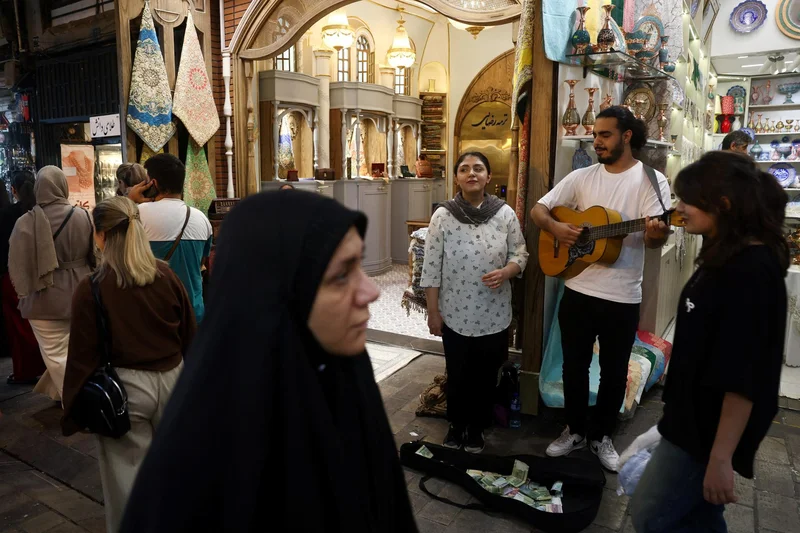
DUBAI — Even as Iran projects resilience in the war with the United States, its leaders are worried that a threat of more economic punishment by Donald Trump could increase hardships, reignite unrest and further erode the Islamic Republic’s legitimacy.
The U.S. president vowed on Friday to hit Iran hard economically, a day after Treasury Secretary Scott Bessent said Washington would impose measures on Tehran that have "never been seen" as early as next week. Washington has not said what those measures will entail.
For all the bravado of Iran's leaders after holding out in nearly six months of conflict and effectively closing the Strait of Hormuz, a vital global oil supply route, they face mounting pressure at home that could result in nationwide unrest, according to three Iranian officials.
The officials, two political insiders, a former Iranian official and a dozen ordinary Iranians spoke to Reuters for this story on condition of anonymity, either for fear of retribution or because they are not authorised to speak to media.
Iran entered the war with high inflation, a weakening currency, energy shortages, sanctions and deep structural weaknesses, and must now contend with damaged infrastructure, disrupted trade, lost production and the cost of rebuilding.
Arshia, a civil engineer, spent a decade working in Iran’s construction industry before the war that began with U.S. and Israeli attacks on February 28 brought projects largely to a standstill.
He is now struggling to find work as projects are delayed or cancelled and costs soar, with little prospect of a rapid recovery.
"I’m worried. If Trump imposes more sanctions, how will ordinary people survive? I don’t want my country to be punished militarily or economically. We’re already struggling,” said the father of two from the central city of Isfahan.
His plight reflects a broader reality across Iran, where U.S. strikes damaged factories, power plants, transport networks and other critical infrastructure, adding to pressure on an already strained economy.
Mohsen, 53, was forced to shut his small import-export business with Gulf countries after Iran retaliated against U.S. strikes by targeting American bases and assets in the region.
"I had to lay off 10 employees. It was painful, but I had no choice. I could no longer afford to pay their salaries, and now I’m relying on my savings to support my family," he said from the southern port city of Bandar Abbas.
Inflation, uncertainty hit households
Iran’s annual inflation rate reached 66 percent in July, while consumer prices were 87.9 percent higher than a year earlier, according to Iran’s Statistical Centre. Food inflation hit 128 percent year-on-year.
For Iran’s rulers, the greater threat may be not economic pain itself, but the risk that worsening hardship reignites mass unrest, said the two insiders and one official.
The appointment of Hossein Taeb last week, a key architect of past crackdowns, to lead Iran’s Basij militia is one of the clearest signs yet of growing concern over a resurgence of unrest, a former reformist official said.
The Basij, a paramilitary volunteer militia, is affiliated with Iran's powerful Revolutionary Guards, which have both been used by the clerical rulers to quell protests.
Economic grievances have repeatedly spilled into nationwide protests in Iran in recent years.
In January, nationwide protests over economic hardships were crushed by the IRGC and the Basij force, with thousands killed.
In recent months, Iran’s clerical rulers have responded to fears of renewed unrest with executions, arrests, summonses and lengthy prison sentences targeting journalists, lawyers, activists, human rights advocates and students, rights groups say.
Officials say the measures are needed to maintain stability during wartime. Critics say they could deepen the divide between the clerical establishment and a public frustrated by rising economic pressures.
Salary 'gone within days'
Families are cutting back on meat and other staples, opting for cheaper alternatives.
"I’m ashamed in front of my children. My salary is gone within days. Meat and chicken have disappeared from our table. I have no idea how we’re going to get by," said Hossein, a government employee in the central city of Yazd.
Rents rose 31 percent year-on-year in March, according to the Statistical Centre, while state media reported Tehran housing prices at roughly 50 percent above last year.
Iran’s minimum wage was raised by about 60 percent this year, but continued rial depreciation has eroded purchasing power, with the dollar value of the minimum wage falling from about $105 to $86 since late March.
Bijan, 40, earned about $1,000 a month as an engineer when he entered the job market 15 years ago. He has since turned to online tutoring to make ends meet. Now, he and his wife struggle to make about $400 a month and have left Tehran for a cheaper province.
"I used to work maybe five or six hours a day … Now, it’s all work or looking for work, or feeling anxious about not having enough work," said Bijan.
For many Iranians, fear of renewed conflict has made planning for the future increasingly difficult.
U.S. naval blockade ratchets up costs
Iran has sought to keep essential goods moving through alternative routes, including land corridors and the Caspian Sea, but those alternatives are also coming under strain.
Strikes on bridges have disrupted overland transport, increasing the cost and time needed to move goods into Iran.
President Masoud Pezeshkian last week acknowledged the squeeze, saying: “Our problems have multiplied several times over, while our income has also fallen.”
Goods that once arrived by ship now take longer routes into Iran, driving up prices, he said, adding that Iran is selling less oil and collecting less tax revenue from damaged or struggling businesses.
The blockade has also effectively cut off Iran’s gasoline imports, lawmaker Reza Sepahvand told Iran's ILNA news agency on Saturday, adding that Iran’s daily gasoline output had reached its limit at about 130 million litres, compared with consumption of 137 million litres.