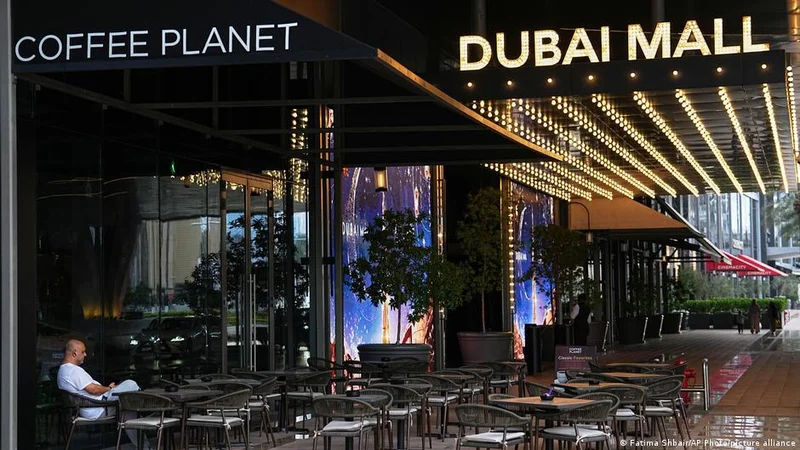
In July, authorities in the United Arab Emirates made a headline-grabbing offer: If UAE residents could entice visitors there between July and October this year, the residents would qualify for a package of perks worth around $800. That was despite the fact that most foreign governments are still cautioning their citizens against travel to the UAE due to the Iran war.
After Israel and the US began launching strikes at Iran at the end of February, Iran responded by attacking US allies in the region, including the UAE. As a result, hotel occupancy in the emirate of Dubai plummeted, with rooms going from 80% full to only around 10% occupied.
Since then, some UAE hotels have closed prematurely for planned renovations and other five-star resorts have enticed UAE residents for "staycations" in luxury accommodation with a 50% discount.
Iran war impacts foreign residents
Out of around 11.8 million people in the UAE, up to about 10.4 million are non-nationals. These locals run the gamut from millionaires enjoying their tax-free status in the UAE to expats who work on building sites or as cleaners and send their wages to family back home.
Many wealthier individuals with security concerns left when Iranian missiles began flying overhead. To ensure they return after the war, the UAE has said it will take a more flexible approach to rules around tax residency. That is, individuals can be out of the country for longer and not worry about losing their UAE tax status.
The New York Times has reported on the difficult situation that many of the lower-paid foreigners find themselves in as work in hospitality and tourism evaporates. Reporters in Dubai said they had seen individuals going door-to-door looking for work.
The UAE also put together a package worth around $680 million (€587 million) to help affected sectors — this included exempting hotels, restaurants and some private schools from municipality costs or delaying licensing fees.
There have been many more worrying indicators, though. Analysts predict that foreign direct investment in the Gulf states will drop and gross domestic product fall for the first time since the COVID-19 pandemic.
"Although tensions have calmed, the latent risk of a regional conflict reigniting will underpin investor wariness for the remainder of the year," the Economist Intelligence Unit warned in a July 31 briefing.
Employers said they were planning to cut jobs and didn't expect to make new hires, and inflationary pressure, due to things like the blockage of the Strait of Hormuz, meant raw materials and imports of all kinds were rising in price. UAE real estate prices also fell.
Currency swap emergency?
With some of those reported numbers and the apparently desperate measures being undertaken by authorities, it certainly makes it sound as if the UAE economy is having problems. The authoritarian country doesn't regularly publish its latest financial figures but, in a variety of interviews, the country's leaders have given the opposite impression.
One example of how differently economic measures to ameliorate the impact of the Iran war are being represented came when the UAE's central bank requested a currency swap line with the US.
Currency swap lines allow institutions to obtain the other's currency directly, bypassing foreign exchange markets. "In recent years [swap lines] have become an important tool for preserving financial stability and preventing market tension from affecting the real economy," the European Central Bank explains.
When news broke of the UAE request, US Treasury Secretary Scott Bessent said the discussion took place to help the UAE economy deal with fallout from the war.
But shortly thereafter, the UAE's ambassador to the US, Yousef Al Otaiba, stated on social media that "any suggestion that the UAE requires external financial backing misreads the facts … The UAE is one of the world's most financially resilient economies," he wrote in a Facebook post.
And in May, Abdul Aziz al-Ghurair, chairman of the UAE Banks Federation, told journalists at a press conference there was no fear about capital leaving the country or a dollar shortage.
"It's about building confidence and signalling we are one of the most trusted economies in the world," another local source told the UK's Financial Times.
Why the UAE really discussed a currency swap line with the US was more likely "as a precautionary backstop rather than a sign of acute distress," Adam Holdstock, an economist with the UK-based advisory firm Oxford Economics, explained.
The amount of money in circulation in the UAE, also known as the monetary base, did fall by 8% in March, he told DW. "That said, the UAE's underlying position is strong and the decline in the monetary base has since stabilized."
"If you look at market reactions, at local stock markets, also at the rhetoric of businesses, of investors who want to stay in the good graces of their local partners, I think the image that's being projected is still that this is supposed to be temporary," Steffen Hertog, an associate professor at the London School of Economics and expert in the Gulf's political economy, told the Money & Macro podcast in mid-July. "The realization that there might be a new normal — neither war nor peace, that could drag on for a long time — that hasn't quite sunk in."
Hertog also pointed out that high summer in the UAE, when temperatures rise uncomfortably high, is also the country's low season.
So what is the real story?
Is the UAE's economy in dire straits or on the way to recovery?
"The reality is [is that this is] sectoral and both readings are partly right," Holdstock said. "Most of the damage is concentrated in retail, transport and storage and tourism, as international visitor inflows are not expected to return to 2025 levels until 2028."
But sectors that are more insulated, like financial services and government-linked activity, are partially offsetting losses, Holdstock explained, which is why the overall picture "looks better than the hospitality data alone would suggest."
"The Emiratis are doing everything they can to manage Iran-war related pressures but with the region stuck in limbo between conflict and stability, it is difficult to build and sustain economic momentum on multiple fronts," Robert Mogielnicki, founder of consulting firm Polisphere Advisory and a non-resident fellow at the Arab Gulf States Institute, told DW. "It is too early to speak of a genuine recovery because a sustainable end to hostilities has yet to emerge."
However, Mogielnicki and other analysts do expect the UAE to recover in the future.
"Assuming the war is resolved, we don't expect lasting damage," Holdstock argued. "The UAE's fundamentals, business-friendly regulation, its position as a global aviation hub, and its record of attracting capital and talent remain intact."
Edited by: Martin Kuebler