Readers of a certain age will remember a golden area of asteroid films, capstoned by two with very different endings. Deep Impact engrained the devastating consequences of letting a large piece of rock hit our planet, whereas Armageddon, though arguably the more kitschy of the two films, was an uplifting story about technical ingenuity and sacrifice. And now, the central crux of that movieâs storyline - essentially blasting an asteroid with a nuclear detonation - is taking center stage as our last line of defense against a potential Deep Impact scenario. A new paper from researchers at the China Academy of Launch Vehicle Technology, and published in Space: Science & Technology, describes two potential scenarios examining how we might actually be able to nuke a space rock - and whether it would actually save us.
But before we get into the technical details of nuclear explosions, letâs set the stage for the threat we face. As of July 2024, out of 35,269 total Near-Earth Asteroids (NEAs) discovered, we know of 10,933 NEAs with a diameter larger than 140 m. If one of those rocks happened to be on a collision course with Earth (which, to be clear, none of the known ones are), it could cause continent-wide or even global devastation, resulting in the deaths of millions of people.
Terrifyingly, asteroid defense experts consistently warn that simulations show there are a massive number of undiscovered NEAs that could easily blindside us. In some cases the warning time between an NEAâs discovery and impact could be as little as a few days. That doesnât give us a whole lot of time to mount a defense.
So itâs best if we plan it out beforehand - and modeling is one of the easiest ways to do that. With such a limited amount of time between discovery and impact, the only way we would have a chance of saving a large portion of the planet would be through imparting as much force as possible to the asteroid, in an effort to either break it apart or drastically change its orbital path. And the best way we know of to do that is by hitting it with a nuke.
The new paper examines two potential ways of doing this. The first is the simplest, and also the fastest. Simply fly a nuclear weapon into the side of an asteroid and detonate it with the right timing to knock it off its orbital path. This is quick, dirty, and could work, but also comes with major downsides. In this fast scenario, selecting an ideal site for the nuclear impact is impractical, and the âcoupling energyâ (i.e. the energy transferred from the blast to the asteroid itself) might be relatively weak. But for it to even work in the first place, the nuclear warhead will have to survive high speed debris impact and detonate with microsecond precision - both of which are major engineering challenges.
Anyone familiar with the details of their 90s asteroid movies, the main characters of Armageddon werenât astronauts - they were oil prospectors. And in the movieâs lore, that meant they were really good at one thing - drilling. Itâs logical that having a nuke planted inside an asteroid would make the blast more impactful (literally). But unfortunately, the likelihood of us sending a bunch of wildcatters from the fracking basins to an NEA even with a few years notice is not very high.
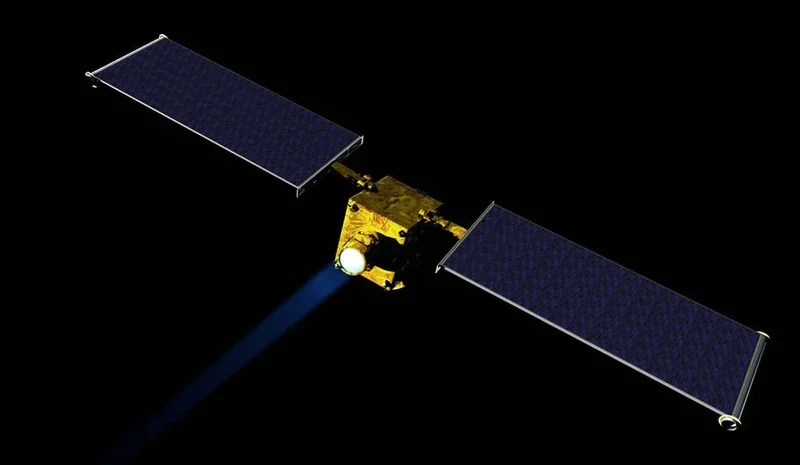
Instead, the paper suggests building off of a recent success in an asteroid defense mission - the Double Asteroid Redirection Test (DART). This mission slammed a non-threatening asteroid with an âimpactorâ - basically a giant metal rod - and intentionally shifted it from its orbit. That method in itself might be enough to save Earth from a hazardous asteroid if we catch it early enough. But on short notice it canât produce enough of an energy transfer to make much of a difference. But what it can produce is a crater.
In the second scenario (the flyby pre-excavation detonation mode), the mission uses a conventional penetration deviceâsuch as a â1+1â tandem impactor where two kinetic projectiles strike the exact same spot in sequenceâto pre-excavate a deep crater reaching up to tens of meters across. After the crater is opened, a nuclear device follows into the pre-excavated pit to initiate detonation.
Simulations show why that second technique is a game changer. The deeper the explosion happens inside the asteroid, the more energy is transferred into pushing the rock off its course. For an asteroid that is a kilometer in diameter, detonating a 3-megaton nuke in a shallow surface crater (i.e. one without deep pre-excavation, as in Mode 1) changed the asteroidâs velocity by only 9.2 cm/s. Whereas, if the same nuke was detonated in a 30-m crater created by the pre-excavation process, the velocity change jumped to 30 cm/s or more - in other words, over three times as much energy was imparted if the detonation happened within a deep crater rather than on the asteroidâs surface.
Admittedly, there are some problems with the current simulations. The authors modeled the asteroids themselves as solid basalt - and ask any planetary defense expert and youâll find that hazardous asteroids are more likely to be ârubble pilesâ consisting of a bunch of loosely bound rocks rather than a solid chunk of material. Itâs unclear whether the simulation would hold for that much more chaotic (but likely) scenario, though someone will undoubtedly follow up with the math to show it one way or another.
Another major sticking point is how hard it is to pull off the second scenario - the launcher platform would have to match the asteroidâs orbit, do site reconnaissance, plan consecutive kinetic impacts, and make sure the nuke is delivered to the exact same space while navigating the debris the impactors made. Almost every step of that process is a massive engineering challenge, and one that weâve only started to tackle with missions like DART.
But perhaps most important to all of these safety precautions is actually finding the asteroids that are potentially dangerous. NEO Surveyor, a NASA mission designed to look specifically for near-Earth asteroids, is currently scheduled to launch in September 2027. If it happens to find a rock headed straight for us, we better have all of our ducks in a row for how to handle it - because Bruce Willis definitely wonât be coming to save us this time.
Learn More:
Beijing Institute of Technology Press Co / EurekAlert - Virtual potential threat asteroid database. (A) Virtual asteroid orbit that will impact Earth 1 year later. (IMAGE)
X. Wang et al - Analysis of Defense Technology for Large-Sized Near-Earth Asteroids