Brazil · Defense
Key Facts
—First locally assembled fighter FAB 4109 is the first modern supersonic combat aircraft ever assembled in Latin America.
—Assembly hub Final assembly takes place at Embraer’s plant in Gavião Peixoto, São Paulo, the only Gripen E line outside Sweden.
—Technology transfer scale Over 350 Brazilian engineers and technicians were trained in Sweden to master the production process.
—Job creation The Gripen program has generated more than 12,000 direct and indirect jobs across Brazil.
—Contract value The 2014 deal for 36 aircraft is worth roughly US$5.4 billion, financed over 25 years.
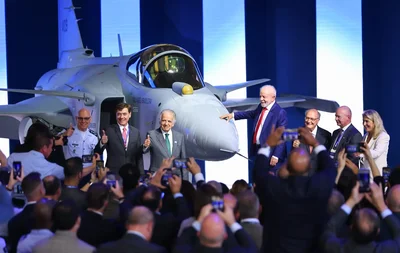
A Gripen E supersonic fighter jet has rolled out of an Embraer factory in upstate São Paulo with one crucial difference from its predecessors: it was built in Brazil, not Sweden. The aircraft, serial number FAB 4109, marks the first time a modern combat jet has been assembled anywhere in Latin America.
Embraer manufactures the advanced Gripen E multirole fighter jet for the Brazilian Air Force.
RTAsk Rio TimesCost of living, safety, visas across Latin America›
From Swedish Kit to a Brazilian Gripen E
The jet came together at Embraer’s plant in Gavião Peixoto, a specialized military aviation hub far from the company’s commercial jetliners in São José dos Campos. Workers joined forward and rear fuselage sections — some made at Saab’s facility in São Bernardo do Campo, others shipped from Linköping, Sweden — then installed wiring, avionics, landing gear, the engine, canopy, and ejection seat.
The assembly took roughly two years and ten months from the first structural cuts to the March 2026 rollout. The Gavião Peixoto line is now the only Gripen E final assembly site outside Sweden, responsible for 15 of the 36 jets Brazil ordered.
This is a radical departure from how Brazil acquired fighter jets in the past, when aircraft arrived fully built from foreign factories. Now Brazilian technicians handle every step of final assembly, from joining the massive fuselage sections to testing the jet’s advanced radar and electronic warfare systems before it ever leaves the ground.
What Technology Transfer Means in Practice
When Brazil signed the US$5.4 billion (R$27.4 billion (US$5.39 billion)) contract with Saab in 2014, the price tag included far more than hardware. It bought a structured knowledge pipeline.
More than 350 Brazilian engineers and technicians spent extended periods in Linköping learning design, systems integration, and flight-test protocols directly from Saab’s teams. That training now allows Embraer and Saab Brasil to manufacture key aerostructures — rear and forward fuselages, tail cones, air brakes — not just for Brazilian jets but for the global supply chain.
Brazilian-made components are shipped back to Sweden, integrating the country into Saab’s worldwide production network for the first time. For readers unfamiliar with defense contracts, this is the difference between buying a car and learning to build one.
Brazil now owns the industrial capability, not just the finished product, which means future upgrades, repairs, and even new variants can be handled domestically without depending entirely on a foreign partner.
Live Company IntelligenceEmbraer SA ADR — the full investor dossierInside: live share price, market cap, three-year financials, valuation, ESG and peer benchmarks — plus the latest Rio Times coverage.
E
◆ Live Company Intelligence
Embraer
NYSE: ERJEMBJ3IndustrialsAerospace \& Defense20,923 employees
$12.33B
Market cap
Analyst target $68.50
Wall Street view
3.9Moderate Buy/ 5
10 Buy3 Hold1 Sell
Avg. price target $68.50 · +30% vs 200-day
Valuation \& profitability
Market cap$12.33B
Revenue (TTM)$39.80B
P / E ratio37.7
Profit margin5.4%
Return on equity11.3%
Price \& risk
52-wk low
$46.1552-wk high
$66.87
Beta (volatility)0.92
200-day average$52.79
Revenue trend · 6y
20192024
Latest $6.39B
Ownership
Institutions46.0%
Shares outstanding183M
Top holderGQG Partners LLC
Institutional holders5+ funds
Dividend
Yield0.1%
Payout ratio31.0%
Fwd. annual$0.05
What Embraer does. Embraer S.A., together with its subsidiaries, designs, develops, manufactures, and sells aircraft and systems worldwide. It operates through Commercial Aviation; Defense \& Security; Executive Aviation; Services \& Support; and Other segments. The Commercial Aviation segment develops, produces, and sells commercial jets. Its Defense \& Security segment develops and produces military aircraft and…
A Production Line That Creates More Than Jets
The program has generated over 12,000 jobs in Brazil, spanning high-precision manufacturing, software engineering, and maintenance planning. Local suppliers now produce composite parts and subsystems that previously had to be imported.
This industrial footprint stretches from the São Paulo interior to Anápolis Air Force Base near Brasília, where Brazilian Gripens have been flying Quick Reaction Alert missions to protect the capital’s airspace since February 2026. These missions involve keeping armed jets on standby to intercept unidentified aircraft approaching sensitive government zones.
The economic ripple effect extends well beyond Embraer and Saab. Small and medium-sized Brazilian firms now supply everything from specialized tooling to avionics test equipment, building a domestic aerospace supply chain that can serve both military and civilian markets in the future.
What Comes After the First 36 Jets
Brazil’s original order covers 28 single-seat Gripen E fighters, designated F-39E by the Brazilian Air Force, and eight twin-seat Gripen F models. Eleven aircraft have been delivered so far, with the 15 locally assembled units now flowing into the fleet.
The Brazilian government is actively studying a follow-on order for roughly 20 more jets, a move The Rio Times reported on July 20. A larger fleet would deepen the industrial logic: more jets mean more local production, more supplier contracts, and a stronger case for Brazil to become a regional maintenance and upgrade hub.
There is also a potential defense barter on the horizon. Sweden has expressed interest in purchasing Embraer’s C-390 Millennium transport aircraft, creating a two-way industrial partnership that could lock in decades of aerospace cooperation between the two nations.
Why This Matters for Expats and Investors
For foreign professionals and investors watching Brazil, the Gripen E program signals something broader than a military upgrade. It demonstrates that high-tech manufacturing can thrive in Brazil’s interior, far from the traditional industrial corridors of São Paulo’s coast.
The Gavião Peixoto facility and its surrounding supply chain are creating demand for skilled engineers, project managers, and technical specialists — roles that often attract international talent. The program also strengthens Brazil’s position in global aerospace, a sector where the country already excels through Embraer’s commercial jet business.
Investors should note that the 25-year financing structure of the original US$5.4 billion deal means steady, predictable spending rather than sudden budget shocks. A follow-on order would extend that visibility well into the 2030s, benefiting Brazilian aerospace stocks and the broader industrial base.
A Regional Ripple Effect
Brazil’s success with local Gripen E assembly is already drawing attention from neighboring countries. Colombia has separately signed a deal for 17 Gripens, with deliveries running from 2026 to 2032, though those aircraft are not part of Brazil’s production line.
The existence of a fully operational fighter assembly line in Latin America could reshape how other air forces in the region think about fleet modernization. Maintenance, pilot training, and eventual upgrades become far more practical when the industrial base sits on the same continent rather than across the Atlantic.
Frequently Asked Questions
Where is the Gripen E assembled in Brazil?
Final assembly takes place at Embraer’s dedicated defense plant in Gavião Peixoto, São Paulo state, the only Gripen E production line outside Sweden. The facility is separate from Embraer’s main commercial jet factory in São José dos Campos and specializes in military aircraft production.
How many Gripen fighters has Brazil ordered?
Brazil ordered 36 aircraft — 28 single-seat Gripen E and 8 twin-seat Gripen F — under a 2014 contract valued at approximately US$5.4 billion. Eleven jets have been delivered so far, with 15 slated for local assembly and the Brazilian government actively studying a follow-on order of roughly 20 additional units.
What does the Saab technology transfer include?
It includes training over 350 Brazilian engineers in Sweden, local manufacturing of fuselage sections and air brakes, and integration into Saab’s global supply chain. Brazilian-made components are now shipped back to Sweden for use in jets built there, making Brazil a two-way partner rather than just a customer.