Brazil · Markets
Key Facts
—Average daily volume R$6.03 billion (US$1.19 billion) in July, down 32.5% from June's R$8.94 billion (US$1.76 billion).
—Total monthly trades 18.36 million so far in July, compared with 21.38 million in all of June.
—Foreign absence Analysts blame the summer holiday lull in Europe and the United States for keeping international funds away.
—Index level The Ibovespa closed at 173,371 points on July 20, still up 10.39% year-to-date.
—Election caution Uncertainty ahead of Brazil's presidential vote is adding to the reluctance of global funds to commit fresh capital.
The Ibovespa, Brazil’s benchmark stock index, is enduring its thinnest July trading since the coronavirus pandemic, with average daily volume collapsing by nearly a third as foreign investors stay home for the northern summer.
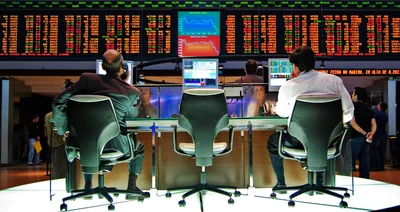
The São Paulo stock exchange is Brazil's main securities marketplace for trading equities and derivatives.
What Falling Turnover Means for Your Money
When daily volume shrinks to R$6.03 billion (US$1.19 billion) from R$8.94 billion (US$1.76 billion) in a single month, the market becomes a less friendly place for anyone buying or selling shares.
Wider spreads are the first sting. With fewer orders on the book, the gap between what a seller wants and what a buyer will pay grows, so you pay more to enter and receive less when you exit.
Thin liquidity also means that even modest trades can leave a footprint. In a deep market, a US$50,000 order might barely nudge the price, but when daily volume is this low that same order can push the quote noticeably higher or lower before it is fully filled.
For comparison, July 2025 saw average daily volume of roughly R$8.1 billion (US$1.59 billion), and July 2024 was around R$7.5 billion (US$1.48 billion). This year’s R$6.03 billion (US$1.19 billion) is the weakest July reading since the pandemic-scarred summer of 2020, when fear kept many players on the sidelines.
The practical takeaway is that investors should size their orders carefully and consider using limit orders rather than market orders. A limit order lets you name your price, protecting you from the wild swings that thin conditions can produce.
Harder Exits and Thinner Price Discovery
A thin market also means harder exits. An investor trying to sell a meaningful block of stock risks moving the price against themselves simply because there are not enough resting bids to absorb the trade.
Price discovery suffers too. When only 834,350 trades happen each day on average, compared with over a million in June, the quoted price of a stock reflects the opinion of fewer participants and may not represent its true value.
Live Market IntelligenceBrazil — Live Market BoardInside: market breadth, the sector heatmap, currencies \& rates, the Latin America scoreboard and the full instrument board.
Rio Times · Live Market Intelligence
Brazil — Live Market Board
B3 · São Paulo
Jul 21, 2026 · 15:30
Ibovespa · benchmark
173,107.90
-0.15%
L 172,219day rangeH 173,720
+29.12% over 12 months
Market breadth · 13 names
54% advancing
7 ▲ advancing6 declining ▼
Currencies, rates \& key inputs
Sector heatmap · average move today
Energy
+1.32%
PETR4, PRIO3
Financials
+0.74%
ITUB4, BBDC4, BBAS3, B3SA3
Consumer Staples
+0.51%
ABEV3
Mining
+0.20%
VALE3, CSNA3, GGBR4
Industrials
-1.56%
WEGE3, RENT3
Consumer Disc.
-2.20%
AZZA3
Latin America scoreboard
IndexLastTodayStrength
IbovespaBrazil
173,107.90
-0.15%
S\&P/BMV IPCMexico
66,125.27
-0.74%
S\&P IPSAChile
10,963.36
+0.61%
S\&P MERVALArgentina
3,294,537
+2.20%
MSCI COLCAPColombia
2,319.30
+0.91%
BVL S\&P PerúPeru
56,620.35
—
Full instrument board
| Instrument | Last | Change | YoY | Prev. | High | Low | Volume |
| --- | --- | --- | --- | --- | --- | --- | --- |
| IBOV | 173,107.90 | -0.15% | +29.12% | 173,371.35 | 173,720 | 172,219 | — |
| USD/BRL | 5.07 | -0.43% | -9.14% | 5.09 | 5.09 | 5.07 | — |
| SELIC | 14.25% | | — | — | — | — | — |
| PETR4 | 41.63 | +1.17% | +34.04% | 41.15 | 41.67 | 41.13 | 19,349,100 |
| VALE3 | 72.36 | +0.60% | +29.12% | 71.93 | 72.97 | 71.57 | 8,233,000 |
| ITUB4 | 42.52 | +0.52% | +23.44% | 42.30 | 42.56 | 42.18 | 6,375,200 |
| BBDC4 | 18.56 | +0.81% | +18.37% | 18.41 | 18.57 | 18.35 | 12,500,000 |
| BBAS3 | 20.68 | +2.53% | +4.23% | 20.17 | 20.74 | 20.08 | 15,761,000 |
| B3SA3 | 15.12 | -0.92% | +15.42% | 15.26 | 15.32 | 14.95 | 20,137,200 |
| ABEV3 | 15.87 | +0.51% | +18.26% | 15.79 | 15.88 | 15.74 | 8,998,700 |
| WEGE3 | 42.72 | -0.95% | +1.79% | 43.13 | 43.34 | 42.50 | 5,809,200 |
| PRIO3 | 58.54 | +1.47% | +36.90% | 57.69 | 58.96 | 58.11 | 3,536,100 |
| SUZB3 | 41.57 | -0.76% | -18.49% | 41.89 | 42.01 | 41.44 | 1,301,700 |
| RENT3 | 36.68 | -2.16% | +2.40% | 37.49 | 37.51 | 36.57 | 4,189,400 |
| AZZA3 | 17.77 | -2.20% | -49.99% | 18.17 | 18.27 | 17.56 | 839,300 |
| CSNA3 | 5.07 | +0.00% | -36.55% | 5.07 | 5.16 | 5.05 | 5,895,700 |
| GGBR4 | 23.62 | +0.00% | +42.18% | 23.62 | 23.77 | 23.42 | 2,301,800 |
| ENEV3 | 25.35 | -1.17% | +83.77% | 25.65 | 25.66 | 25.12 | 2,276,600 |
Largest moves today
BBAS3
20.68
+2.53%
AZZA3
17.77
-2.20%
RENT3
36.68
-2.16%
PRIO3
58.54
+1.47%
PETR4
41.63
+1.17%
ENEV3
25.35
-1.17%
WEGE3
42.72
-0.95%
B3SA3
15.12
-0.92%
The session read
The Ibovespa eased 0.15%, with breadth positive — 7 of 13 names higher. Energy led, while Consumer Disc. lagged.
From The Rio Times
Related coverage · 21 Jul 2026
Brazil Builds Its First Gripen E Fighter Jet at Home
Read →
Why the Ibovespa Has Gone Quiet
Analysts point squarely at the northern hemisphere summer holiday period. Institutional desks in London, New York, and Frankfurt are thinly staffed, and portfolio managers are simply not placing the orders that normally drive Brazilian equities.
The early July US Independence Day break set the tone, delivering unusually thin turnover that left domestic rate-cut bets in charge of price action. That pattern has persisted through the month.
Election Jitters Add to the Caution
Brazil’s looming presidential election is compounding the seasonal slowdown. International funds that were pouring money into the country in 2025, with inflows reaching R$21.5 billion (US$4.23 billion) by May of that year, are now holding back.
A positive election poll gave the Ibovespa a brief lift on July 21, but the broader posture remains one of wait-and-see. No one wants to build a large position when the political outlook is unresolved.
The Bigger Picture: From Flood to Trickle
The current drought marks a sharp reversal from the foreign-investor enthusiasm that defined 2025. That year, international funds injected R$21.5 billion (US$4.23 billion) into Brazilian equities by May alone, the strongest monthly inflow since 2019.
The contrast with 2024 is even starker. That year saw a net outflow of R$24.2 billion (US$4.76 billion), meaning the long-term trend had finally turned positive before this July lull hit.
The current slowdown appears seasonal rather than structural, but it still stings for anyone needing to trade now.
What Expats and Foreign Investors Should Watch Next
For an expat or foreign investor holding Brazilian stocks, the immediate lesson is patience. Attempting to move large positions in August, another traditionally slow month, could amplify the costs of wide spreads and shallow order books.
The real test arrives in September, when northern hemisphere desks return to full strength and election polling intensifies. If foreign flows resume alongside clearer political signals, the Ibovespa could quickly regain its normal liquidity rhythm.
Frequently Asked Questions
Why is Ibovespa liquidity so low in July 2026?
The main reason is the summer holiday season in Europe and the United States, which keeps foreign institutional investors away from Brazilian equities. With key trading desks in London, New York, and Frankfurt operating with skeleton staff, the flow of buy and sell orders that normally fuels the São Paulo stock exchange dries up. Uncertainty around Brazil's presidential election is adding to the reluctance to trade, as global funds prefer to wait for a clearer political picture before committing fresh capital.
How does low trading volume affect a foreign investor?
Low volume widens bid-ask spreads, making it more expensive to buy and sell shares because the gap between the highest bid and the lowest ask grows when fewer orders sit on the book. It also makes exiting larger positions harder without moving the price against yourself, since there are not enough resting bids to absorb a big sell order quietly. Finally, it weakens price discovery, meaning the quoted price of a stock reflects the opinion of far fewer market participants and may not represent its true underlying value.
Is the Ibovespa still up for the year despite the liquidity drop?
Yes. Even with the thin July trading, the Ibovespa closed at 173,371 points on July 20 and remains up roughly 10.39% year-to-date. Heavyweight stocks like Vale, the giant iron-ore miner, have helped support the index, with Vale alone trading around US$321 million on a single day earlier in the month and adding significant points during a July 11 surge of nearly 3%.