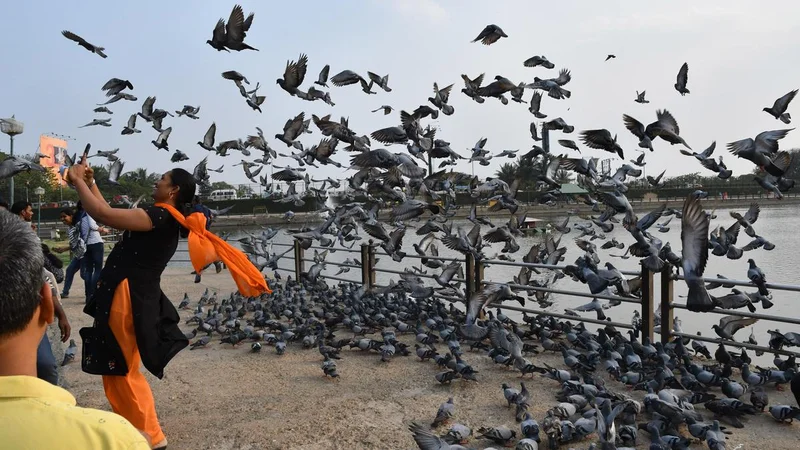
The State Health Department has for the second time issued directions to regulate pigeon feeding in public places, citing concerns over public health risks.
Uncontrolled feeding leads to large congregations of birds and excessive droppings. Exposure to pigeon feathers may lead to severe and sometimes irreversible lung damage, especially among vulnerable groups including children, the elderly and persons with pre-existing respiratory conditions.
The circular issued on Thursday (July 23) by the State Health Commissioner, directs the Commissioner of the Greater Bengaluru Authority (GBA) and Commissioners and Chief Officers of other municipal corporations to take measures to mitigate the causes of disease-spread linked to pigeons.
The directions have been issued under the provisions of the Greater Bengaluru Governance Act, 2024, and the Karnataka Municipal Corporations Act, 1976.
In designated areas
The Health Department has directed that no person shall feed pigeons or cause pigeons to be fed in areas where such activity may result in nuisance or pose a health hazard.
Pigeon feeding will be permitted only in designated areas identified by the local authority in consultation with stakeholders. Such areas will have to be managed by charitable organisations, NGOs or registered organisations authorised by the local authority. The designated organisations will be responsible for maintaining cleanliness and ensuring compliance with the guidelines, stated the circular.
Feeding in designated areas will be permitted only between 7 a.m. and 9 a.m. The circular stated that pigeon feeding will not be allowed on footpaths, roads or other public or private places outside the identified locations.
Conditions for feeding areas
The locations selected for feeding should be away from hospitals, schools, residential areas, markets, public parks, lakes, food establishments and other sensitive public places, and should not create public nuisance or health hazards.
Only approved grains or feed can be used for feeding pigeons. Disposal of cooked food, food waste, bread or other refuse for feeding pigeons has been prohibited.
The feeding activity should not obstruct pedestrian movement, vehicular traffic or access to public places. The authorised organisation managing the feeding area will have to ensure daily removal and scientific disposal of pigeon droppings, leftover feed and other waste.
Role of civic authorities
According to the circular, the authorised organisations will have to install and maintain signboards displaying permitted feeding timings, feeding rules, health precautions and contact details of the responsible organisation.
The government has directed that no designated pigeon feeding area should be established near airports or in locations where bird congregation could adversely affect aviation safety.
Awareness measures
The local authorities have been instructed to conduct public awareness campaigns through signboards, banners and digital messages explaining the health concerns associated with pigeon droppings and feathers, the contents of the order and penalties for violations.
The campaigns should also highlight alternative humane methods of bird conservation that do not endanger public health.
The Zonal Commissioner of the concerned GBA zone has been designated as the nodal officer for management of pigeon houses in their jurisdiction and for ensuring compliance with the directions.
Published - July 23, 2026 07:32 pm IST