Iran will pay for any Houthi-led attacks, Trump says
Tehran-backed militants claim strikes against 2 Saudi-linked ships
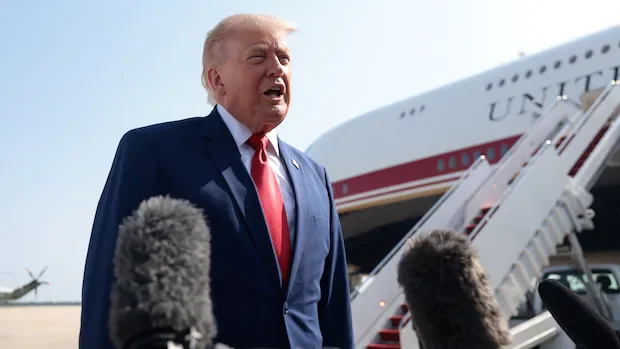
U.S. President Donald Trump said Thursday he would hold Iran accountable for any attacks by Yemen's Houthi militants, who said this week they were imposing a naval blockade on Saudi Arabia.
Trump vowed "major military punishment" against Iran and its Houthi allies in a Truth Social post.
The Houthis, he said, are "starting up again, shooting at two Saudi Arabian ships last night."
The Houthis — who control Yemen's Red Sea coast and the narrow chokepoint where it connects to the Arabian Sea — said this week they were imposing a blockade on Saudi Arabia, which has diverted millions of barrels of oil per day south, by pipeline to the Red Sea, to get around Iran's blockade of the Persian Gulf.
In their first such strikes since announcing the move, the Houthis said Thursday their forces had carried out missile and drone strikes on two Saudi oil tankers, identifying them as the Encelia and the Layla.
Saudi state news agency SPA said the strike on the Encelia had caused a fire at the bow. Reuters could not immediately confirm the other attack, on the Layla.
A Saudi-led coalition fought the Houthis for years beginning in 2015, after the militant group seized Yemen's capital and caused the recognized government to relocate. The war triggered one of the world's worst humanitarian crises, and the two sides reached a truce in 2022.
The Houthi attacks on the ships were condemned as irresponsible by the European Union.
LISTEN | The war on Iran drags on:
More ship transit woes
Houthi attacks on tankers could effectively close the Bab el-Mandeb Strait which controls access to the Arabian Sea and Indian Ocean, the second most important waterway for energy markets after the Strait of Hormuz at the mouth of the Gulf.
In the days since the Houthis announced their blockade, several tankers have already changed course to avoid the Bab el-Mandeb, heading north instead through the Suez Canal, potentially using a much longer and more expensive route to reach Asian customers by sailing around Africa.
U.S. Secretary of State Marco Rubio said the Houthis got "snookered into this" by Iran, expressing hope the situation would de-escalate soon, while at the latest Association of Southeast Asian Nations meeting in Manila.
But global prices spiked Thursday due to the latest developments to their highest level since early June, with Brent crude oil, the international standard, rising 4.3 per cent to $98.16 US.
In the Strait of Hormuz, Iran aims to assert control by requiring ships to sail close to its coastline and eventually charge transit fees. It has fired on ships using an alternative channel farther from its coast, promoted by Washington.
Exchange of airstrikes continues
Two weeks since the effective collapse of an interim memorandum of understanding meant to end the war, the U.S. military launched another nightly round of airstrikes on Iran.
Iranian media reported the U.S. twice on Thursday attacked a military target in Bushehr, near Iran's only operating commercial nuclear power reactor.
State TV reported two people were killed and 11 wounded in what a Khuzestan provincial official described as a U.S. missile attack on the Shalamcheh border crossing with Iraq, which remained open.
In response, Iran to fire at neighbouring Arab countries that house U.S. bases.
Iran said it attacked U.S. missile systems, weapons and fuel storage sites in Jordan, as well as U.S. military posts in Kuwait. It has also hit water desalination and energy plants in Kuwait this week.
Jordan's army said it engaged four Iranian missiles and six drones in the past 24 hours, intercepting all but one missile, which fell in an uninhabited area.
- Despite the war, the U.S. and Iran are working together to deport asylum seekers, lawsuit says
- Houthis adding to pressure on Iran conflict, as U.S. undertakes 12th consecutive night of strikes
Iranian military spokesperson, Gen. Mohammad Akraminia, said Iran would keep retaliating as long as the U.S. continued to attack its infrastructure and coastal areas, Iranian state TV reported.
Trump vowed on Wednesday to destroy an Iranian bridge or power plant every time Iran shoots at a ship in the Strait of Hormuz.
Iran's joint military command in turn warned it would target regional oil, gas, electricity and economic infrastructure and prevent the export of "even a single drop of oil," Iranian state media reported.
The war has led to the deaths of 18 U.S. service members and injured more than 450 troops. Trump attended a ceremony on Wednesday at Dover Air Force Base in Delaware for four U.S. service members killed in Iranian attacks on military bases over the past few days.
Earlier this week, Defence Secretary Pete Hegseth testified that the war has cost the U.S. over $37 billion so far.
WATCH | The U.S. struck Houthis last year: