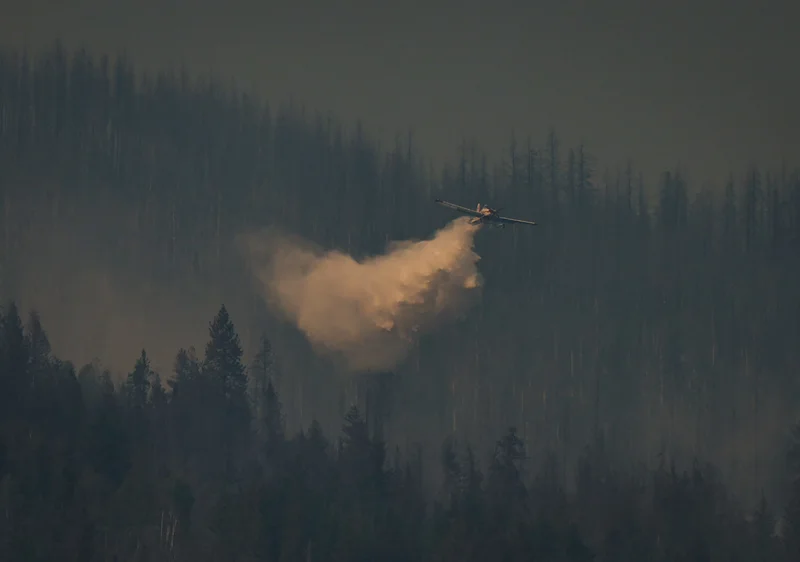
Ontario Premier Doug Ford said the country needs at least 60 new water bombers to build a national fleet to combat wildfires as part of a Canada-wide wildfire strategy.
Mr. Ford made the comments on Monday during a speech at the Association of Municipalities of Ontario’s annual conference in Ottawa. He told municipal leaders that Prime Minister Mark Carney and the premiers recently talked about the need for a national strategy.
“We need to go out there and buy at least 60 fire bombers because they take a long time to build,” he said.
“But we need to all collaborate, put them right across the country from coast to coast to coast, starting in B.C. and all the way out to the East Coast and everything in between.”
Some provinces are already purchasing additional wildfire-fighting aircraft from Calgary-based De Havilland Aircraft of Canada Ltd. Alberta announced a plan earlier this year to buy five water bombers from De Havilland for $400-million, while Ontario announced a similar plan in July to purchase five new helicopters and six new water bombers for $650-million.
Mr. Ford’s office declined to provide more information about the proposal for Canada to acquire 60 water bombers or how the Ontario government arrived at that figure.
A B.C. government source said Monday was the first time they had heard Mr. Ford mention that number. The Globe and Mail agreed not to name the source, who was not authorized to speak publicly about the issue.
Wildfires have raged in British Columbia and Ontario this summer. Last week, a fire near Summerland, B.C., forced 20,000 people from their homes, triggering a provincial state of emergency.
In July, wildfires in Northern Ontario blanketed much of the province and large swathes of the United States with orange smoke, and sent multiple First Nations communities fleeing the flames.
Canada does not have a national wildland firefighting strategy, despite long-standing calls to create one. It’s also one of the few G7 countries that does not have a stand-alone federal emergency management agency.
The severe wildfires have fuelled the push for a national strategy and the development of a Canada-wide water bomber fleet. In June, the Senate’s agriculture and forestry committee released a report on Canadian wildfire response with 15 recommendations, including that the federal government should create and fund a national firefighting aircraft fleet.
Neil Sweeney, vice-president of corporate affairs for De Havilland, said he had never heard of Mr. Ford’s touted number before Monday, but noted that the Premier’s comments are “timely.” The company manufactures the DHC-515, a new generation of the famous Canadair water-bombing planes.
“The sooner that everyone can get moving on new equipment, whether it’s ours or others, the sooner we’ll have it in time to protect people when there are devastating wildfires,” he said.
De Havilland has recently been advocating for a national water bomber fleet.
Mr. Sweeney said the water bomber manufacturer had promised the federal government, before last fall’s budget, that the company would create a second production line specifically for Canada if it ordered 50 or more water bombers.
If an order of that size was placed, the company could start delivering by 2030, he said, targeting 10 water bombers per year.
Currently, the company has 38 orders for water bombers, Mr. Sweeney said. The Globe and Mail previously reported that the first 22 planes to be completed are destined for European countries, such as Greece and France.
Government spokespeople in Alberta, B.C. and Ottawa issued statements endorsing the need to co-ordinate wildfire responses.
Alberta supports creating a co-ordinated aircraft strategy for Canadian-made water bombers as demand increases, Ministry of Forestry and Parks spokesperson Riley Gough said in an e-mailed statement.
Earlier this year, the federal government announced over $300-million in funding for 10 firefighting aircraft and two support assets through contracts with Conair Group Inc., Coldstream Helicopters and VIH Helicopters.
John Gradek, a lecturer on aviation management at McGill University, said Mr. Ford’s water bomber number appears to be “pulled from thin air” and is premature without a clear plan for how the aircraft would be used. The planes could either be used in a defensive mode when a fire threatens communities or in attack to douse flames before they grow out of control, he said.
“The question you have to ask yourself before you say, ’yeah, we need assets,’ is what the heck are these assets going to do, and how do you deploy them, and what type do you get?” he said.
“And right now, everybody’s just jumping on numbers and billions of dollars without really understanding what is it that we really need as a national asset.”
With files from Laura Stone