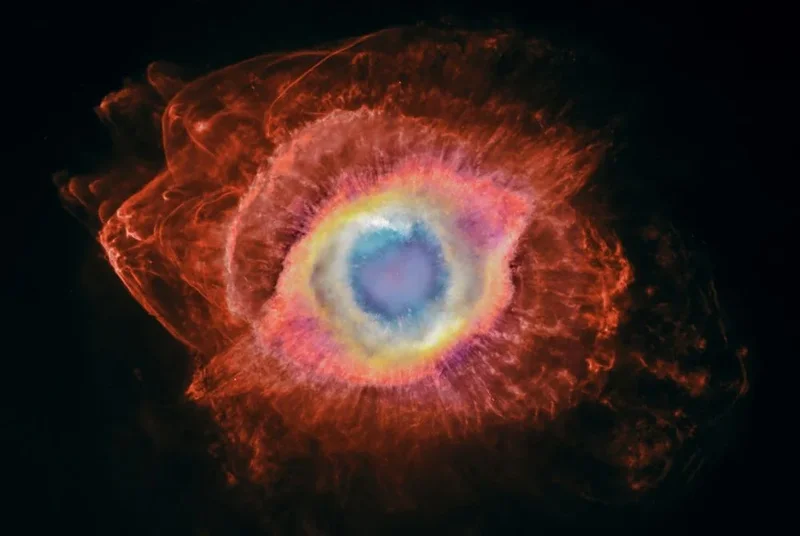
Most stars end their lives not in cataclysmic supernova explosions, but with a final exhalation instead. Main sequence stars like our Sun gradually run out of fuel, destabilize, and eject their outer layers into space, forming a planetary nebula. These nebula are favorite targets for professional and amateur astronomers alike.
One of the most well-known planetary nebula (PN) is the Helix Nebula. It stares at us from about 650 light years away like a translucent human eyeball. The Hubble image of the Helix Nebula is one of the space telescope's most iconic images. The JWST's image is likewise defining; it's observations revealed more intricate detail in the nebula.
Two views of the Helix Nebula. The Hubble captured the image on the right in 2004, highlighting the delicate appearance of the nebula, with its filaments and gentle transitions. The JWST captured the image of the Helix Nebula on the right, showing a new level of detail. Image Credit: Left: Public Domain, https://commons.wikimedia.org/w/index.php?curid=1721117. Right: NASA, ESA, CSA, STScI, A. Pagan (STScI)
A team of astronomers and astrophysicists recently observed the Helix Nebula with a very unique telescope and saw the cast-off stellar remains of the nebula being stripped apart and recycled. The research is published in Nature and is titled "Numerous bow shocks in the outer Helix Nebula." The lead author is Pieter van Dokkum, Professor of Astronomy and Physics at Yale University.
The unique telescope used in this research is called MOTHRA ((Modular Optical Telephoto Hyperspectral Robotic Array) and when completed will consist of 1,140 high-end Canon telephoto lenses. These lenses are adept at suppressing the internal diffraction of light that large astronomical telescopes can struggle with. It means the telescope can have an advantage when observing some types of targets, in this case, the detailed bow shocks on the Helix Nebula's outer regions.
"Near the end of their lives, low-mass and intermediate-mass stars expel metal-enriched material in winds and outflows, ultimately producing planetary nebulae," the authors write. "The ejected material is expected to fragment and mix into the interstellar medium (ISM), but this final assimilation step has been difficult to observe directly."
But with MOTHRA, which isn't yet complete (and is named after a monster from Japanese monster movies), the researchers found 22 bow shocks on the eastern outside regions of the Helix Nebula (NGC 7283.) Observing bow shocks isn't unusual, but in this case, they were on a very small scale. "Unlike the large-scale windâISM bow shocks commonly observed around evolved stars, the shocks are compact and associated with individual clumps of gas," van Dokkum and his co-researchers write.
The curvature of the nebula changes as the distance from its center increases. The curvature starts out gently rounded and then sharpens dramatically at greater distances. "This is accompanied by a morphological transition from thin, well-defined bows to fuzzy, patchy structures," the authors write.
âThe shocks change dramatically with the distance from the central star,â study co-author Imad Pasha said in a press release. Pasha is a member of Dragonfly FRO and a visiting scholar at CIERA. âThose nearer the center are large, thin and sharply defined. Farther out, they become smaller, fuzzier and increasingly fragmented.â
This is where the action is, according to the researchers.
"We interpret these changes as progressive stripping and fragmentation of asymptotic giant branch-shell remnants as they interact with the ISM," the authors write in their research.
This MOTHRA image has been continuum-subtracted and given an inverted grey-scale to reveal the Helix Nebula's faint outer features. The central colour part is from the Hubble and the Kitt Peak Observatory. The direction of motion comes from the Gaia mission. Image Credit: van Dokkum et al. 2026. Nature.
"The MOTHRA image shows many features at large (roughly greater than 1âpc) distances from the white dwarf that had not been detected in Hα before," the authors write. "The most striking of these are numerous bow shocks on the east side of the nebula, where AGB ejecta encounter the ambient ISM at supersonic relative velocities."
The researchers calculated the expected positions of the objects that created the small bow shocks, which are shown in the image below.
This H-alpha image shows 22 different partial bow shocks in the Helix Nebula. Each one is fitted with a red parabola. The red dots mark the foci of the parabolas, which are the expected approximate locations of the objects that created the shocks. Since there are no H-alpha detections near the objects, they are expected to be largely neutral. Two of the Helix Nebula's known features, NE Object and NE Arc, are also labelled. Image Credit: van Dokkum et al. 2026. Nature.
At these shock fronts, the objectsâwhich are remnant gas clumps from the nebula's progenitor starâare interacting with the ISM and being recycled. The geometric changes in the bow shocks, including the change from gently rounded to sharp, are the main clues.
"This geometric trend is accompanied by a systematic morphological transition: the inner bows are thin and sharply bounded, whereas the outer structures are broader, more irregular, and increasingly clumpy. Taken together, these changes suggest progressive stripping and fragmentation of the dense AGB-shell remnants as they interact with the ambient medium," the authors explain.
"As material is ablated from the fragments and mixed into the surrounding flow, the surviving dense heads become smaller and more porous," the authors write.
Astronomers know that stellar mass loss is the main way that galaxies recycle their gas, metals, and dust. The material becomes part of the ISM, which can then form more stars and even planets as time passes. But determining how that happens on a small scale at the end of the assimilation process has been difficult to determine.
"Our empirically inferred roughly 104âyears disruption time implies that once AGB ejecta are fragmented and exposed to the diffuse medium they lose their coherent identity rapidly, providing a benchmark for models of recycling and feedback," the authors write.
âWe are seeing material shed near the end of a starâs life being broken apart and returned to the galaxy,â lead author van Dokkum said in a press release. âThat handoff â from recognizable stellar debris to the diffuse gas between the stars â has been very difficult to observe. Far in the future, the Sun will go through a similar process, and its material will enter the same cycle.â
The study shows that the final stages of recycling happen about 10,000 years after the star first expels its shell of material. But this needs to be confirmed in other nebula, where velocities may be different.
"The Helix is a fairly typical planetary nebula, and we should see similar fragment-driven bow shocks in the outskirts of other planetary nebulae," the authors write. "When more examples are found, it will be interesting to see if the mixing timescale depends on the shock velocities," they conclude.