July 22, 2026 — 5:00am
Save
You have reached your maximum number of saved items.
Remove items from your saved list to add more.
AAA
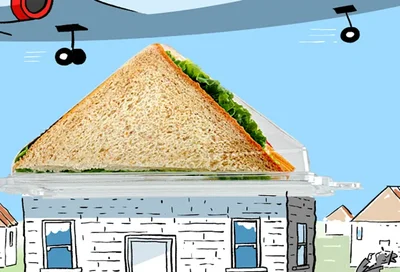
Walk into any airport, even a touch peckish, and it’s game over. There are few places that feel quite as extortionate as Australia’s housing market, but airports surely come a close second. The thing is – they have a lot in common.
Illustration by Simon Letch
I was reminded of this fact just before boarding a red-eye flight this week. A sandwich (the kind you slap together for a kid’s lunchbox with a bit of cheese, ham and lettuce) was $15; a shallow takeaway dish of salad was $21; and a tiny pack of cheese and crackers was $7.
The latter – full price and exactly the same brand as at Coles and Woolworths – retails for $3.20, meaning the airport store was charging more than double the price you’d pay at the supermarket.
Most of us grit our teeth and pay up. That’s because, much like housing, food is something we need to survive.
Sure, some people might pack snacks ahead of time. But preparing or buying a proper meal, carrying it to the airport and through security and making sure it doesn’t become unappetising in the process can be tricky. That means airport food is difficult to swap out or substitute perfectly.
And if you’re about to hop onto a flight for several hours with limited food options, or find yourself stuck in the airport waiting for (an often delayed) flight, buying a decent meal can become more of a necessity than a “nice to have”.
These characteristics make airport food a relatively “inelastic” good: one where demand doesn’t change drastically even if the price does. We’re willing (usually very begrudgingly) to pay up for it because we don’t have much of a choice.
Our housing market puts us in a similar position. We all need a place to live and don’t have many realistic alternatives (carrying a tent or couch-hopping aren’t long-term solutions), so we tend to suck it up – and pay up – for our home, even if it chews up huge shares of our income.
In 2024-25, for example, more than one in four Australian households were spending more than 30 per cent of their disposable income on housing-related costs such as mortgage and rent, meaning they were in financial stress.
Both airports and housing are also “captive markets”: places where there are few suppliers. That means those suppliers don’t have to compete quite so hard, and buyers are left with little choice but to buy what is available, leaving them with very little bargaining power.
They’re also places where “switching costs” – the time, effort or money required for customers to go for an alternative – are high. In an airport, it means leaving the terminal, then lining up and having to go through security again after securing a cheaper sandwich elsewhere. For housing, it means going to inspections, bidding for a property and having to pay for removalists or spend hours or days doing it yourself.
The “captive market” factor is one of the reasons we never seem to find a single store at an airport that is trying to dramatically undercut its competitors. The vendors all know they’ll make more money by agreeing (usually implicitly) to all charge high prices, even if it means serving fewer customers than if they decided to lower their prices.
The housing market is somewhat similar. Because of the limited supply of housing, especially in popular areas, sellers know they can charge more. There’s also little incentive for them to try to “undercut” other sellers because most people want to maximise their profit and only need to find one buyer.
The handful of large developers that need to sell larger volumes of homes also have little incentive to compete because, like airport food vendors, it’s more beneficial to maximise their profit margins than try to “outsell” their competitors by selling apartments at a cheaper price.
The mark-ups by airport food retailers of course also come down to the higher costs they face. That includes the additional costs of transporting food to the airport, getting that food (and staff) through airport security, and paying especially high airport rents. They’re also often required to hand over a portion of their sales revenue to the airport operator.
The requirements also make it difficult for competitors, especially smaller businesses, to enter the market. That is, there are high barriers to entry. Even if a space becomes available, only businesses able to meet the airport’s strict security screenings and background checks – and able to bid for highly competitive contracts with the airport – can get in. Once they’re in, though, they’re guaranteed limited competition and a lot of foot traffic.
That’s why airports tend to be dominated by bigger chains such as fast food giants McDonald’s or Hungry Jacks which can meet these requirements. Even these bigger businesses, which have relatively uniform pricing across locations, bump up their prices in terminals.
While airports don’t generally publish per-square-metre rental figures, the competition watchdog’s airport monitoring report for the 2024-25 financial year showed Sydney, Melbourne, Perth and Sydney’s airports were “very profitable” with commercial operations such as shops in terminals contributing “material” amounts of revenue.
The housing market also has its own additional costs and restrictions. Zoning laws, for example, limit how much supply can be added to the market, especially in desirable locations. And there are a bunch of other regulatory burdens such as long planning approval processes and building codes which make building a home more cumbersome.
Finally, there’s a big “location premium” in airports and in the housing market. A house located closer to the city, or in a safer neighbourhood, generally costs more than one in a less desirable location, even if it’s an otherwise identical home.
Similarly, you’re not paying for higher quality food in an airport. You’re usually being charged more, simply because of the location.
The good news is we can bring down house prices.
While some things (like land availability) can’t be changed, policy overhauls such as paring back the capital gains tax discount and negative gearing have helped to reduce demand from investors and a push to build more homes is expected to further slow down house price growth – as could changes to zoning laws.
Airport food prices, though? They’ll probably remain sky high.
Get a weekly wrap of views that will challenge, champion and inform your own. Sign up for our Opinion newsletter.
Save
You have reached your maximum number of saved items.
Remove items from your saved list to add more.
Millie Muroi is the economics writer at The Sydney Morning Herald and The Age covering workplace and economics. She was formerly an economics correspondent based in Canberra’s Press Gallery and the banking writer based in Sydney.Connect via X or email.