- Unlock more of the best of our cricket coverage with a DailyMail+ subscription - brilliant exclusives, in-depth insight and the writers you love every day
Whatever concerns England fans may have about the decision to reappoint Joe Root to the captaincy as the Test team embark on yet another of their resets, no one can accuse him of lacking self-awareness.
‘I think the hardest thing for me will be people’s opinion of how I captained four years ago,’ he recently told Sky Cricket’s podcast, as if pre-empting the likely criticism.
As he very well knows, positioning himself as the candidate for change simply isn’t an option. Root has already captained England in more Tests than anyone (65), to more victories (27) and more defeats (27).
He also knows that his best bet – perhaps his only bet – is to leave the past behind: of the 15 men to have done the job for at least 25 Tests, only Graham Gooch, Mike Atherton and David Gower have a worse win/loss ratio.
On one level, Root deserves sympathy, since his first crack at the job was ultimately derailed by the Covid pandemic. Now, on the brink of his second, he will be without Ben Stokes, a handicap that no England captain has had to suffer since the early days of Alastair Cook.
Root does not return in a position of strength. England have won only two of their last ten Tests, and no series since the end of 2024. The situation isn’t quite as dire as when Stokes replaced Root four years ago: back then, they had won one out of 17, giving birth to the briefly liberating effects of Bazball.
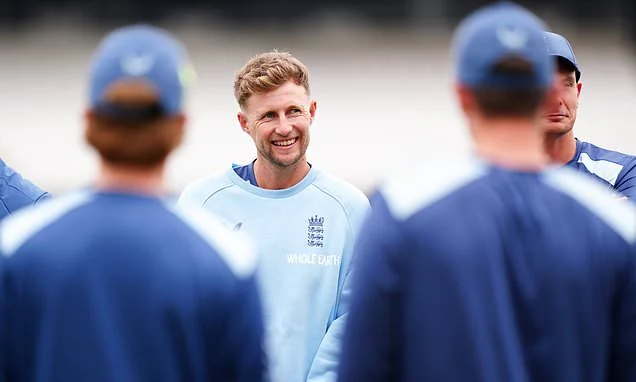
Joe Root does not return to the captaincy in a position of strength. England have won only two of their last 10 Tests
The returning captain's approach so far has been to position himself as a steady hand on the tiller
But it’s pretty bad, and Root’s approach so far has been to position himself as a steady hand on the tiller, a been-there-done-that veteran who has learned from his mistakes. Phrases such as ‘I’ve got a wealth of experience’ and ‘I’ve got lots to fall back on’ are not unreasonable ahead of the first Test against Pakistan at Headingley, but they will start to grate if we hear them too often.
Quite how his experience can be best put to use is another matter, and a recent dress rehearsal did not bode well. When Root stood in for Stokes against New Zealand at the Oval in June, he allowed a mind-numbing passage of play on the second morning.
The night before, Glenn Phillips – determined to reach stumps unscathed – had swayed repeatedly out of the way of a hostile spell of short-pitched bowling from Jofra Archer. Yet when Root persisted with the short stuff next morning, he ignored Archer until it was too late. New Zealand couldn’t believe their luck, and threw the bat to great effect. By the time England finally took the last three wickets, they had added a rapid 100 and constructed a match-winning 391.
It recalled Root’s decision to bombard India’s tailenders at Lord’s in 2021, when Mohammed Shami was allowed to make an unbeaten 56, the highest score of his Test career, and Jasprit Bumrah, who had failed to get off the mark in 20 of his previous 32 Test innings, made an equally invaluable 34 not out.
The worry, then, is that Root – for all his insistence that he is older and wiser – has not changed much at all. And yet England are in no position to be picky. The Test vice-captain Harry Brook was rendered ineligible because the ECB covered up his set-to with a nightclub bouncer in Wellington before the Ashes, and Root has emerged from the chaotic end to the Bazball era as one of the last remaining adults in the room.
It is to his credit, and testimony to his enduring love of the game, that he sounds very much up for the challenge.
Whisper it, but he may even allow the dressing room some breathing space after the growing tension of Stokes’s reign. There will be no main-character energy from Root, no unwelcome appearances on the front pages rather than the back. What, after all, does it say about England’s overreliance on Stokes that no new alternative has emerged to lead them in the meantime?
In that respect at least, Root can legitimately argue that the Test team is set for a new era, for it will demand others to plug the gaps left by their former captain. Ben Duckett has played 46 Tests now, Brook 38, Jamie Smith 22 and Archer 20. Even the likes of Gus Atkinson (18) and Josh Tongue (12) are ready for more responsibility. The Stokes comfort blanket is no more.
Nor is the midnight curfew, imposed after the Ashes by, among others, Stokes himself, then made to look less than the paper it may or may not have been written on by the Rex Rooms drama after the Lord’s Test against New Zealand.
Root did not use Jofra Archer intelligently during the recent New Zealand Test at the Oval, which England lost
Harry Brook was rendered ineligible to become captain because the ECB covered up his set-to with a nightclub bouncer in Wellington before the Ashes
Root’s decision, made with the incoming head coach Stephen Fleming, to treat the players like adults is an indication of the latitude he intends to give them. In Stokes’s absence, it may also be easier to implement.
None of this means Root is not under pressure, nor that England haven’t risked blunting their greatest weapon. As captain, he averaged 46. In the ranks, that number swells to 53. And since his first spell in charge, he has averaged 54, while converting 16 of his 30 scores of 50-plus into hundreds.
Ideally, England would have allowed a man who turns 36 in December to spend his remaining time as an international cricketer hunting down Sachin Tendulkar’s Test-record 15,921 runs, holding the middle order together without fretting about the captaincy. Root currently has 14,114.
But nothing about English cricket has been ideal for some time now, and while Brook might have been the bolder choice, Root radiates calm – a word rarely associated with the Bazballers. For that, and for his willingness to do the job, English cricket ought to be grateful. Beat Pakistan, and Root may find the power of people’s opinions begins to fade.