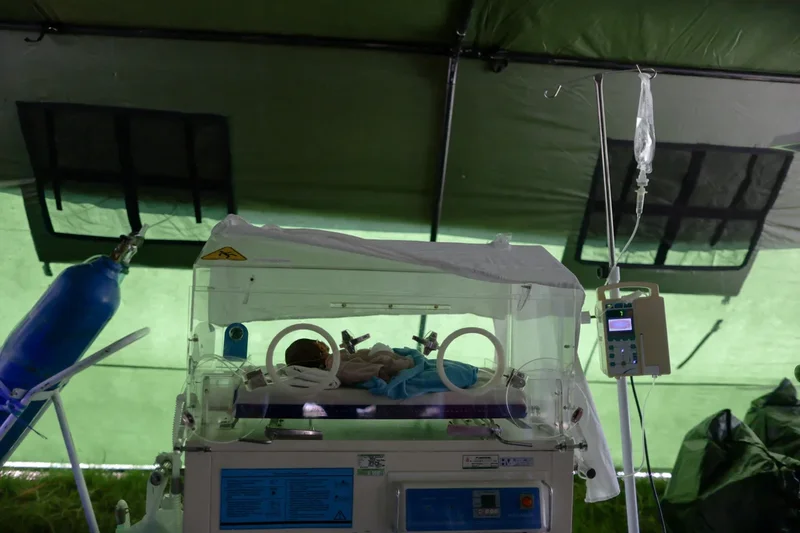
A woman gave birth by emergency caesarean section as an earthquake struck eastern Indonesia, with doctors working under torchlight as the power failed and the hospital shook around them.
Maria Florida Nogo Kelen, 39, was two months from her due date when Saturday's magnitude-7.7 quake struck East Nusa Tenggara.
A complicated pregnancy meant delaying the birth risked a seizure that could have killed her.
"During the surgery, I was not afraid," she told Reuters. "I had to be healthy for my kids." She lives in Nagekeo, close to the epicentre of the quake that killed at least 68 people. It was her fourth child.
"We had no choice," said her obstetrician, Yona Sara Pardede. "As humans we were afraid. The surgery was difficult as she was a small baby. I ask God, please help us. We don't even have a ventilator."
The girl was born weighing 1.3kg during the aftershocks and was named Gempita, from gempa, the Indonesian word for earthquake. She has remained stable in an incubator set up on a patch of grass inside a tent in Nagekeo.
Maria, who suffered a haemorrhage after the birth, said she was grateful to be alive.
"I was very grateful for the doctors, even when the room had collapsed, they did not abandon us," she said.
Medical staff across the province have been treating the injured in tents outside, with hundreds of hospitals and homes damaged.
Rescuers searched on Monday for people feared trapped under rubble, and aid was being flown in. Residents sheltering in evacuation tents said they needed clean water and food, and most were afraid to go home because of the aftershocks.
At least 995 aftershocks have been recorded since Saturday, though only 46 have been felt. A magnitude 5.9 tremor struck on Monday as Indonesia marked its 81st Independence Day.
The earthquake struck shortly before 6am on Saturday at a depth of 10km, with its epicentre about 68km north-west of Ende on the south coast of Flores, according to the US Geological Survey. Tsunami warnings were issued and later lifted when no significant change in sea levels was detected.
Alongside the 54 dead, 135 people were injured and more than 1,300 homes were damaged across the province, nearly 250 of them destroyed on Flores. About 5,000 people are in temporary shelters, and the provincial governor declared a 14-day state of emergency on Sunday.
It is Indonesia's deadliest earthquake since 2022, when a quake killed hundreds in West Java.
Indonesia, an archipelago of more than 17,000 islands, sits on the Pacific Ring of Fire, a horseshoe of seismic faults and volcanoes around the ocean's edge, and records thousands of earthquakes a year.
Flores was struck by a tsunami after an earthquake in 1992 that killed about 2,500 people.
A magnitude-7.5 quake on Sulawesi in 2018 triggered a tsunami that killed more than 4,400, and the magnitude-9.1 quake off Sumatra in 2004 caused a tsunami that killed about 230,000 across a dozen countries, nearly 170,000 of them in Aceh.