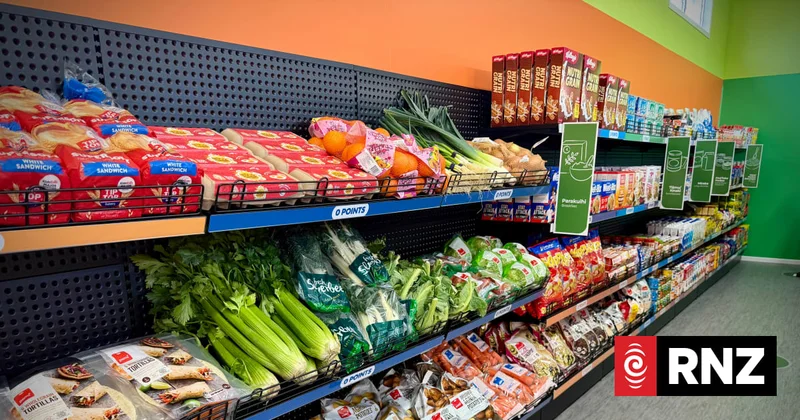
Hamilton's first social supermarket has officially opened its doors, but it is a stark reminder that many are unable to afford basic necessities.
Unlike a traditional food bank, Tamariki Tū Tamariki Ora's new social supermarket is set up much like a regular supermarket.
Customers are allocated a certain number of points, according to their circumstances, and can use those to choose the items they need.
Alongside food and household essentials, whānau can access budgeting and financial planning support, social work services and rangatahi mentoring.
Community advocates say it is often the food budget that gets cut first.
"It's a very flexible part of the budget, the food bill, and tends to be the one that takes a hit when everything else goes up," Hamilton Budgeting Advisory Trust manager Tony Agar said.
After families have paid for rent, mortgage, power, petrol and other debts, there was not much left.
"In many cases, a lot of our clients are resorting to things like Afterpay for food, which is very concerning. So we're seeing people actually getting into debt for food."
He said a family that might have had $20 at the end of the week, now often had nothing.
"The majority of people that we see, it's not because they can't manage their money, it's because there's not enough money to go around."
The new social supermarket was being heralded as a way to help. Walking down the stocked aisles, it looks like an ordinary supermarket, except instead of dollar prices marking each item, there are labels totalling points.
Families were given an allocation of points based on needs.
"The need behind this is the fact that 40 percent of our whanau in the Waikato region are experiencing some type of food insecurity," store manager Hera Taiapa said.
She said it was like a self-choice food bank, where people could choose what they needed.
"They're not just ending up with a random box of stuff that is someone's leftovers or nearly ready to expire or strange random products that they can't quite piece together to create one full meal, this is a way better option."
And with that, she said, came an opportunity to educate.
"It's dignity and it's keeping their mana intact and it's also opportunity for education. It would be different if we were just giving away free food."
She said it was teaching people how to budget and how to choose food that had a well-rounded nutritional value.
"Anything we can feed in through the mouths of our whanau, but also through the minds of our whanau, through education and support, is all going to find its way back into our communities to essentially end up seeing us having happier, healthier whanau in our society."
Tamariki Tū Tamariki Ora chief executive Jaye Wainui said food insecurity was not a new issue. It was something they had been seeing for a long time.
"What really has been pulling my attention certainly is seeing whanau who may not be accustomed or those whanau who are not used to reaching out to other services for assistance, the amount of working families that are coming in really started setting off alarm bells. It's no secret the cost of living crisis is not fussy with who it rains on.
"The supermarket is the front door, but it is not the destination. We want whānau to come in for what they need today and leave with access to the people, services and opportunities that can help strengthen their future. That is what makes this model different."
A maara kai had also been developed alongside the social supermarket, which provided fresh produce while creating opportunities for people to learn about growing, and preparing food.
Foodstuff's PAK'nSAVE Mill Street was supporting the initiative as the local buddy store.