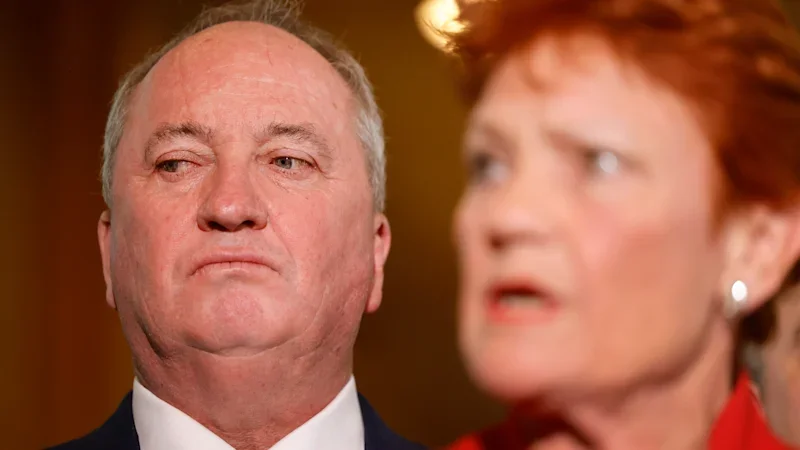
One Nation’s Barnaby Joyce and Pauline Hanson have apparently discovered a brilliant economic principle: if Australians cannot afford to live today, let them spend the money they will need tomorrow (“Chalmers warns of Hanson threat to super after One Nation leader calls system ‘broken’”, 17 August). Joyce wants broader access to super for housing and hardship; Hanson says the system is “broken”. What’s broken is their logic. If people cannot afford food, rent or a home, tackle those problems – don’t hand them a crowbar and point them towards their retirement savings. COVID should have taught us the danger of treating super as readily available cash: more than $36 billion was withdrawn, much of it by people who could least afford to sacrifice future returns. Existing early-access provisions cover cases of genuine hardship. Every dollar raided today means less at retirement and years of lost returns. It simply shifts today’s problem into the future and makes it bigger. Nor does it fix housing affordability. It doesn’t build a single home; it just pours more money into the market, pushing prices higher. One Nation’s apparent unfamiliarity with what drives inflation is becoming something of a theme. It is painfully clear that Hanson and her clueless treasury spokesperson understand remarkably little about superannuation. Tackling hardship at 40 by helping create poverty at 70 isn’t reform – it’s economic vandalism dressed up as compassion. Denise McHugh, Tamworth
What the likes of Liberal senator Andrew Bragg, and now Pauline Hanson, don’t get is that while superannuation may be “our money”, it has strings attached. It is intended for retirement and is not freely available. If it was, you might as well not have superannuation at all. Similarly, a term deposit might be your money, but you don’t expect free access it without incurring a penalty. As for people taking lump sums from super and then falling back on the age pension, blame former Liberal treasurer Peter Costello, who made all withdrawals from superannuation after the age of 60 (including lump sums) tax-free. If needs be, make incomes more attractive than lump sums (as is already happening) rather than scrapping the whole system. Talk of higher taxes on superannuation is just scaremongering. If it does happen, it will probably be on those with big accounts, which is reasonable. How much do people need to live on in retirement, and is it reasonable for the rest of the taxpayers to subsidise concessions to the rich? Australia’s compulsory superannuation system is the envy of many other countries. So much for a “public policy failure”. David Rush, Lawson
Of all the subjects that could gain the attention of our political leaders, compulsory superannuation should be at the bottom of the pile. Question time, government and media focus is being wasted on a non-issue. Superannuation provides for people in their retirement and, with reduced levels of tax on their income and investment earnings, it reduces the call on other taxpayers to fund the aged pension. It significantly reduces pensioner poverty and provides a national investment fund for the future. Where is the problem? The real agenda should include gambling addiction, the budget deficit, caring for people with a disability and funding of the NDIS, artificial intelligence, poor housing affordability, the energy transition and climate change. David Hind, North Sydney
As One Nation continues to enjoy strong support, Pauline Hanson and de facto deputy Barnaby Joyce are continuing to muddle their policies publicly. Apart from immigration (“One Nation in a migration muddle over visa numbers”, August 18), superannuation and taxes so far, there are no signs how the party will manage our economy. Our younger generation is smart enough to recognise the dangers of having One Nation elected to government. Peng Ee, Castle Cove
Don’t opposition politicians realise the negative reaction they provoke when they criticise simply for the sake of criticising? There are plenty of legitimate reasons to hold a government to account, and that is an essential part of any democracy. But when every announcement, proposal or decision is automatically condemned, regardless of its merits, the criticism begins to lose its force. Opposition for opposition’s sake doesn’t make politicians look effective. It makes them look predictable – and eventually people stop listening. Gregory Sale, Saratoga
Ideology first
Catholic Schools NSW chief executive and Liberal Party powerbroker Dallas McInerney gave the game away when he said that various conservative Coalition operatives he employed directly or indirectly “were aligned to the ideological positions of Catholic Schools NSW” (“He’s never been called an idiot”, August 18). It is not the task of Catholic Schools NSW to promote a political ideology, but to promote Catholic teaching. Given the Coalition’s persistent refusal to take climate change seriously, this puts their ideology at odds with the teaching of Pope Francis in his two teaching documents, Laudato Si’ and Laudate Deum. McInerney’s position was indeed ideological, but certainly not fully Catholic. He has no place leading a Catholic institution. Neil Ormerod, Kingsgrove
Old boys are still boys
How fitting that a group of “old boys” from Scots College have reportedly come to the defence of three current students charged with sexual assault (“Text messages emerge in Scots College rape case amid calls for principal’s resignation,” August 18). The term “old boy” prompted me to think that I have never heard of an “old girls” network from private single-sex schools. Is this because, generally speaking, women grow up more compassionate and develop meaningful relationships within other friendship groups without clinging to the old school tie? This seems so different to those boys, educated in privileged private schools, who never grow up and cling to the notion that they are the special few born to rule, to whom society’s laws and values just don’t apply. Rob Asser, Balmain East
It’s great to see my tax dollars at work. Some private schools buy up city blocks and others grapple with the fallout of students allegedly committing serious crimes. May I suggest that sexual consent activist Chanel Contos be appointed to clean up the mess (“When the accused in sex crimes are children, school leaders must wake up to a toxic culture”, August 18)? Mark Paskal, Austinmer
I’d like to remind readers and correspondents that there is no such thing as consent for anyone under 16. It’s a moot point whether Scots College embraces sexual consent education in the context of the recent allegations and charges. Jenny Greenwood, Hunters Hill
Current affairs addict that I am, I undertook a quick pre-bed scroll of the news. I wish I had rather just brewed some chamomile tea. The top three stories were about male violence. Scots College teens allegedly assaulting a young girl, Swans players allegedly involved in a sexual assault (“The Swans players who could be stood down on finals eve”, August 18) and the Alan Jones allegations, currently in court (“Jones accuser told Ray Hadley, Peter FitzSimons about alleged assaults”, August 18). I love men. I despair men. Christine Northam, Cronulla
It seems that the three Scots students who were charged with sexual assault are out on bail. Despite new laws, 85 per cent of children refused bail in NSW are Aboriginal. Homeless children are also very unlikely to be allowed bail. It seems not all children are equal under the law. Jennifer Killen, St Peters
Educational imbalance
When discussing the private versus public education question, examine the facts. As private education has proliferated, Australia’s world rankings in student performance has continued to decline. Australian students once ranked near the top in most areas. Sadly, our misguided leaning towards private schooling has destroyed our performance. Very few other countries support private schools as Australia does, and guess what? They outperform us massively. How could we have got it so wrong? Ian Roberts, St Ives
Off target
Does anyone believe that the proposed gun buyback is effectively targeted (“The Sydney stockpiles targeted in major new surrender scheme”, August 17)? Are politicians too focused on the next election instead of trying to solve social issues properly? Do they really believe that the illegal and nefarious users will hand in their guns? Does anyone think that community gun reduction might be better aimed at the source rather than the end user? Effective change takes time, and targeting the vendors, importers, manufacturers, illegal makers and retailers might just better reduce the number of guns circulating in this country. Can the politicians please apply their minds to more effective measures? That is why we vote you in. I live in hope. Peter Singh, Dubbo
We are told Australia has more guns now before the Port Arthur shooting. It would thus appear that the current legislation to control guns has failed, with police just rubber-stamping applications. Tighter gun laws are required. Allowing farmers to possess 10 firearms and individuals four is simply too many. Are we going to have expensive buybacks every 20 years, or tighter controls on the number of firearms owned and entering our country? Brian McDonald, Willoughby
Transport cost doubts
The latest step towards Sydney-Newcastle high-speed rail does little to dispel “deep community scepticism” surrounding a project estimated at $90 billion (“High-speed line design right on track”, August 18). With Newcastle and the Central Coast having a combined population of about 700,000, that equates to almost $129,000 per resident. That makes the “build it and they will come” case rather ambitious. Before committing taxpayers, shouldn’t we ask whether a more sensible path exists? Tilt-train technology, which allows trains to take corners faster than standard trains and is proven globally, could allow faster services using the existing Sydney-Newcastle rail corridor, particularly through the curves north of Hornsby. Australia already knows it works on the Rockhampton-Brisbane route. Upgrading existing infrastructure could avoid much of the cost of new tunnels, bridges and land acquisitions. While high-speed rail could cut the journey to about an hour, a NSW parliamentary inquiry found tilt trains could do it in roughly one hour and 45 minutes. Is saving less than an hour really worth $90 billion? By all means investigate the project, but with $90 billion at stake, surely the cheaper alternative deserves serious consideration. As transport professor David Levinson put it: “Until they show us the money, it’s not real.” John Kempler, Rose Bay
The Productivity Commission has found that “heavy vehicle transport is vital to Australia’s economy, but road freight physical productivity has stalled for more than a decade” (“Electric trucks ‘can deliver productivity boost’ ” 18 August). This means that governments have spent many billions on main roads over the past 30 years for a limited return. Two questions need to be asked: why hasn’t the commission looked at rail reform for more than 20 years? And why are there still more than 5000 heavy trucks travelling each day, in each direction, between Sydney and Melbourne?Chris O’Rourke, Bathurst
Three is enough
No, no, no, John, Dennis and Bipin – a thousand times no (Letters, August 18). Even if the federal pollies could just legislate four-year terms without a referendum, why should we not pass judgment regularly on our representatives? Those who want to face the will of the people less often should ring a loud warning bell. The old canard about three years not being long enough to get things done is nonsense. We see various programs (e.g. the NDIS) playing out over many years and decades, utterly unimpeded by election cycles. But longer terms would deny us the ability to remove a government quickly if it was damaging our nation and was on the nose. Ask yourself how you’d feel if a government with which you disagreed spent an extra year legislating for policies you find objectionable? You’d be happy with that? Three years is plenty of time to persuade us that you deserve another three years to continue. The fact that you can’t legislate some things quickly – indicating significant opposition among Australians and their representatives – is a good thing, not some problem to be done away with. Chris Mangan, Bracken Ridge (Qld)
Power of the post
With the current coverage of The Boathouse’s predicament, it seems the time has come for another step in modernising the NSW liquor licensing laws (“Regulator blocks Boathouse’s bid to loosen liquor rules at popular Sydney beach”, August 17). In 1999, I owned a 35-seat restaurant in a tourist area. In the lead-up to the Sydney 2000 Olympics, I wrote a letter to the Herald explaining that I expected to be embarrassed when overseas visitors came to my restaurant and I wasn’t allowed to sell them a glass of wine or a beer with their meals. The letter was taken up by a Herald journalist, and their response encouraged me to pursue the issue with the state government. Eventually, I received a letter from the then-minister responsible, assuring me that he would introduce reforms. This he did, the law was amended and I became NSW’s first licensee of a small restaurant – in time for the games. Even now, more than a quarter of a century later, I still smile at the sight of patrons in a small restaurant, glasses in hands, oblivious to the efforts that facilitated it. Writers should never underestimate the potential power of a letter to The Sydney Morning Herald. Randi Svensen, Wyong
Maker mischief
I read your letters about God, and then delved into God-proof logic, but failed to find an answer (Letters, August 17). So could someone please explain how God’s perfect design can incorporate my missing teeth, arthritis, COVID, bad eyesight and poor hearing. God has still a bit of work to do on me. When can I expect to be perfected? Ian Catt, Maroochydore
- To submit a letter to the- Sydney Morning Herald, email letters@smh.com.au. Click here for tips on how to submit letters.
- The Opinion newsletter is a weekly wrap of views that will challenge, champion and inform. Sign up here.