For decades, including during South Africa's apartheid era, Black South Africans have lived, worked alongside and built communities with African foreign nationals. This is not a romanticised ideal but a well-documented historical reality. The country's farms, mines, construction sites and households were shaped by both South Africans and migrant workers from neighbouring countries such as Mozambique, Lesotho, Malawi, Zimbabwe and others. This shared history challenges the narrative that Black South Africans are inherently xenophobic or Afrophobic.
These neighbouring states were also at the forefront of supporting South Africa's liberation struggle by providing refuge, travel documents, homes and, in many cases, burial sites for South African freedom fighters. To suggest that Black South Africans are inherently xenophobic or uniquely Afrophobic, is therefore not only an affront to this historical reality but also serves to deflect attention from genuine public concerns about illegal immigration and the state's perceived inability to manage it effectively.
The reality is that there is a widening gap between what many ordinary South Africans experience in their daily lives and how those experiences are reflected in public and media discourse. Whether every perception is factually accurate is not the central issue. What matters is that public confidence in the state's ability to enforce immigration laws has weakened considerably. This has created fertile ground for frustration, misinformation and, ultimately, acts of vigilantism.
One of the most contentious recent developments was the coronation of a Nigerian national as "Igbo King" in East London (KwaGompo). The event sparked public outrage, protests, looting and renewed debate over both traditional authority and national sovereignty. It also reignited public discussion about undocumented migration.
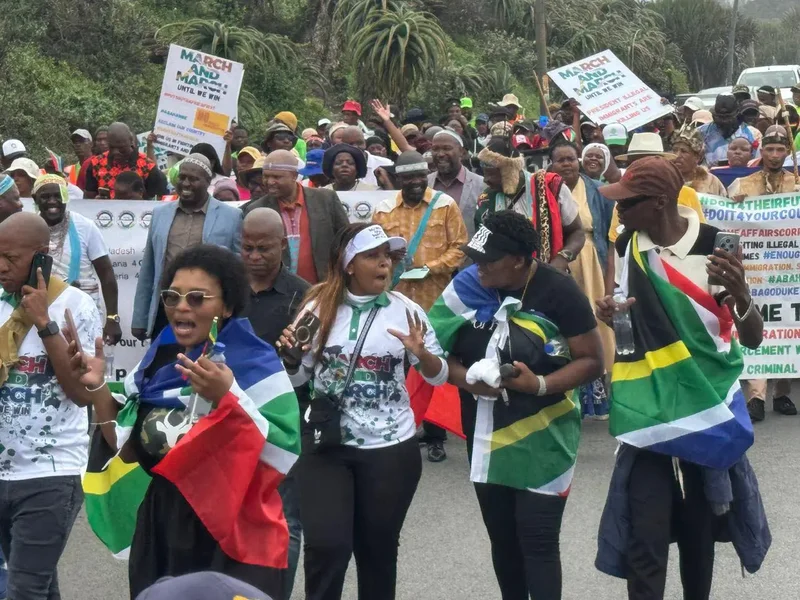
Subsequently, demonstrations were held in various parts of the country involving local residents, political parties including ActionSA, the MK Party and the Patriotic Alliance, anti-illegal immigration movements such as March and March and Operation Dudula, as well as other civic organisations. Some of these demonstrations targeted businesses alleged to be operating unlawfully or employing undocumented foreign nationals. Widely shared on social media, they generated significant public debate.
The debate intensified following the announcement of a 30 June 2026 deadline by the March and March movement and other civic organisations, whose leaders include Jacinta Ngobese-Zuma and Phakel’uMthakathi. The organisers maintained that the deadline applied only to undocumented foreign nationals and that they were encouraging them to leave South Africa voluntarily and peacefully before that date, which has since come and gone.
The organisers further argued that their planned demonstrations fell within their constitutional right to protest peacefully. They stated that their objective was to compel the South African government to enforce existing immigration laws and declare illegal immigration a national crisis. Supporters praised Ngobese-Zuma and Phakel’uMthakathi for confronting issues they believe the government has neglected, while critics described the campaign as vigilantism.
The South African government rejected the legitimacy of any privately imposed deadline, stating that only law enforcement agencies have the authority to determine whether foreign nationals are in the country legally or illegally. This was followed by the deployment of additional law enforcement personnel ahead of the planned demonstrations on 30 June.
Whether one supports or opposes the campaign, the symbolism of the 30 June deadline remains significant. For perhaps the first time in South Africa's democratic history, a non-state actor succeeded in placing illegal immigration at the centre of the national political agenda. The debate moved beyond Parliament and policy documents into communities, the streets and social media, exposing deep public dissatisfaction with the state's perceived inability to manage immigration effectively.
Regardless of one's view of March and March or similar civic movements, their growing popularity reflects an uncomfortable reality. Many South Africans have lost confidence in the state's ability to address illegal immigration, enforce regulatory compliance and combat organised crime. History suggests that when confidence in state institutions declines, informal political actors often emerge to fill the vacuum. This observation, however, should not be interpreted as an endorsement of vigilantism, violence or attacks on foreign nationals. Rather, it offers one explanation for the growing public support these movements receive.
The consequences of these developments have extended beyond South Africa's borders. Amid fears of possible xenophobic violence ahead of the 30 June deadline, governments including those of Ghana, Nigeria, Malawi, Zimbabwe and Mozambique reportedly facilitated the voluntary return of some of their nationals and issued travel advisories. Consequently, what began as a domestic policy debate has taken on regional diplomatic significance and may affect South Africa's standing on the continent.
Central to this debate is the increasing use of accusations of Afrophobia against Black South Africans. There is no denying that xenophobic violence and harassment have occurred in South Africa. In some cases, foreign nationals have been assaulted or killed. Such incidents must be unequivocally condemned.
However, these incidents should not automatically be taken as evidence that Black South Africans generally hate other Africans. Instead, public concern has been driven primarily by perceptions of rising levels of illegal immigration and the state's inability to manage the situation effectively.
For this reason, accusations of Afrophobia should not become the default response whenever concerns about illegal immigration are raised. Such labelling risks conflating legitimate policy debates with racial, national or ethnic hostility and may discourage necessary public discussion.
A distinction should therefore be drawn between hostility directed at individuals because of their nationality and legitimate public concerns about immigration governance. Millions of documented African foreign nationals live and work peacefully in South Africa. The central concern expressed by many citizens and civic organisations is not migration itself but the perception that the South African government is no longer able to maintain a credible immigration system capable of distinguishing between those who are in the country legally and those who are not.
The solution does not lie in vigilantism, nor does it lie in dismissing every concern about illegal immigration as xenophobia or Afrophobia. Rather, the solution lies in restoring public confidence in the state's capacity through a corruption-free Department of Home Affairs, effective and sustainable border management, consistent enforcement of immigration laws and constructive diplomatic engagement with other African states. Unless this occurs, the gap between what many South Africans experience and what they are told is happening will continue to fuel distrust, deepen social fragmentation and prolong instability.
Katlego Sesana is a Master's student in Political Science at North-West University (Mahikeng). His research interests include South African politics, governance, constitutionalism and public policy. His current research focuses on South Africa's evolving political landscape following the 2024 general election.