Brazil · Business
Key Facts
—Net revenue estimate. Analysts project net revenue around R$ 9.97 billion (US$ 1.96 billion), a roughly 3% decline from a year earlier.
—Net income forecast. Bradesco BBI sees net income falling 8% year-on-year to approximately R$ 1.47 billion (US$ 289 million).
—Margin pressure. The EBITDA margin is expected to hover near 21%, squeezed by currency effects and factory expansion spending.
—Release timing. WEG typically publishes second-quarter results in late July or early August, putting the report days away.
—Share price context. Bank of America and Citi hold neutral ratings with target prices near R$ 50 (US$ 9.84), implying modest upside.
WEG, the Brazilian multinational that manufactures electric motors, generators, and transformers, is expected to report weaker second-quarter results within the next two weeks, according to estimates compiled from major financial institutions.
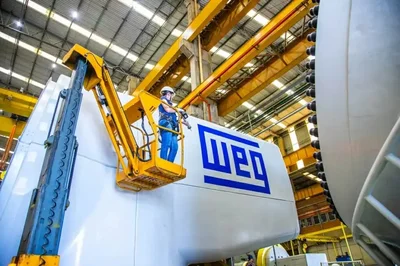
WEG manufactures electric motors and industrial equipment for global markets.
One-stop reference
Company Intelligence
Every listed company in Latin America — financials, ownership and structure for 1,450+ companies across 26 exchanges, in one place.
RTAsk Rio TimesMarkets, currencies and the economy›
RT
Ask Rio Times
Latin American markets, currencies and companies.
×
Markets todayThe currencyRates \& inflationEconomy outlook
What WEG Makes and Why It Matters
WEG is one of Latin America’s largest industrial groups, producing everything from industrial electric motors and power transformers to automotive alternators and home-appliance components. Its equipment drives factory floors, wind turbines, transmission grids, and household appliances across more than 135 countries.
For Brazil’s export story, an electric motor maker carries outsized weight. WEG converts domestic engineering into high-value manufactured goods sold abroad, making it a bellwether for the country’s industrial competitiveness and a direct beneficiary—or victim—of currency swings.
The Numbers: What Analysts Are Previewing
Bradesco BBI forecasts net revenue of R$ 9.97 billion (US$ 1.96 billion), down roughly 3% from the same quarter in 2025. Safra and Citi publish similar top-line estimates, while BTG Pactual’s consensus sits slightly lower at R$ 9.8 billion (US$ 1.93 billion).
Net income is expected to land near R$ 1.47 billion (US$ 289 million), an 8% year-on-year decline. EBITDA should reach about R$ 2.1 billion (US$ 413 million), implying a margin around 21%, a touch below last year’s level.
Why WEG’s Results Are Under Pressure
A stronger Brazilian real is the main headwind. The exchange rate has hovered near R$ 5.05 per US dollar, reducing the local-currency value of revenue earned abroad by an estimated 3% to 5%.
WEG generates a large share of its sales outside Brazil, so a firmer real directly compresses reported top-line figures.
Costs tied to transformer factory expansion in Brazil are also eating into margins. While the new capacity should support future revenue growth, the near-term drag is showing up in analyst spreadsheets.
Slower domestic demand for industrial equipment adds a third layer of caution.
The Bigger Picture: WEG’s Role in a Shifting Economy
WEG’s performance often mirrors broader trends in Latin America’s largest economy. When the real strengthens, Brazilian exporters across the board see their overseas earnings shrink when converted back to local currency, and WEG is no exception.
The company’s transformer expansion is a strategic bet on long-term electrification demand, both in Brazil and abroad. For foreign investors, this kind of capital expenditure signals confidence in future orders, even if it temporarily weighs on profitability and keeps the stock in a holding pattern.
What It Means for Expats and Investors
For expats and foreign investors holding Brazilian assets, a weaker quarterly report from a blue-chip industrial name like WEG can reinforce caution about the country’s near-term growth story. Currency volatility remains a double-edged sword: a stronger real helps your purchasing power locally but can hurt the companies in your portfolio that depend on exports.
Analysts at Safra and Itaú BBA note that as transformer capacity comes online and if currency pressures ease, revenue growth could reaccelerate in the second half of 2026. That potential recovery makes the current dip worth watching for those considering entry points into Brazilian industrials.
What Comes Next for Investors
WEG has not yet confirmed the exact publication date, but the company historically releases second-quarter figures between July 30 and early August. That puts the report roughly ten days away from the current date of July 21, 2026.
Despite the cautious preview, some analysts see a progressive recovery later in the year. Bank of America and Citi maintain neutral ratings with target prices near R$ 50 (US$ 9.84), implying modest upside from current levels.
The market will be listening closely for any update on transformer orders and export demand during the earnings call.
Frequently Asked Questions
What does WEG manufacture?
WEG produces electric motors, generators, power transformers, automotive components such as alternators and starters, and motors for home appliances and HVAC systems. The company sells to more than 135 countries and is a key player in industrial electrification.
Why are WEG’s Q2 2026 earnings expected to decline?
Analysts point to a stronger Brazilian real reducing export revenue, costs tied to transformer factory expansion, and softer domestic demand for industrial equipment. The exchange rate near R$ 5.05 per US dollar has trimmed the local-currency value of overseas sales by an estimated 3% to 5%.
When will WEG publish its second-quarter 2026 results?
WEG has not confirmed the exact date, but based on historical patterns the report is expected between late July and early August 2026. Investors typically receive the full earnings release and a conference call with management shortly after publication.