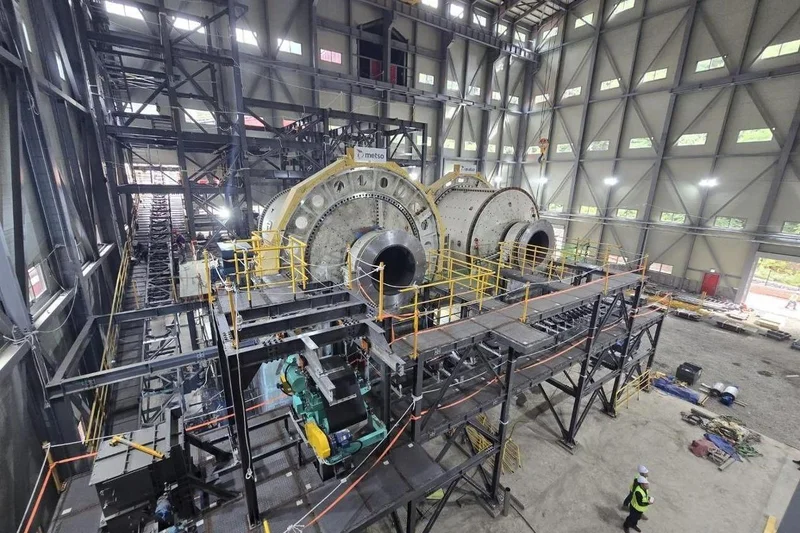
The Sangdong mine in Yeongwol County, Gangwon Province, is emerging as a strategic asset in efforts to build a non-Chinese tungsten supply chain for the semiconductor industry. Operated by Almonty Korea Tungsten Corp. (AKTC), the mine is one of the world’s largest tungsten deposits and has moved from development toward production readiness.
The Sangdong mine is expected to supply tungsten concentrate and support the production of higher-value materials such as high-purity tungsten oxide. AKTC said the mine could strengthen Korea’s domestic critical-mineral security while providing an alternative source for global semiconductor and advanced-manufacturing industries that remain heavily dependent on China.
The mine development project has gained importance as concerns over global tungsten hexafluoride (WF6) supplies intensify. WF6 is a specialty gas used in semiconductor metallization, including tungsten deposition processes required for 3D NAND, DRAM and high-bandwidth memory. Rising demand from AI servers and data centers is increasing demand, while the qualification of alternative suppliers can take 18 to 24 months.
The immediate challenge is not limited to WF6 production. WF6 manufacturers require high-purity tungsten feedstock, and China’s export controls have made that material increasingly difficult to obtain. China added several tungsten-related products to its export-control framework in 2025, including ammonium paratungstate (APT), tungsten oxide and certain tungsten products. AKTC said Chinese exports of high-purity tungsten powder to Japan ceased entirely for three consecutive months between February and April.
The resulting pressure has spread across the tungsten value chain. China’s General Administration of Customs said the average export price of WF6 exceeded 950,000 renminbi ($140,935) per ton during the first five months of this year, while the price of electronic grade WF6 rose to 2.5 million renminbi per ton by the end of June.
AKTC cited Persistence Market Research in forecasting that the global specialty electronic gases market will grow from $5.1 billion in 2025 to $6.9 billion by 2032. AKTC added that 69 percent of total demand will be concentrated in the Asia-Pacific region, including China, Taiwan and Korea, where the world’s semiconductor manufacturing capacity is concentrated.
The situation has highlighted the structural concentration of the global market. Japan’s Kanto Denka Kogyo and Central Glass have historically accounted for roughly one-quarter of global WF6 production and supplied major customers, including Samsung Electronics, SK hynix and TSMC. All three companies warned of production risks after difficulties securing Chinese tungsten powder.
However, the companies subsequently indicated that production would continue. Central Glass announced in June that it had secured the raw materials needed to meet customer orders, while Kanto Denka’s financial briefing in May indicated continuing WF6 activity and stronger specialty-gas sales. These developments may ease immediate supply concerns, but they do not resolve the underlying dependence on Chinese tungsten feedstock.
WF6 is difficult to replace in the short term because semiconductor manufacturers must complete customer-specific qualification procedures before adopting alternative suppliers. New WF6 facilities and qualification programs generally require 18 to 24 months to prepare, leaving limited capacity to absorb a prolonged disruption.
AKTC is positioning the Sangdong mine as the foundation for a more diversified tungsten network. Korean chipmakers have moved to diversify procurement through domestic and overseas sources, but the market still lacks sufficient high-purity non-Chinese feedstock.
The company's tungsten oxide plant in Yeongwol, scheduled for completion in 2028, is intended to process concentrate from the Sangdong mine into APT and then tungsten oxide. The company said the project could help Korea capture greater value and provide feedstock for downstream tungsten-metal and WF6 production.
Producing WF6 from tungsten concentrate requires four stages. The concentrate is first chemically processed and purified to produce APT. APT is then thermally decomposed and calcined to produce tungsten oxide, primarily tungsten trioxide. High-purity tungsten oxide is then reduced in a hydrogen atmosphere to produce metallic tungsten powder. The tungsten powder then reacts with fluorine gas to form WF6, which is subsequently purified into a semiconductor-grade, ultra-high-purity specialty gas.