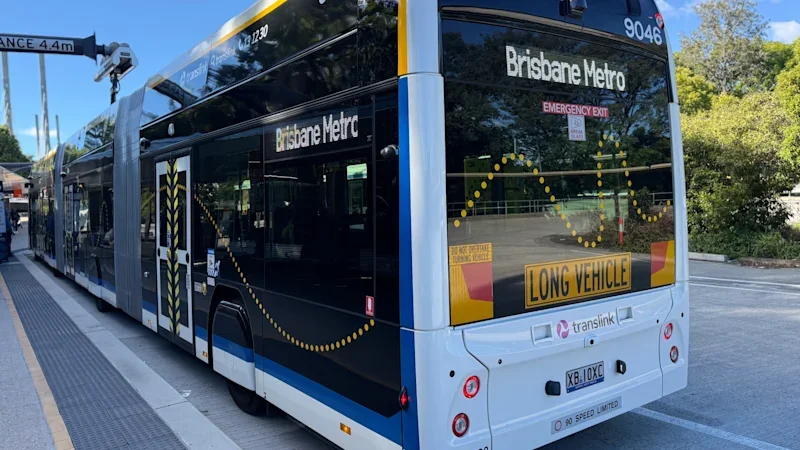
Brisbane’s “tram-like” Metro is prompting revellers to ditch taxis and Ubers on Friday and Saturday nights, the council says.
Brisbane City Council released figures showing trips on the M2 Metro, which replaced the Route 66 bus in January 2025, surged 161 per cent on Fridays and Saturdays from 7pm to midnight, compared with the previous 13 months.
On those nights there are also 58 more services on the route, which connects UQ Lakes with the Royal Brisbane and Women’s Hospital.
Brisbane Lord Mayor Adrian Schrinner said international research showed people wanted to use a “tram-like” service, and it was the most affordable way to roll out mass transit, particularly with the Olympic and Paralympic Games on the horizon.
“When you provide 24-hour services on the weekend, people use them, so there’s great demand for it,” he said.
“A lot of people are now shifting their habits. They’re using public transport instead of Ubers, and that is a great thing.”
The surge has been supported by the introduction of 50¢ fares, which began as a trial under the former Labor government in August 2024.
The Brisbane Metro launched in October 2024, before being quietly stopped a month later, with the M2 line then launching on January 28, 2025, and the M1 line on June 30, 2025.
Coinciding with the M1 line, there was also a shake-up of the bus timetable on June 30, 2025.
Schrinner said the Metro was a trunk service, so at night people might, for example, ride it to Garden City and catch an Uber for the remainder of their journey, but the council worked with the state government to expand services where there was demand.
The lord mayor said he caught the Metro at night on the Ekka public holiday with his son, expecting it would be quiet.
“It was so crowded, and it’s a great thing,” he said.
“In past years, you would see not so many people using public transport on public holidays, and the frequency would have normally been right down.
“But Metro comes every five to 10 minutes on public holidays.”
Another route to become more popular was the 425 from Kenmore Village to the CBD, which had a 37 per cent increase in weekend patronage.
QPAC executive director Rachel Healy said more than one in three patrons now arrived at its South Bank venues by public transport, and it was perfectly located near bus, train and ferry stops.
“It is crazy to bring your car into central Brisbane,” she said.
The council also announced its business case for an expansion of the Brisbane Metro would be finished by August next year, with new funding from the state government meaning it was now funded by all three levels of government.
Only $12 million from the federal government contribution was needed for the business case, allowing $38 million for early works.
Schrinner said current Metros were bi-articulated vehicles produced by manufacturer Hess, but new technology had emerged, and the council would investigate the next generation of Metros while the business case was developed.
This masthead previously revealed a full expansion of the Brisbane Metro was unlikely to be delivered before the 2032 Olympic Games, according to a leaked draft of its updated transport legacy plan.
The expansion was set to feature 22 new stations and stops, south to Springwood, east to Capalaba, and north to Carseldine and the airport.
In response, Schrinner argued the Metro expansion could not happen without federal funding.
Labor council opposition leader Jared Cassidy said the lord mayor said in February 2025 he could start on a business case after the federal government contributed $50 million, but Cassidy said progress had been delayed.