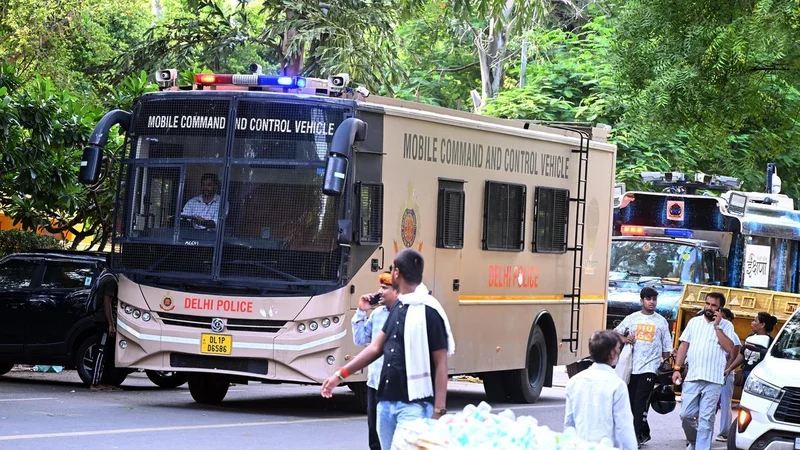
A Delhi Police affidavit in the Supreme Court has acknowledged the use of facial recognition system during the NEET-UG paper leak protests in the national capital, but said the technology was deployed in “legitimate State interest”.
The affidavit does not specifically address the issue of use of pellet guns by the Rapid Action Force on protestors.
The police said force employed was proportionate, reasonable, graded and strictly in accordance with law to control the surging crowds. The police said it would deal with the allegations against police officers before the committee proposed by the Supreme Court to examine “all issues related to the use of force by the police”.
The police maintained that the use of facial recognition system (FRS) constituted a “legitimate, bona fide and proportionate policing measure”.
“FRS does not automatically capture, create, generate or maintain profiles of every individual present at the protest site, nor is it deployed for indiscriminate surveillance or collection of personal information of peaceful protestors unless he has a previous criminal record,” the police assured.
The affidavit further explained that the police only maintained a record of the faces of accused involved in serious offences, and not in cases of petty offences like traffic challans.
FRS found 2,873 persons with serious criminal antecedents, of which 92 were involved in over 10 cases. Forty-seven of the 92 were history-sheeters. Their crimes range from murder, rape, kidnapping, child sexual abuse to narcotic offences.
“A false narrative is being built to the effect that based upon the FRS, biometrics of everyone and anyone is obtained, people are being called with their Aadhar cards and the data is being sold to private entities. Such narrative is built not only falsely but with ulterior motives,” the Delhi Police said.
The police said the deployment of plainclothes police personnel as “spotters” were globally recognised arrangement to keep a “vigil on anti-social elements or criminal activities that pose a threat to the gathering or movement”.
The police said tear smoke shells were used only as a last resort. The lathi charge was “limited and controlled” .
The police further added that lathis were an acceptable “helping gear” to protect themselves in a mob like situation. The affidavit denied the use of “nail lathis”. It said the solitary video claiming the use of a nail lathis was actually a stick, possibly used by a protestor in which the National Flag had been attached.
“These officers had merged with the protestors to avoid being identified by the anti-social elements and criminals and to be in a position to provide immediate assistance to anyone being harassed at the protest site,” the affidavit maintained.
The affidavit denied police officers manhandling women protestors.
Noting that the petitions were based on incomplete narration of events and disputed questions of fact, the police maintained that “operational decisions taken by officers on the ground in a rapidly evolving and violent law and order situation necessarily involve instantaneous assessment of security risks and cannot be subsequently misjudged in hindsight by selectively relying upon isolated video clips or media reports”.
The police said the background to the protests and consequent police action on July 20 was of “considerable significance”. The protests at Jantar Mantar were “potentially sui generis” or one of its kind.
The series of events began on June 6 when some individuals began an agitation. On June 20, Saurav Das, a member of the Cockroach Janta Party, sought permission from the Delhi Police on June 17 to organise a peaceful demonstration on June 20 with an expected gathering of 500-600 people. Permission was granted as a “one-time exception”. However, the protestors did not vacate the area after the scheduled time on June 20, rather a large number of students, political workers and leaders, activists and others came and addressed the gathering to continue and expand the agitation. The police said the protestors’ strength had increased from a “few dozen” of the initial days of the agitation.
Events took an unprecedented turn, the police said, with the commencing of the Monsoon session of the Parliament. Permission was neither sought nor granted for any ‘Sansad Chalo’ march on July 20.
The march took an aggressive turn when a section of the protestors attempted to breach police barricades to advance to the Parliament. The police had to prevent the protestors from causing any damage to vital installations like the Parliament, Rashtrapati Bhavan, Seva Teerth, Kartavya Bhavan, Central government offices, residences of Union Ministers, Armed Forces and the Judiciary located in the high security zone around the Parliament, the affidavit said.
Videos on social media show police personnel thrashed, women police officers manhandled, government vehicles burnt, creating a grave law and order as well as security situation. The police said that, at one point in July 20, there were 30,000 plus protestors faced by only 5,000 uniformed police officers. Police personnel were attacked without any provocation “almost in a mob lynching fashion”, the affidavit said.
Published - August 18, 2026 11:30 am IST