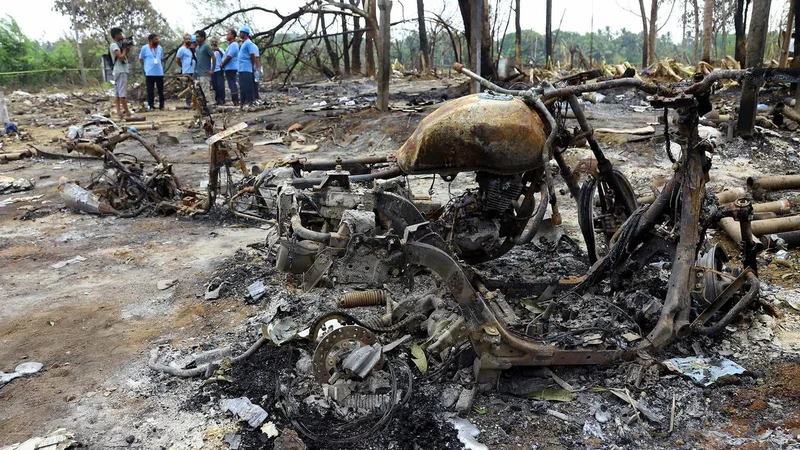
The City Police Commissioner, Thrissur, has proposed measures to strengthen regulatory safeguards and safety standards to minimise the risk of accidents involving explosive substances such as firecrackers.
The official filed a statement before the Division Bench of Chief Justice Soumen Sen and Justice V.M. Syam Kumar in a suo motu petition based on news reports of the Mundathikode fireworks tragedy in April.
Advocate General Jaju Babu, who appeared in the court, informed the Bench that certain manufacturers were supplying substantially larger quantities of fireworks for public displays without authorisation or adequate storage facilities, resulting in violations of statutory requirements.
Mr. Babu further informed the court that a comprehensive inquiry is under way by a Special Investigation Team constituted under the supervision of senior police officials.
The proposed safety measures included the strict compliance of various provisions of the Explosives Act, 1884 and the directions issued by the Petroleum and Explosives Safety Organisation (PESO). Mandatory joint inspections may be conducted by the Police department, district administration, Fire and Rescue Services, PESO, Electrical Inspectorate and other competent authorities before granting or renewing of licences for fireworks manufacturing units.
Periodic safety audits
Licensed fireworks manufacturing and storage units may be subjected to periodic safety audits, reviewed by the district administration and licensing authorities. All licensed units may be made accessible to enforcement agencies. Copper grounding plates may be made mandatory at the entrance of manufacturing sheds, to discharge static electricity from persons, with entries restricted exclusively to licensed, authorised and trained personnel.
All units must have open access to facilitate movement of fire and emergency services, and there should be at least two access roads of sufficient width for large emergency vehicles. The licensing authority should ensure that the manufacturing units maintain the prescribed minimum storage capacity and that it is proportionate to the authorised production capacity when granting or renewing licenses, according to the Advocate General.
Mandatory training
There should be mandatory training and certification for persons engaged in the manufacture, storage, transportation and display of fireworks, along with regular technical and safety training programmes. To minimise fatigue and reduce the risk of accidents, appropriate restrictions may be employed in the working hours of such personnel.
A comprehensive risk analysis must be conducted considering the venue, expected crowd, proximity to residential areas, hospitals, educational institutions, fuel storage and other such vulnerable locations. During major festival seasons, special enforcement drives may be conducted to detect illegal fireworks manufacturing units, unauthorised storage facilities and violations of licence conditions, with joint inspections by competent authorities.
The penalties prescribed in the governing laws may be enhanced to deter violations. Persons, organisations, festival committees or other entities that ask manufacturers for excessive quantities of fireworks in violation of safety norms could be punished by expanding the penalty for abetment of offences under the law. If such a violation leads to loss of life, the punishment for death by negligence under the Bharatiya Nyaya Sanhita could also be applied.
Public awareness campaigns may also be conducted regarding safe handling of fireworks, safety requirements therein and consequences of non-compliance.
Published - July 23, 2026 08:21 pm IST