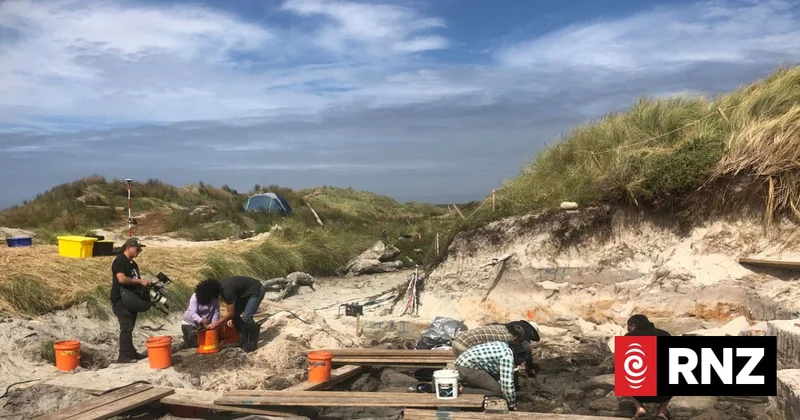
Ancient waka excavation: No govt assurances around further funding
A man who discovered an ancient waka partially buried in dunes on the Chatham Islands says the government has made no guarantees over paying for its preservation.
Described as one of the most significant archaeological discoveries ever made in Aotearoa and the wider Pacific, the waka remains buried in coastal dunes on the Rēkohu island of the Chathams.
Pieces of the waka were discovered nearly two years ago by the Dix whānau, who own the land where about 750 fragments have since been recovered.
The waka believed to be Rangihoua - a double-hulled ocean-going waka thought to be part of an early migration from Hawaiki centuries ago.
Minister for Arts and Heritage Paul Goldsmith visited the site on Monday.
Speaking to Checkpoint, Vincent Dix said the visit was "more positive than what we've had".
"Hopefully with him being able to see what we've actually got and trying to deal with may help our cause," he said.
While the recovered fragments are now being cared for, the remaining section of the waka is still exposed to erosion, storm surges and the risk of permanent loss.
It is believed the remaining pieces represent about 10 percent of the entire waka.
Goldsmith made no assurances around further funding during the visit, Dix said.
"They've got to go away and discuss the possibilities of what they can do for us," he said.
Dix said the minister was unable to physically see the waka during his visit as it was covered up and protected by sandbags.
"I think they would have realised how sort of vulnerable it is here, with the tide draping around it like it was when we were down there. They understand, I think, now that it's urgent to get it out."
Archaeologists say time is critical and have warned that sandbags and other temporary protections are unlikely to save the site from a major storm, and that delaying or repeatedly stopping and starting the excavation could cause further damage.
In a recent court case to establish ownership of the waka, the Ministry for Culture and Heritage argued that its legal responsibilities extended only to the pieces already uncovered, not those still buried. It also said it did not currently have the funding required for a full excavation and the years of conservation work that would follow.
With cold howling southerlies hammering Rēkohu on Monday, Goldsmith would have seen first hand the type of conditions the waka was being exposed to.
But it was the northerly winds which were the biggest threat to the waka.
Dix said another major archaeological dig was needed to remove the remaining pieces of waka from the dunes, a process that could take up to six months.
"It's quite a painstaking process to get everything out, but it's sort of got to be done very carefully due to the fact there is bits like sail and rope and things there that are very delicate."
The waka would continue to deteriorate the longer it was left where it is, Dix said.
"Because it's been exposed, so from now on every day it's slowly decaying. Because the oxygen and everything is getting at it.
Preserving the waka was of paramount importance, he said.
"It's like the most complete waka ever discovered.
"We definitely know we've lost a lot due to the storms and that. But we've still got a lot to recover, and it's quite an amazing piece of engineering."
Goldsmith said a decision on funding would need to be made by Cabinet and he would not make any commitments ahead of that.