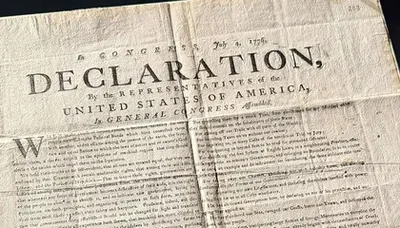
A Volunteer Stumbled Upon a Strange Document in the U.K. National Archives. It Turned Out to Be a Rare Copy of the Declaration of Independence Printed in July 1776
Michael Scurr, a retired insurance broker, found the text while cataloging boxes of 18th-century correspondence housed at the London archives. It’s the only known copy of its kind outside the United States
Ellen Wexler
\| Writer and Special Projects Editor
July 21, 2026 3:23 p.m.
Before this document was discovered, only ten copies of the Exeter Declaration were known to exist.
National Archives
When he unfolded the document, Michael Scurr noticed the word “Declaration” printed in large letters across the top. Feeling a swell of excitement, he showed it to his supervisor.
“I thought, ‘Oh, right, OK. This is definitely a Declaration of Independence,’” he tells the Associated Press’ Danica Kirka. “How exciting is this?”
Scurr, a retired insurance broker, has been volunteering at the National Archives in London for more than a decade. He made his discovery in May, while cataloging boxes of Royal Navy captains’ correspondence during the American Revolution.
This copy of the Declaration was printed in a New Hampshire newspaper between July 16 and 19.
National Archives
Experts confirmed that Scurr had uncovered a rare copy of the Declaration that was printed in Exeter, New Hampshire, in July 1776. Previously, only ten copies of the so-called Exeter Declarations had been known to survive, according to a statement from the archives. All of them are housed in the United States.
After the Continental Congress adopted the Declaration on July 4, 1776, newspapers printed copies that spread throughout the American Colonies. During this period, “the news of the Declaration is traveling fast around North America, and it’s being reprinted as it reaches each successive colony,” Graham Moore, a records specialist at the archives, tells BBC News’ Joe Coughlan.
The Exeter Declarations were printed in a publication called the New Hampshire Gazette or Exeter Morning Chronicle between July 16 and 19. They weren’t the first copies of the document to circulate, but they’re now among the rarest.
Quick facts: The Dunlap broadside
- John Dunlap, the official printer for the Continental Congress, produced the first copies of the Declaration in July 1776.
- Around 26 of the estimated 200 Dunlap copies are known to survive today. The National Archives already holds three of these copies, one of which is currently on display in the “Revolution 250” exhibition in London.
The newly discovered copy belonged to someone aboard the Dalton, an American privateer. Amanda Bevan, head of legal records at the archives, thinks that the ship’s captain, Eleazer Johnson, may have read this copy aloud to the crew.
“I like to think that if Captain Johnson read the orders and the commission to his crew, he also read the Declaration to them,” Bevan tells NBC News’ Elmira Aliieva. “It would have made clear what they were fighting for and involved all of them in that hope for a better world.”
The Dalton was a private ship that had been commissioned by the Continental Congress, which ordered it to “attack, seize and take the ships and other vessels belonging to the inhabitants of Great Britain,” according to the archives.
The ship departed from Newburyport, Massachusetts, in the fall of 1776. It then stopped to pick up more men 20 miles north of Portsmouth, New Hampshire, which is likely where the document came aboard. On December 24, the HMS Raisonnable, a British Royal Navy ship typically crewed by more than 500 men, spotted the Dalton near the coast of Portugal.
The smaller vessel, which had only 120 crew members, surrendered after a seven-hour pursuit. Johnson threw almost all of the ship’s written records into the water before the British came aboard, but he saved three documents: his commission, his instructions from Congress and this copy of the Declaration.
An entry in HMS Raisonable's log describing the capture of the Dalton
National Archives
Thomas Fitzherbert, the captain of the Raisonnable, sent the printed Declaration to the Admiralty, which managed the Royal Navy. According to the archives, it’s the “only copy of the U.S. Declaration known to have been taken in military action.” The document eventually traveled from the Admiralty to the archives, where Scurr discovered it earlier this year.
Scurr is part of a team of volunteers working under Bruno Pappalardo, a principal records specialist at the archives. As Pappalardo tells the New York Times’ Isabella Kwai, the team has cataloged more than 110,000 letters from Royal Navy captains. They had finished a daunting collection from the French Revolution and the Napoleonic Wars before turning to letters from the American Revolution.
The newly discovered document is a “tangible connection to the past, because holding that piece of paper in the archivist’s hand today is a way to transport us back to 1776. The baton being passed, in a way,” Matthew Skic, director of collections and exhibitions at the Museum of the American Revolution in Philadelphia, tells the AP. “Even though 250 years [have] gone by, we still do not know everything about the American Revolution, and there are still finds left to be discovered.”
Exeter Declarations appear only rarely at auction, where they tend to sell for impressive sums. In January, Christie’s sold a copy for nearly $5.7 million. “We are aware [of] the existence of a total of ten extant copies of this broadside,” the auction house had written in the lot listing. The newly discovered copy brings that total to 11.