WASHINGTON — The National Reconnaissance Office has awarded HawkEye 360 a new contract to provide commercial radio-frequency intelligence, moving the company from a multiyear evaluation program into operational support for U.S. intelligence and defense agencies.
The NRO said Aug. 17 that the contract was awarded under its Commercial Radio Frequency Capabilities Augmentation program, or CRFCA, an effort to expand the intelligence community’s and military’s use of commercial RF data. The value of the contract was not disclosed.
The award marks the next stage of an NRO effort that began in 2022 to determine how commercially operated satellites could supplement government intelligence systems by detecting and locating electronic signals from space.
Unlike optical satellites, which collect images of the Earth, RF satellites listen for electronic emissions from sources such as radars, communications systems and maritime equipment. Measurements taken by multiple spacecraft can be used to determine where a signal originated.
HawkEye 360’s new contract follows the NRO’s three-phase Commercial Radio Frequency Capabilities program, which began in September 2022 with study contracts awarded to six companies. The agency evaluated commercial RF capabilities through modeling and simulation before moving to on-orbit demonstrations.
The CRFCA vehicle is designed to allow the NRO to scale purchases as mission requirements change.
The approach mirrors the NRO’s efforts to bring other forms of commercial remote sensing into its intelligence architecture, including electro-optical and synthetic-aperture radar imagery.
CRFCA is managed by the NRO’s Commercial Systems Program Office and is intended to supply RF collections for national security as well as civil and humanitarian missions.
Demand expanding overseas
HawkEye 360, which went public in May, said during its Aug. 13 earnings call that international revenue reached a record $21 million during the second quarter, up 134% from $9 million a year earlier. International customers accounted for about 42% of the company’s $49.8 million in quarterly revenue, and executives said the international growth was organic rather than driven by acquisitions.
The company has disclosed more than $100 million in recent international awards, including work on a European electronic-warfare program and a multiyear contract supporting the Indian Navy and other customers in the Indian Ocean region. The growth reflects broader military demand for space-based RF intelligence amid conflicts and security concerns in Europe, the Middle East and Indo-Pacific.
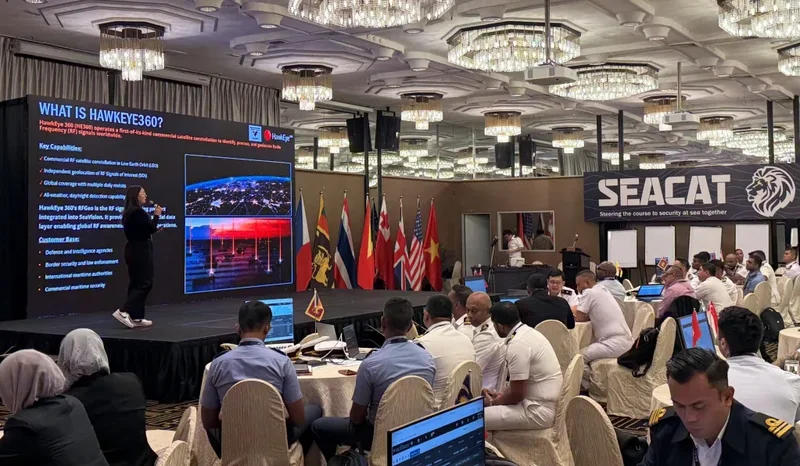
Based in Herndon, Va., HawkEye 360 operates more than 30 small satellites in low Earth orbit, generally flying in three-satellite clusters that work together to detect, characterize and geolocate RF emissions.
As demand grows, the company is looking to shorten the time between collections and delivery of its data. Executives said HawkEye 360 is targeting roughly 10-minute revisit and latency within two to three years and is considering a combination of additional satellites and hosted payloads to reach that goal.