Last weekend, it was reported that the 53-year-old known as Doctor A – and also referred to as the ‘boyfriend’ of Lucy Letby during her trial – was found slumped in his vehicle in a car park in the North-West of England.
He’d been reported missing to the police by his family. It was the day after he had been sacked from his job as a hospital consultant, following an investigation into inappropriate text messages he’d exchanged with Letby while they both worked at the Countess of Chester Hospital and which were found to have breached patient confidentiality.
He was admitted to the Whiston Hospital in Merseyside intensive care unit, where he died nine days later on July 3. A date for the inquest into his death has been set for February next year.
I have every sympathy for the grieving family of Dr A, but we must not forget he was a key witness at a trial at the centre of continuing public and media interest. Regular readers will know I believe that Letby’s trial and conviction may well prove to be the biggest and cruellest miscarriage of justice this country has seen for decades.
Two things are now imperative in relation to both his death and inquest. The first is that the proceedings are open and transparent and that any information regarding his death relating to Lucy Letby is presented at the inquest and made public.
We must be informed if anything is found which mentions or pertains to Letby and her trial in any way whatsoever.
The second point is that the coroner who presides over the inquest proceedings should be from outside of the North-West region and not a Cheshire-based coroner who is on first name terms and has a cosy relationship with key members of Cheshire Police who were involved in the Letby prosecution.
As it stands today, the coroner’s officer – who will decide which documents should and should not be submitted as part of the inquest into the death of Dr A – works for Cheshire Police.
Lucy Letby was convicted for the murder of seven babies and the attempted murder of seven others at the Countess of Chester Hospital between June 2015 and June 2016
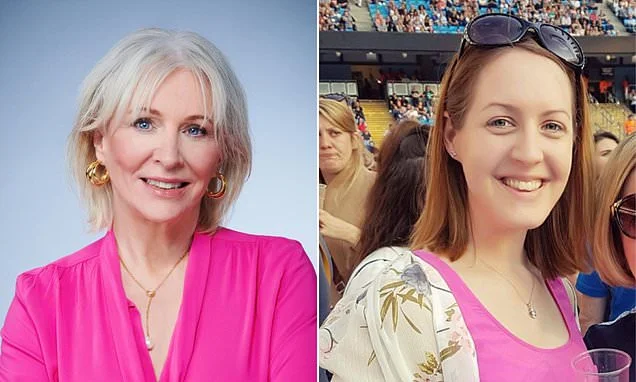
I am convinced that, had there been greater transparency in the original trial of Lucy Letby, she would never have been found guilty and would not be in prison today, writes Nadine Dorries
I am not suggesting that such an individual would necessarily act improperly but, surely, there is not a single member of the public who would think that this looks right or proper?
One thing has always bothered me in relation to Dr A. Why was he granted anonymity during the trial? Legal friends tell me the criminal anonymity – which protects the identities of vulnerable witnesses – may no longer apply now that he has died. It is understood a civil court order protecting his identity remains in place.
But the public have a right to know who he was because, largely thanks to his evidence, a young woman, now 36, has been condemned to spend the rest of her life in prison for crimes – the murder of seven babies and the attempted murder of seven others – many leading experts (including lawyers, scientists, statisticians and doctors) believe she did not commit.
Given the doubts which now swirl around the safety of Letby’s conviction, it is almost inconceivable that the Criminal Cases Review Commission will refuse her barrister Mark McDonald’s application for an appeal (which was filed in February last year).
If he has been successful, this is likely to be announced in the autumn, with an appeal hearing taking place roughly this time next year.
If and when that happens, I firmly believe that the hearing should be filmed live so that the public can see for themselves how it is conducted.
I know this would be unprecedented. Unlike in America, where high-profile trials and hearings are often livestreamed, complete criminal trials have never been broadcast in Britain which, of course, is why we rely on the work of courtroom sketch artists.
But I am convinced that, had there been greater transparency in Lucy Letby’s original trial, she would never have been found guilty and would not be in prison today.
Letby went into her trial sure that she would be acquitted because she was innocent and certain that, in this country – the birthplace of the jury system – she would be set free, writes Nadine Dorries
The secrecy surrounding it and the media lockdown – which involved far-reaching and highly unusual reporting restrictions which prohibited the Press from naming the dead and surviving infant victims as well as their parents – seemed excessive.
As a result, I believe justice was not seen, not by any stretch of the imagination, to have been done.
Back to Dr A. Why do I believe he was such a significant and important witness during the trial, and why does it matter that his inquest is transparent?
Dr A was key in providing the prosecution with a motive for murder, given the fact that there was no credible evidence against Letby. No one had seen her harm any baby and nothing about her personality fitted the profile of a serial killer. In fact, it was quite the opposite.
She was a popular, slightly shy, conscientious and happy young nurse, who was liked by everyone. She could be irritating because she was a stickler for the rules, and when it came to cutting corners, she refused to comply.
Indeed, she made complaints about doctors who tried to do just that. She was surprisingly stubborn, and not someone doctors could push around.
The prosecution was struggling to build their case, but they found their chance with Dr A and they jumped on it.
Dr A was 17 years older than Letby, married for 27 years with grown children. He visited her at home, took her to London and on days out, they met for coffee, she called him ‘sweetie’ and he loaned her his car. They sent each other well over a thousand messages, often late at night.
He flirted with Letby and, as a friend of hers told me, she was slightly in awe of him. He was respected by the nurses, not unattractive and had chosen Lucy as the object of his attention.
As a former nurse, I’ve seen it so many times before. Of course, it happens in workplaces everywhere: male bosses taking advantage of young female employees. But in hospitals, where the God complex infects so many male doctors who thrive on praise and adulation, it happens all the time.
But far from being intimate, I’m told that Letby, who had never had a serious boyfriend, held her ground. Meanwhile, his interest in her didn’t wane as he continued sending her those late-night messages and asking to see her.
Dr A later claimed that it was Lucy who had manipulated and deceived him. She was questioned by the prosecution in a manner which portrayed her as an emotionally needy temptress and, worse, a harlot for having what everyone assumed was an intimate relationship with a married man.
However, the power dynamic was entirely in the opposite direction. Still, that image of Letby was put across to the judge and the jury; the woman blamed, accused of deliberately harming babies just so she could call Dr A to the unit to get his attention.
Yet, according to the 1,355 messages and his visits to her home, his attention was certainly not something she was short of – or had to do anything to encourage.
From his secure place behind a screen in court, which Dr A had requested, he threw her under the bus. Her reputation destroyed, her credibility undermined and I believe the jury’s mind was made up.
The prosecution went on to interrogate Letby, knowing – as is courtroom procedure – that while a witness is on the stand, she is not allowed to speak to her lawyers until her time in the witness box is over. During the month she spent giving evidence, she was alone, unsupported, taunted, embarrassed and broken. Her character and reputation were in shreds.
Lucy Letby went into her trial sure that she would be acquitted because she was innocent and certain that, in this country – the birthplace of the jury system – she would be set free.
When Dr A took the stand, it was surely the moment when she must have realised things had gone terribly wrong. When he started giving evidence, Letby recognised his voice and became visibly distressed, tearful and attempted to leave the dock. Proceedings halted until she could compose herself.
She had once written the words, ‘I love you. But I think you know that.’ At that point she must have realised: if this person could betray her, she was lost.
My heart goes out to Dr A’s family. But I am deeply concerned for the wellbeing of Lucy Letby, too. There are no words to describe how dreadful and harmful this entire situation is.
The sooner what I believe to be the facts are out, open, and unequivocal, the sooner this will be over. No stone unturned. No behind-closed-doors hearings. No media clampdown. Just the open, honest truth.