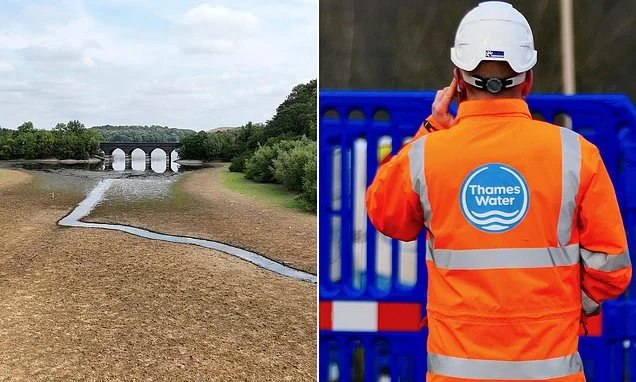
With parts of the country coming to resemble the 1930s Oklahoma dustbowl and others the set of the 1961 disaster movie The Day The Earth Caught Fire, there is one oasis where householders are spared restrictions on water usage.
Millions of residents supplied by Severn Trent water are not subject to the otherwise widespread hosepipe bans imposed on much of drought-stricken Britain.
From Lincolnshire in the east to Gloucester in the south and Welshpool in the west, 4.6 million householders are free to carry on as normal, watering their gardens and washing their cars and windows.
Severn Trent is trusting its customers to preserve water voluntarily and sensibly without introducing punitive measures. In other parts of Britain, breaching a hosepipe ban can result in fines of up to £1,000.
The company is proud of its record in maintaining continuity of supply while encouraging alternative conservation measures such as collecting rainwater in butts. It claims to be fixing leaks at record levels. Consequently, it hasn’t had to impose a hosepipe ban for three decades. The last one was in 1995.
You might have thought that this was a cause for celebration. You’d be wrong.
The Environment Agency, which regulates the water industry, criticised Severn Trent for sending out the ‘wrong message’.
Wrong message?
Water levels in England's rivers and reservoirs have dropped dramatically after an exceptionally hot and dry summer
Surely Severn Trent should be congratulated for avoiding a ban as a result of responsible management of supplies – unlike most of the other water companies in Britain who have banned domestic hosepipes while failing to stop leaks from the mains flooding streets and wasting millions upon millions of gallons.
Admittedly, those unfortunate folk who lost their homes to fire in Stourbridge, which falls within Severn Trent, have no reason to celebrate. But their terrible ordeal was reportedly caused by human stupidity – sparks from a disposable barbecue – not by any shortage of water to tackle the flames.
So why on earth is the Environment Agency chiding Severn Trent for not imposing a ban?
Simple. That’s the way the bureaucratic mindset always works. It demands conformity, even when there’s no justification. We saw this in extremis during the blanket Covid lockdowns, which were rigorously enforced unnecessarily. Hefty fines for sunbathers and dog walkers, for instance.
The thinking goes: if there are no restrictions in Severn Trent, then how long before residents in other areas start to think they can defy the hosepipe bans with impunity? All must suffer equally.
The real scandal here is that householders right across Britain are being punished for the failure of politicians and privatised utility companies to do their job properly. Britain is an island with plentiful annual rainfall and is surrounded by water. Yet under successive governments, there hasn’t been a new reservoir built since 1992, despite the population explosion caused by mass immigration. There’s only one desalination plant – in Beckton, east London – and by all accounts that’s hopelessly inadequate.
Water shortages aren’t caused by ‘climate change’ or semi-detached suburban Mr James washing his new Chinese-built EV. It’s down to a hopeless lack of forward planning by ministers and civil servants and greedy water company directors paying themselves and shareholders billions in bonuses and dividends, which should have been invested in reservoirs, distribution pipelines and plugging leaks.
So the paying public must suffer, through water rationing and ever-higher bills. The latest scam is a plan to levy Uber-style ‘surge pricing’ that would allow the water companies to charge more during droughts. It’s seen cynically as a way of forcing people to use less water or face much bigger bills.
Householders right across Britain are being punished for the failure of politicians and privatised utility companies to do their job properly, writes Richard Littlejohn
Governments of all stripes have neglected spending on essential infrastructure projects while feeding the welfare monster to buy bigger televisions for layabouts and free cars for chancers allegedly suffering from ‘anxiety’.
Time and again, we are made to pay for their incompetence, mistakes or pursuit of policies which have no popular support.
Take mass immigration. No one has ever voted for that, yet the population continues to rise inexorably, putting extreme strain on public services.
The politicians have failed miserably to stop the boats or ‘smash the gangs’. As a result, tens of thousands of illegal migrants arrive here every year in ever-larger cross-Channel boats. Yet rather than turn them back, our Border Force ‘rescues’ them and brings them ashore, where they are fed and watered and given free sim cards for their mobile phones.
Our new, mandate-free PM declares that we must all share the burden of accommodating military-age, single young men from alien cultures in settled communities, such as the village of Piddington in Oxfordshire. He insists middle-class areas must take in more.
Why? His first duty is to British citizens, not undocumented economic migrants who have no right to be here.
Yet again, though, we are expected to live with the consequences of the problems which the politicians themselves have created, often deliberately and with utter contempt for the people they were elected to serve.
Same goes for the privatised, snouts-in-the-trough utilities, such as the water companies whose directors put filling their boots ahead of ensuring continuity of supply and now expect us to pay for their greed and neglect through rationing and sky-high ‘surge’ prices.
Yet the only criticism of any of these monopoly companies the Environment Agency can muster is to attack Severn Trent for continuing to serve its customers and not imposing a hosepipe ban.
You couldn’t make it up.
Richard Littlejohn with an Arabic translation of Mein Kampf during a documentary
A bookshop in London’s Arab quarter, on the Edgware Road, has withdrawn from open sale copies of Hitler’s Mein Kampf, in which the Fuhrer sets out his vile anti-Semitic manifesto, after protests from a nearby synagogue.
Apparently, though, it’s still available in reference libraries and online.
This story intrigued me because almost 20 years ago, when I was filming my TV documentary The War On Britain’s Jews, I bought a copy of an Arabic translation of Mein Kampf and held it up on camera.
The bookshop which sold it to me was on the Edgware Road, probably the same one. Given the frightening explosion of far-Left/Islamist anti-Semitism in London since October 7, I shouldn’t be surprised to find that in another 20 years Mein Kampf is on every state school GCSE syllabus.
Never mind flying ants and mosquitoes, the hot weather is driving rats indoors in search of food. Apparently, Roland doesn’t like the heat any more than we do.
There have been casualties, too. But what would you do if you stumbled across an injured or ailing rat? Plan A would surely be to smash it over the head with a spade and dump it in the recycling bin under a stack of newspapers.
Not according to the RSPCA. Mail reader Malcolm Swift has drawn my attention to the animal charity’s website, which advises you to pick it up using thick gloves, wrap it in a towel, tuck it up in a secure container and contact a vet or ‘wildlife rehabilitator’. Who in their right mind wants to rehabilitate a rat? Then again there’s apparently no limit to sentimental stupidity when it comes to what most of us would consider vermin, such as foxes, and pests, such as wasps.
Yes, wasps.
A woman called Eilish Rothney, who works for the Norfolk Wildlife Trust, discovered a wasps’ nest in her office. Instead of sending for an exterminator, she decided to foster them. ‘The poor things are starving,’ she said and thought they should be provided with sugar.
(I think we’ve already found a clear winner of this year’s Here We Go Looby Loo awards.)
‘I’ll be sad when they leave. I do feel motherly towards them.’
She could always adopt a rat.