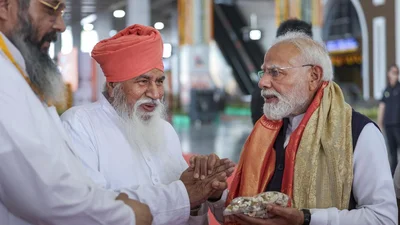
‘Prime Minister Narendra Modi’s meeting with the Dera Sachkhand Ballan Head Sant Niranjan Dass on July 17, 2026 in Jalandhar, indicate the BJP’s Dalit outreach attempt, which has yet again renewed the debate surrounding Dalit-centric politics’. File photo: PMO via PTI
The Scheduled Caste (SC) community of Punjab is close to 32% of the total population of the State, the highest in the country, yet they remain politically marginalised, having produced only one Dalit Chief Minister and that too for a brief period in the year 2021.
With elections due in early 2027 in the State, mainstream parties, including the Congress, the Shiromani Akali Dal (SAD), the Bharatiya Janata Party (BJP) and the Aam Aadmi Party (AAP), are once again courting Dalit voters.
While the SCs in Punjab are close to 32% of the total population, the Jat Sikh population is over 20%; yet since 1977, the State has not seen a single non-Jat Sikh Chief Minister till 2021, when Charanjit Singh Channi held the top post for a brief period during the Congress regime, indicating the political dominance of the Jat Sikh community. Before Mr. Channi, it was Giani Zail Singh who was the last non-Jat Sikh Chief Minister of Punjab between 1972-77.
Sharp divisions
Even as political parties continue to make efforts to garner their support, sharp caste divisions among SCs is believed to be among the key deterrents to their emergence as a unified force. Punjab’s SCs, like their counterparts in many other parts of the country, are not a homogeneous community. They are split into about 39 different castes, and are further divided by religions and mixed faiths that have taken the form of sects, popularly known as ‘Deras’.
While some of the SC Deras, such as the Ravidassias and Ad-Dharmi groups are well-off in terms of education and have attained upward social mobility, others, like the Balmikis and Mazhabis, are the ‘marginalised within the marginalised’. They are spread over different religions as well, including Christian, Hindu, Sikh, and independent religions. This prevents them from coming together as one community or working with a unified approach to make a forceful impact in politics.
Kanshi Ram, the founder of the Bahujan Samaj Party (BSP), tried hard to unite the different SC castes in Punjab politically, but when he didn’t see much success, he moved his focus to Uttar Pradesh instead. The inability of the BSP’s ideological plank to thrive in the socio-cultural terrain of Punjab, reinforces the argument that the Dalit community here remains far from being a unified voting bloc.
As the elections to the 2027 Punjab Assembly draws nearer, the beeline of politicians across party lines at different Deras in the State has already begun. Several leaders of all key political parties have been seen visiting different Deras in order to seek their ‘blessings’, which is aimed at garnering support and votes of the respective Dera followers.
Prime Minister Narendra Modi’s visit to Dera Sachkhand Ballan in Jalandhar on February 1 on the occasion of the 649th birth anniversary of Guru Ravidass, and his latest meeting with the Dera Head Sant Niranjan Dass on July 17, 2026 in Jalandhar, indicate the party’s Dalit outreach attempt, which has yet again renewed the debate surrounding Dalit-centric politics. Mr. Dass has recently been conferred the Padma Shri as well.
In 2023, Punjab Chief Minister Bhagwant Mann, along with AAP supremo Arvind Kejriwal, met Sant Niranjan and paid obeisance at Dera Sachkhand Ballan and laid the foundation stone of the Guru Ravidass Bani Adhiyan Centre. In August 2025, Mr. Mann again met the Dera head and laid the foundation stone for a Sewage Treatment Plant (STP) at Dera Sachkhand Ballan. These repeated visits only show the significance of Dalit voters.
Leaders from other parties, including the SAD and the Congress, have also been visiting Deras as the countdown to the polls has begun.
Appeasement politics
As per an academic estimate, in Punjab, Dalit voters have a high to moderate electoral influence in at least 55 Assembly constituencies of the total 117 Assembly constituencies.
While the division among the SCs has been one of the reasons behind their political marginalisation, over the years, political parties have often made what observers see as token gestures toward the Dalit community’s upliftment, rather than pursue genuine empowerment by sincerely implementing constitutional protections and reservation laws. Mainstream political parties have largely kept their focus on appeasement politics and have hardly nurtured any genuine Dalit leadership.
Published - July 22, 2026 01:15 am IST