(This is Part 2 of a series on what we can actually find on an exoplanet. Read Part 1 first.)
It's not hopeless, because the James Webb isn't the last telescope we'll ever build.
Next up on the docket of space launches is the Nancy Grace Roman Space Telescope, which will mostly run deep-universe cosmology surveys but will also, almost incidentally, pick out millions of exoplanets using a trick called microlensing. That only reveals that a planet exists, not whether it can support life, which is very cool but not our subject today.
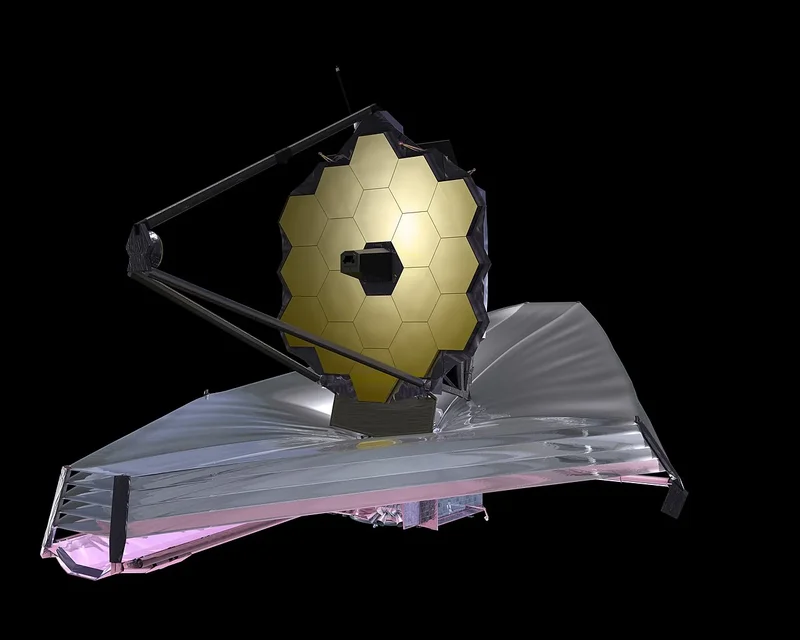
Our subject today is what comes after that: the Habitable Worlds Observatory. It'll surely be renamed after someone famous eventually, but for now it's a little more than a sketch in a notebook. The HWO is like a super-James Webb, and the James Webb was already a super-Hubble, which makes this a super-duper Hubble. And despite a planned mirror actually a touch smaller than the James Webb's, it carries one instrument that earns it the title of biosignature hunter: a coronagraph.
A coronagraph is a very simple device that has to be built almost impossibly well. It's basically a bit of metal shaped to blot out the light of the parent star while you look at the system around it. You know how you cover the Sun with your thumb to see something near it in the sky? It's like that, except that to reach the precision it needs, it actually uses a series of exquisitely shaped masks that exploit the wave nature of light. The starlight is made to destructively interfere with itself and cancel out at exactly the spot where the planet's light is slipping through untouched.
The whole point is to stop relying on filtered starlight to do our dirty work and instead get a picture of the planet itself, in all its reflected-light glory. And this is an undertaking, to put it mildly. To directly image an Earth-like planet around a Sun-like star, you have to pick out something roughly ten billion times fainter than the star sitting right next to it. Picture standing on a beach in California and trying to spot a single match being struck next to a lighthouse in Japan. The star is firing ten billion times more photons at you, at every wavelength you care about, than the planet is, and essentially all of the HWO's design effort goes into building a coronagraph that can pull the planet out of that glare.
The HWO is not a survey telescope. It's not a scanner. It's a hunter. Its stated goal is to find and directly image at least 25 potentially habitable worlds and take their pictures. Hubble was a general-purpose observatory. The James Webb was built for early galaxies first and exoplanets second. Every choice about the HWO, the mirror size, the coronagraph, the wavelength range, the stability requirements, was made with "find life on another world" sitting at the top of the list.
But to reach that kind of precision, to hit the contrast level where we can actually pick out the fine details of a planet's light, the mirror has to hold its shape to within picometers. That means the whole telescope, floating in space, buffeted by temperature swings and the vibrations of its own machinery, has to stay stiller than the jiggling of individual atoms. If you blew the HWO mirror up to the size of the continental United States, keeping it stable to picometers would be like holding that entire surface flat to within the width of a human hair.
I'll be honest with you: we don't currently know how to do this. That's why, even though it's about the same size as the James Webb, the HWO is a generation-scale engineering problem, and why it won't launch until the 2040s at the earliest.
Which is fine, because hunting biosignatures isn't only a technology problem. It's also a theory problem. Even with perfect data, we'd hit a wall, because to turn a spectrum into "here's how much of each gas is in this atmosphere," we need reference tables built from laboratory measurements and theoretical calculations: how much light does methane absorb at 3.3 microns, at what temperature, at what pressure, mixed with what other gases. These are called opacity models, because of course they are.
Imagine you're a bartender trying to identify a mystery cocktail by taste alone, except your recipe book was written by someone who tasted each ingredient one at a time, at room temperature, and never actually mixed anything. Now you're handed a drink that's been chilled, shaken, and blended with five other flavors. Your recipe book is technically correct, the best kind of correct, but the actual taste in your mouth is doing things the book never anticipated. Sometimes you can't even tell if that's gin or vodka.
That's roughly where we are with exoplanet atmospheres. We know how methane absorbs light at room temperature in a lab. We know how water does. We don't really know what happens when both sit at 700 Kelvin and ten atmospheres of pressure, mixed with hydrogen and traces of a dozen other gases, billions of molecules deep. There's so much uncertainty in these models that ten astronomers could look at the exact same spectrum and walk away with eleven different interpretations, some of them thrilling hints of life and some of them nothing at all. This is why we keep getting headlines about big biosignature discoveries, only for those studies to be quietly walked back a few months later when nobody's watching. The devil is in the details, and with biosignatures it is all details.
But we've got time, a couple of decades, to sort it out before the HWO starts pointing at planets and telling us what they're made of. And yes, you heard me right: about two dozen candidate planets, total. We're putting a lot of eggs in one basket, because honestly it's the only basket current technology gives us, and even that is stretching the meaning of "current technology."
And all of that, for our first pictures of potentially habitable worlds to amount to a single pixel of light.
Is that enough?
In Part 3, it turns out one pixel is enough for a shocking amount, as we learn to read oceans, continents, and even forests off a single point of light.