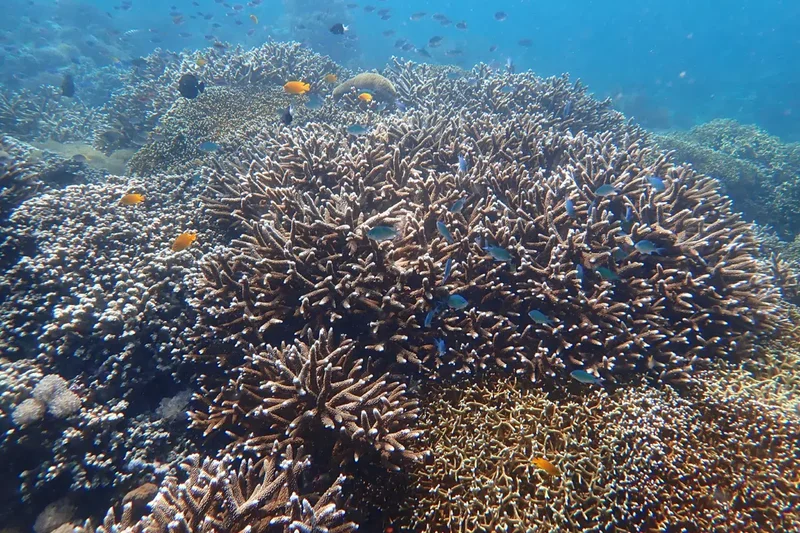
76% of coral reefs in Indo-Pacific at risk of drowning from rising seas in coming decades: NTU study
AI generated
SINGAPORE - Three-quarters of coral reefs in the Indo-Pacific region, which includes Singapore, could drown as sea levels rise, a study by Nanyang Technological University (NTU) has found.
Most corals will not be able to keep pace with the waters if sea level rise exceeds 5.3mm per year, a threshold that can be surpassed by the 2060s if greenhouse gas emissions continue to rise rapidly.
By 2023, global sea level rise has been around 4.5mm per year, according to NASA.
As Riovie Ramos, the study’s first author and research fellow at NTU’s Earth Observatory of Singapore puts it, rising sea-level is not the first enemy of coral reefs.
Longer term sea level rise compounds the threats the underwater gardens already face due to construction works at coastal areas and bleaching caused by marine heatwaves.
Although coral reefs are submerged, if sea levels rise faster than a reef’s growth, the reef will sit under progressively deeper water, a process scientists call reef drowning. Deeper waters tend to cut off sunlight, and corals’ survival is highly dependent on the amount of light available.
In Singapore, corals already live in murky waters, and any further reduction in light reaching them can be dangerous.
The loss of complex reef structures could also reduce the habitats available to fish and other marine animals, affecting fisheries, tourism and communities that depend on reefs for food and income, said NTU in a statement on Aug 18.
Kyle Morgan, an assistant professor at NTU’s Asian School of the Environment who led the research, said: “Reefs will become progressively submerged. They may still contain living corals, but they will no longer function in the same way, potentially allowing greater wave energy to reach the coastline and increasing (flood) risks to coastal communities.”
The study was done by tracing the histories of 288 ancient reef cores from 92 sites across the Indo-Pacific, including the Great Barrier Reef in Australia, Maldives and the Coral Triangle, one of the most biodiverse marine areas in the world spanning the waters of South-east Asia and the Solomon Islands.
Reef cores are metres-long cylinders of rock drilled from the reef base, made up of calcium carbonate. They preserve entire past coral histories. By calculating the dates of different sections of a core, scientists can reconstruct how reefs have built up over thousands of years and how the types of corals living on them have changed through time.
The NTU researchers calculated the coral fossils’ vertical growth rate across 11,700 years, which is the current geological era after the last ice age. These were done by scouring existing research and by studying some cores collected by the researchers.
Reef cores from Singapore were not included in the study.
To make future projections, the researchers identified the highest growth rate each reef achieved in the past and compared them to future sea level rise scenarios, said Ramos.
“Under the high-emissions scenario, the sea is projected to rise faster than 76 per cent of the studied reefs can grow, meaning they will likely be inundated by 2100,” added Ramos.
Thousands of years ago during the early Holocene period, reefs were often in a high growth state, allowing them to keep up with sea level rise.
“Today, reefs face repeated bleaching, ocean acidification, pollution and other stressors which reduce their ability to produce carbonate materials needed for vertical growth,” she noted.
The study’s findings were published in scientific journal Nature Communications in August.
The researchers also found that the changing landscape of coral reefs, with an increasing share of weedy species, could speed up reef drowning. Weedy species are small, fast-growing corals that can settle on disturbed reefs, but are poor at growing upwards, at 1.9mm a year.
“Weedy species are just like weeds on land - the grow fast and cover reef quickly but don’t provide meaningful structure or habitat,” said Morgan.
Ancient reefs, on the other hand, were made up of competitive, branching corals that grow upwards the fastest, at 4mm a year.
Conservation and reef restoration efforts cannot fully compensate for coral loss if sea levels continue accelerating, added NTU.
A 2023 study led by NUS marine biologist Huang Danwei found that in a high carbon emissions scenario, up to 10 per cent of Singapore’s corals could perish.
“These dead corals will not be able to contribute to future reef (growth) and thus further impact coral reef persistence over the next century,” said Huang, an associate professor and deputy head of the NUS Lee Kong Chian Natural History Museum.
Commenting on the NTU study, he said conservation efforts must be tailored to local reef conditions, which include water quality and the movement of water and sediments.
Stressing that the water quality of reefs should be improved, Huang said: “Allowing reefs to naturally recruit landward as sea levels rise would also reduce the overall loss of reef habitats.
“Unless emissions are meaningfully curbed and coral reefs actively managed, the processes that build coral reefs and the vital ecosystem services they provide will remain in jeopardy.”