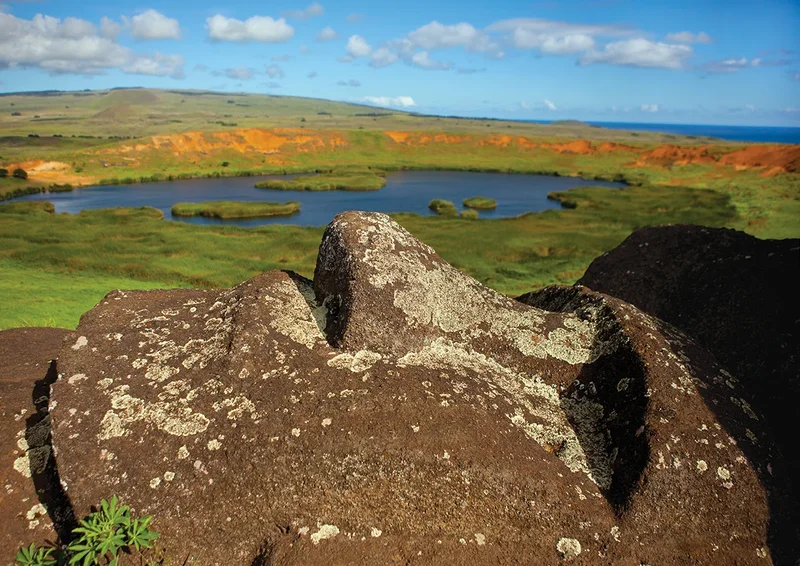
When surgeon J. Linton Palmer landed on Easter Island in 1868 onboard HMS Topaze, he found the marks of disaster. The island, known to its Indigenous people as Rapa Nui, was barely inhabited; little more than 100 people remained. Yet it was clear that there had once been a larger, organized society. Rapa Nui was dotted with stone statues of elongated human faces: “gigantic stone images,” as Palmer called them. Someone had carved, moved and raised them, but by the time Palmer arrived, that world had dwindled to almost nothing. Many of the statues “had been thrown down in all directions and were all more or less mutilated.” Something had gone terribly wrong.
For decades the story that many learned about Rapa Nui was one of environmental ruin. The people cut down their trees, degraded their land and squandered scarce labor on the construction of hundreds of statues, called moai by the Rapanui. Hunger followed. So did violence. Some versions of this story even invoked cannibalism. The moai became monuments to human folly: a warning from one small island to a crowded planet.
But recent research makes that version increasingly hard to defend. Archaeology, ancient DNA and aerial survey data now challenge the claim that the Rapanui suffered a self-inflicted collapse before Europeans arrived. The emerging picture is of a small society that sustained itself for centuries by adapting its farming methods and water management to one of the most isolated places on Earth. The catastrophe that reduced the Rapanui to a remnant came later, after European ships brought disease, slave raiding, forced labor, annexation and confinement. The old story now looks like an accusation that hardened into a conclusion.
On supporting science journalism
If you're enjoying this article, consider supporting our award-winning journalism by subscribing. By purchasing a subscription you are helping to ensure the future of impactful stories about the discoveries and ideas shaping our world today.
Rapa Nui lies in the southeastern Pacific Ocean, 3,700 kilometers west of Chile and 1,900 km east of Pitcairn Island, the nearest inhabited land. It is roughly triangular and measures just 23 km at its longest point. “You can walk across [it] in an afternoon,” says archaeologist Carl Lipo of Binghamton University.
Humans first reached Rapa Nui as part of the Polynesian expansion. About 3,000 years ago descendants of Austronesian-speaking voyagers entered Remote Oceania, settling Fiji, Tonga and Samoa within a few centuries. After a long pause, a second phase of voyaging carried people farther east into central and eastern Polynesia. Rapa Nui, the easternmost island in this dispersal, was permanently settled around C.E. 1200—although some researchers argue for earlier, perhaps intermittent human presence beginning around C.E. 800.
It was, and is, a tricky place to live in. “Rapa Nui is subtropical and not tropical as [are] the other Polynesian islands where the diaspora came from,” says archaeologist Annette Kühlem of the German Archaeological Institute in Bonn. “That makes a huge difference.” It gets less rainfall than most Polynesian islands, and that rain is erratic.
Another constraint was the island’s lack of large hardwood trees, which Polynesians used for building oceangoing craft. “That would be a very unnerving thing to discover, if you finally made it there,” Kühlem says. The island did have palm trees, which belonged to a now extinct species. But they were useless for sea travel. “You can’t make a canoe out of them, because they’re big, floppy things,” Lipo says. Once people arrived, they might have been more isolated than they had expected.
Written accounts of Rapa Nui begin with that of Jacob Roggeveen, a Dutch sailor whose fleet sighted the island on April 5, 1722. It was Easter Sunday, so Roggeveen called the place Easter Island. A few days later Roggeveen led a party ashore. Soon after they landed, his sailors opened fire, killing 10 to 12 Rapanui people. The Dutch departed that evening.
The old story now looks like an accusation that hardened into a conclusion.
What fascinated Roggeveen most about Rapa Nui were the statues. In his journal, he described “remarkably tall stone figures,” in front of which the people kindled fire and bowed their heads. The moai stood on stone platforms called ahu, many of them near the coast.
“At first, these stone figures caused us to be filled with wonder, for we could not understand how it was possible that people who are destitute of heavy or thick timber, and also of stout cordage, out of which to construct gear, had been able to erect them,” Roggeveen wrote. “Nevertheless, some of these statues were a good 30 feet in height and broad in proportion.”
He also described an island that complicates the later myth. Rapa Nui had rich soil, good weather and cultivated food. The island lacked large trees, but its people were not starving. The Rapanui were cultivating a difficult home.
By the time later European visitors reached Rapa Nui, the record had grown darker. Captain James Cook arrived in 1774 and encountered a far less hospitable island than Roggeveen had half a century earlier. He complained that “No Nation will ever contend for the honour of the discovery of Easter Island as there is hardly an Island in this sea which affords less refreshments,” adding that “Nature has hardly provided it with any thing fit for man to eat or drink,” that the sea was “barren of fish” and “the Natives are but few.”
Furthermore, one of Cook’s parties reported a striking detail: some of the moai had seemingly been thrown down. “On the east side, near the sea, they met with three platforms of stone-work, or rather the ruins of them,” Cook wrote. “On each had stood four of those large statues, but they were all fallen down from two of them, and also one from the third; all except one were broken by the fall, or in some measure defaced.” Almost a century later Palmer found virtually all the moai prostrate.
In the 20th century archaeologists confirmed that Rapa Nui had been deforested and its native palm had gone extinct. This gave rise to a narrative of societal collapse, which was popularized by Jared Diamond in his 2005 book Collapse: How Societies Choose to Fail or Succeed. In that telling, the first settlers began cutting down palms and other trees for agriculture to support the population, ultimately deforesting the entire island. Birds disappeared, soil eroded, farming faltered, and hunger followed. This scenario led to “starvation, a population crash, and a descent into cannibalism,” Diamond wrote, and the religion centered on the moai lost its hold.
Diamond’s version brought the ecocide story to a wide audience. In 2006 he visited the University of Auckland, where Mara Mulrooney, now principal and senior archaeologist at Pacific Legacy, Inc., in Kailua, Hawaii, was beginning a Ph.D. on Rapa Nui settlement patterns. She recalls Diamond standing onstage and asking, “I wonder what was going through the Rapanui person’s head when he cut down the last tree on Rapa Nui in or around 1680.” In her own work, she began looking more closely at the archaeological evidence behind that narrative. “The more I read, the more questions I had about this notion of ecocide or environmental degradation leading to societal collapse.”
Mulrooney wasn’t the only one. Lipo had been visiting Rapa Nui for several years by this point, as part of a project exploring the sociological motivations for building the statues. “We assumed, of course, that the collapse narrative was true,” he says, but the more he excavated, the less sense it made to him.
“What happened after the publication of Jared Diamond’s book Collapse is that archaeologists working in various regions kind of got up in arms,” Mulrooney says. In the two decades since the book, researchers unconvinced by the ecocide narrative have pulled at one part of the story after another: how the forest disappeared, how people farmed, how large the population became, whether those statues were really the wasteful burden they’d been made out to be.
A key discovery is that the Rapanui fed themselves for centuries by adapting their agriculture to thin soil, erratic rain and dwindling tree cover.
They had to improvise because their first decades on the island were marked by trouble. Initially the Rapanui relied on slash-and-burn agriculture, razing some of the trees to clear patches of farmland. On many tropical islands, such as New Guinea, this method can be productive if farmers keep the plots small and leave them fallow long enough: burned vegetation enriches the soil while trees elsewhere regrow. But the trees on Rapa Nui were slow-growing—the now extinct palms could take 70 years to fruit—so this did not prove sustainable.
People were not the only force changing the forest. Lipo and his colleague Terry Hunt have spent years gathering evidence, which they synthesized in work published in 2025, that the deforestation was accelerated by another factor: Polynesian rats (Rattus exulans). Whenever Polynesians arrived on an island, they brought these rats, Lipo says. “We don’t know whether they’re stowaways or if they’re intentional introductions,” he says. Regardless, people did eat them. Polynesian rats live in trees and like to eat palm nuts. “It’s rat candy.”
Rat remains are abundant in the island’s earliest archaeological deposits. At Anakena, a beach on the northern shore that has been excavated repeatedly, the oldest deposits contain hundreds of rat bones per square meter. “It’s crazy how many rats are down there,” Lipo says. Preserved palm nuts often show signs of having been chewed by rats.
With that food source and few predators, the rat population could have exploded. The palm nuts were especially vulnerable: rats gnawed through their shells and into the seeds, preventing new palms from taking root. The rats’ depredations, combined with people clearing land and the palms’ slow growth, left the forest little chance to recover.
Within a few hundred years the Rapanui people found themselves on an island with few remaining trees and with soil that was low in nutrients. So they adapted. They added stones to the soil, a process called lithic mulching. Essential chemicals such as phosphorus and potassium leached out of the rocks into the soil, helping to nourish crops. In 2013 a team that included Mulrooney showed that soils in these rock gardens had more nutrients than soils elsewhere. The stones also held the soil in place, reducing erosion much as tree roots would, and helped to reduce evaporation, Mulrooney says.
Cutting down Rapa Nui’s trees was not a senseless decision, Kühlem says. “With rising population numbers, nature has to make way for agriculture, especially on the most isolated island in the world.” At first the palms “were used as a shade cover,” with gardens planted between them. Later “the palm trees had to make way for more intensive land use” as the people relied more on the rock gardens.
Furthermore, Kühlem and her team have found evidence that the Rapanui actively planted palm trees. They conducted excavations between 2008 and 2024 at Ava Ranga Uka a Toroke Hau, near the center of the island. Near an ahu called Ahu Hanuanua Mea, people carved a planting pit into the bedrock, filled it with garden soil and planted a palm. This means the Rapanui were integrating palm trees into their religious architecture, much like the sacred trees nurtured on other Polynesian islands.
Ava Ranga Uka a Toroke Hau reveals another form of ingenuity: a system for controlling the island’s only seasonal stream. The visible remains included two massive walls reaching into the riverbed and the rim of what Kühlem describes as a megalithic water tank. Excavation revealed a larger system of dams, basins and even underground aqueducts channeling water from the crater lake on the Terevaka volcano toward the southern coast. To Kühlem, it represents “advanced hydraulic engineering”—deliberate resource management on an island where water was never guaranteed. A prolonged drought began around 1550, and this water-management system might have helped the Rapanui survive.
The rock gardens also speak to the scale of Rapa Nui society. In a study published in 2024, researchers used satellite imagery and machine learning to map rock gardens across the island. The analysis suggested that the gardens covered far less land than earlier estimates indicated and that they could have supported only a few thousand people, not the huge population invoked in collapse scenarios. The finding is contested; some archaeologists argue that satellite-based mapping may miss upland cultivation or gardens that left subtler traces. Still, the study sharpened the challenge to the ecocide story: the mapped agricultural system does not look like evidence of a society that ballooned to unsustainable size and then crashed.
Kühlem says that is the crucial difference. The ecocide hypothesis is “a story of people being too stupid to realize what they were doing.” Ava Ranga Uka a Toroke Hau and similar sites point instead to people “mindfully planning” and “making the best out of very difficult environmental circumstances.”
Even the moai, long treated as symbols of waste, look different under this evidence. Most of them were carved at a quarry at Rano Raraku, and hundreds were transported across the island. Lipo and Hunt have spent years figuring out how the Rapanui people did this—work that they drew together in a 2025 review and that weakens the claim that statue building required catastrophic timber use.
The pair found that moai left at the quarry or on roads have a pronounced forward lean. This makes it relatively easy to “walk” them along, a bit like shuffling a refrigerator into place, with ropes and a small team. Using 18 people, they walked a 4.35-ton replica moai 100 meters in 40 minutes. “The statues were carved to move,” Lipo says. Only when they arrived at their destination did the carvers reshape them to stand upright. This helps to explain how the Rapanui transported around 600 moai beyond the quarry: “Because they were good at doing it.”
The collapse story also requires a second disaster: mass hunger or violence before Europeans arrived. Archaeologists have found little trace of either.
Rapa Nui almost certainly saw conflict. “In all Polynesian societies, we know of intertribal warfare or interisland warfare,” Kühlem says. She says it’s unlikely that Rapa Nui was “that one haven of peace and harmony where none of that happened.”
What the record does not show is the islandwide breakdown described in the ecocide story. “There is no archaeological evidence of fortification,” says J. Víctor Moreno-Mayar of the University of Copenhagen. This is doubly striking considering the skilled stonework displayed in the ahu and moai. There are also no mass graves, no abundance of skull fractures or bones marked by stabbing and slashing. There is not even much evidence of weaponry.
In 2024 evolutionary geneticist Moreno-Mayar and his colleagues published a major study of ancient DNA from the island, using remains from 15 individuals held in the National Museum of Natural History in Paris. Radiocarbon dating showed that the remains were from a range of times between 1670 and 1950. All dated to after the supposed 1600s collapse; some also dated to after European contact.
Moreno-Mayar and his colleagues sequenced the DNA from the remains. A population crash large enough to define Rapa Nui’s later history should have left a detectable loss of genetic diversity. “They don’t have this expected telltale signal of the collapse in terms of their genetic diversity,” Moreno-Mayar says. Instead the team’s models suggest that the population grew slowly for centuries without becoming especially large.
The genomes held a second surprise. Threaded through the Rapanui DNA was a pulse of Native American ancestry, which the team dated to roughly 1250 to 1430—generations before Europeans reached the Pacific. The finding points to pre-European contact across thousands of kilometers of ocean, although the route and people who made the crossing remain a matter of debate. For an island so often cast as a marooned dead end, the result is striking: Rapa Nui was isolated but not sealed off.
Combine all these findings—the rock gardens, the water-management system, the lack of a population crash—and a different picture of Rapa Nui emerges: a small society adapting ingeniously to difficult conditions. “Jared Diamond characterized it as a story of failure, and I think that what we’ve learned is that it’s actually a story of success,” Mulrooney says.
The absence of a precontact collapse does not make Rapa Nui’s history any less brutal. By the 1870s, barely 100 Rapanui remained. The old parable falters in the gap between Roggeveen’s cultivated island and Palmer’s devastated one.
What changed was sustained contact with outsiders. Kühlem compares the arrival of European ships to a spaceship landing in medieval Rome. “That does something to a society,” she says. Cultural norms shifted; beliefs and ways of life were shaken. Then came the real calamities.
Introduced diseases such as smallpox and tuberculosis took their toll. “We know that Rapanui women were offered to the seamen,” Kühlem says, contact that brought sexually transmitted diseases with it. In 1862–1863 Peruvian ships ripped through Polynesia, and their sailors kidnapped people as forced laborers, effectively enslaving them, a practice called “blackbirding.” In losing people, Rapa Nui also lost knowledge, she says: “It’s usually the knowledgeable, the high-standing people that would go greet visitors, and so most of the knowledge holders were taken.”
In 1888 Chile annexed Rapa Nui, and later it leased much of the island for sheep ranching to the business interests associated with Scottish firm Williamson-Balfour Company. The ranching regime lasted until 1953. The Rapanui people were forced off their ancestral lands and confined to the island’s one town, Hanga Roa, which they could leave only with a permission slip. “The island was totally scoured by sheep,” Kühlem says.
This was the damaged landscape later researchers encountered. The problem was that they mistook the effects of colonial violence and ranching for evidence of an Indigenous society that had ruined itself.
Today the island remains largely grassland, and its economy is heavily dependent on tourism. But the COVID-19 pandemic had an unexpected impact. The regular flights from Santiago were halted, and Rapa Nui was quarantined. “The island was really shut down for almost three years,” Kühlem says.
And so the people of Rapa Nui started doing what their ancestors did. Fishers traded fish for crops. Farming expanded again, including in rock gardens. Erosion control and water management became central concerns. “Everybody was trading—there was reciprocity,” Mulrooney says.
The island now faces another threat. A 2025 study using high-resolution computer modeling suggests that as sea levels rise, waves could reach Ahu Tongariki, the island’s largest ceremonial platform, threatening the 15 moai that stand there and dozens of nearby sites. Once again Rapa Nui is being asked to absorb damage generated far beyond its shores.
Rapa Nui was never a paradise. It was a hard place to live in, and the people there knew it. Their story is a reminder of how easily a people and their history can be turned into someone else’s morality tale before the past has been fairly read.