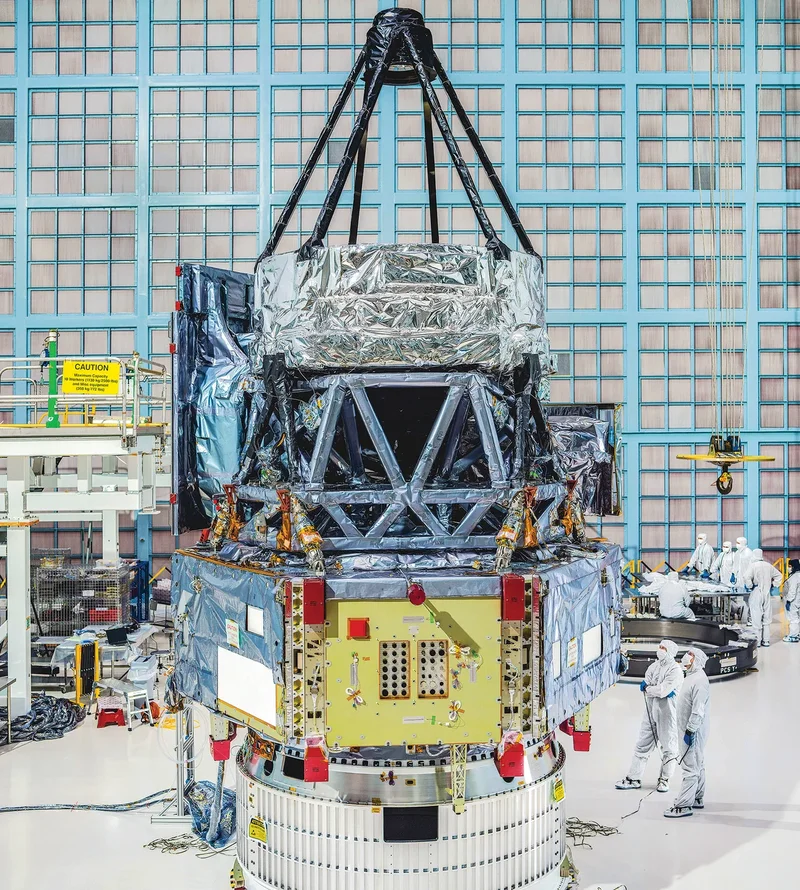
Alan Dressler stared in awe at the line of Hubble telescopes stretching out in front of him. It took NASA two decades to design and build its own Hubble Space Telescope, which transformed our understanding of the galaxies and stars after its 1990 launch. Now, standing inside a New York defense contractor’s clean room in 2012, Dressler faced an assembly line of Hubble clones. They weren’t astronomy telescopes. They were spy satellites of equal capability. And one of them was being given to NASA for free.
So begins the saga of the Nancy Grace Roman Space Telescope, which now sits in Florida, ready to launch on a SpaceX Falcon Heavy rocket within weeks. Roman will offer unprecedented knowledge of dark energy and dark matter, the mysterious components of the universe that explain our very existence. It will find more alien worlds outside our solar system than ever before, and it will also test a crucial technology that may one day reveal life on such worlds. It is, in the words of Julie McEnery of the NASA Goddard Space Flight Center and the mission’s senior project scientist, a telescope capable of “spectacular things.”
And the story of how Roman arrived at the launchpad is as amazing as the science it will perform. The observatory’s core was built to spy on America’s adversaries in a post-9/11 world. When that program collapsed, the National Reconnaissance Office (NRO) found itself with spare telescopes it no longer needed. Would NASA like any of them, officials asked? The space agency jumped at the offer.
On supporting science journalism
If you're enjoying this article, consider supporting our award-winning journalism by subscribing. By purchasing a subscription you are helping to ensure the future of impactful stories about the discoveries and ideas shaping our world today.
Roman’s story is not only a tale of important science and unlikely interagency cooperation but also one of unusual efficiency. It is set to launch under budget and ahead of schedule, a feat almost unheard of for complex astronomical observatories. “When we get things right and have success stories like Nancy Grace Roman, let’s learn from some of the magic that created that outcome,” NASA administrator Jared Isaacman said in an April press conference.
Not only did the spacecraft begin its life in a bizarre twist of fate, but it also has evaded death on multiple occasions. It’s a telescope that for many reasons simply shouldn’t exist, yet here it stands, ready to cast its eye onto the heavens. And in a way, its ultimate mission isn’t so far off from what it was built for. It will still be spying for secrets, after all—but this time, for the secrets of the cosmos.
At the end of the millennium, astronomers made a Nobel Prize–winning discovery that upended modern cosmology. Looking at exploding stars called type Ia supernovae, they found an odd pattern—the supernovae farthest away were dimmer than expected. Scientists had known for decades that the universe was expanding, but this new finding pointed at something even more remarkable: the expansion was speeding up.
To explain this acceleration, astronomers came up with dark energy, an invisible force or pressure that was driving galaxies apart faster and faster and accounted for more than two thirds of the universe’s mass and energy. Albert Einstein had predicted the existence of such an effect in 1917—he invented a “cosmological constant” to explain why the universe was static. He nixed it, though, after the discovery in the 1920s that the universe was expanding. About a century later his prediction is back on the table as a possible reason for the accelerating expansion.
Not only did the spacecraft begin its life in a bizarre twist of fate, but it also has evaded death on multiple occasions.
Solving the mystery of dark energy will require better observations of supernovae across the universe, plus measurements of the shapes and positions of as many galaxies as possible, which scientists will use to study the cosmic structure dictated by the other component of the universe’s dark sector—dark matter. By the end of the 2000s understanding this dark universe had become one of the highest priorities in astrophysics, and in 2010 the National Academies of Sciences, Engineering, and Medicine told NASA to build a telescope to study it in its Decadal Survey, which sets NASA’s priorities every 10 years.
That instrument was called the Wide-Field Infrared Survey Telescope (WFIRST). With a primary mirror measuring just over a meter across—half the size of Hubble’s—WFIRST would conduct a large survey of the sky to map the expansion of the universe and probe distant galaxies. From the start, however, it faced considerable opposition from astronomers who wanted NASA to expand the purview of the telescope, particularly to include exoplanet research, which was becoming the next big thing in astronomy. “We were having a hard time getting traction in the community,” says Dressler, now an emeritus astronomer at the Carnegie Institution for Science and one of the early leads on WFIRST. “They wanted to do something much more ambitious.”
At a 2011 meeting of the American Astronomical Society (AAS), Dressler and his colleagues tried to sell the plan. “That meeting was very controversial,” he says. “A lot of people thought we shouldn’t be wasting our money on this.” Much of NASA’s budget for building telescopes at the time was going toward the James Webb Space Telescope (JWST), which already had a projected cost of $8.7 billion and would balloon to about $10 billion by the time it launched in 2021. WFIRST, before it even got going, looked dead in the water.
So it came as a shock when David Spergel, a theoretical astrophysicist then at Princeton University and a scientific adviser to the mission, quietly pulled Dressler aside at the 2011 meeting and said that WFIRST might have an extraordinary savior—the NRO. The spy agency had spare telescopes it no longer needed, Spergel said, and had asked NASA if it wanted some of them. It was an unbelievable stroke of luck. Was it too good to be true?
In the 1990s the NRO launched a spy satellite project called Future Imagery Architecture. After the September 11, 2001, attacks, the agency doubled down on the program, aiming to build a new era of high-tech telescopes to gather satellite data on America’s adversaries. With Hubble-size mirrors, the telescopes would be able to see objects on Earth smaller than a coffee mug—a feat revealed in a 2019 tweet by President Donald Trump that showed an image of an Iranian rocket launch site from a comparable satellite.
But the project, contracted to Boeing, lagged behind schedule and ran over budget. An investigation by The New York Times found that the total price tag ran up to $13 billion more than its original projected cost of $5 billion. Officials decided to scrap the plan in 2005—but not before some of its hardware had already been constructed. That hardware was sitting in a clean room at a defense company called Exelis, later acquired by L3Harris, in Rochester, N.Y.
Michael Moore, then NASA’s acting deputy director for astrophysics, had been a liaison for the U.S. Air Force in the 1990s and heard from his contacts that some excess equipment might become available. He decided to try for a long shot. “When it became obvious that they were going to have some surplus hardware, I went to the program manager and asked about whether the systems would be available,” Moore says. “At that time, the answer was no.” But by the time of that 2011 AAS meeting, the decision had changed. “I got a call, and they had revisited their position,” Moore says. NASA could have some of the telescopes if it wanted them.
The spy agency had “identified surplus telescope assets that were no longer required” and “determined that our telescope assemblies met or exceeded the specifications NASA required” for WFIRST, according to an NRO spokesperson. So the agency decided to offer the mirrors to NASA—its garbage, essentially, was NASA’s gold. “NRO is proud that technology developed under NRO programs will contribute to groundbreaking discoveries.”
Astronomers met at Princeton University in the summer of 2011 to discuss what they could do with the telescopes. It quickly became clear that one of the scopes would be perfect for WFIRST. Not only would the repurposed spy telescope give WFIRST a mirror twice the size of the one in the original plan, but it would also enable the addition of an instrument called a coronagraph, which would let it block the light of distant stars to image nearby planets, appeasing disgruntled members of the exoplanet community.
The following year officials formally made their offer to NASA. An NRO representative traveled to NASA headquarters in Washington, D.C., and met in a secure room with John Grunsfeld, then the agency’s top science official. He was told that the clandestine agency had two partially disassembled Hubble-class telescopes up for grabs, each with a 2.4-meter (7.9-foot) mirror, and a third primary mirror with some spare components available.
Before long, Dressler, Grunsfeld, and other scientists and engineers traveled to Rochester to see the telescopes in person. They walked into a clean room to find a row of pristine mirrors—all near-replicas of Hubble. “It was beautiful,” Grunsfeld says. Their findings helped to convince then NASA administrator Charlie Bolden, who had the final say, to accept the offer.
In five years of observing, Roman will survey about 12 percent of the sky and image billions of galaxies.
It would still take considerable work to turn the spy telescopes into space telescopes. NASA would receive the 2.4-meter mirror, its supporting struts and a smaller secondary mirror but would need to strip the assembly of its confidential parts and build instruments and cameras. It would also, of course, need to launch the thing. Because of those extra costs, NASA later declined to take the other telescopes, one of which had a slight fault in its mirror.
The fate of the extra telescopes, and whether they are still in Rochester, is unknown. NASA, the NRO and L3Harris, which acquired Exelis in 2015, did not respond to questions about the equipment’s location.
Ultimately it would take more than a decade to transform the telescope from a spy satellite into a space observatory, with a final cost of about $4.3 billion. “Everything was probably taken apart and investigated,” says Dominic Benford, Roman’s program scientist at NASA headquarters. “We made it into what we wanted it to be.”
In 2016 NASA formally began the WFIRST mission and started development, with L3Harris keeping hold of the mirror in Rochester and getting the contract to complete the further work needed.
Even then, WFIRST was not out of the woods. “We had a lot of near-death experiences,” Spergel says. “It was canceled five times in the president’s budget,” he says—twice during the Obama era and three times in the first Trump administration. Each time, Congress elected to save the mission, with astronomers, including Spergel, traveling to Washington, D.C., to sing the praises of the telescope to senators such as Senator Chuck Schumer of New York. “I don’t think this would have happened without Schumer’s support,” Spergel notes.
To legitimize the mission once and for all, Thomas Zurbuchen, then head of NASA’s science projects, decided to name it. “By naming it, it basically becomes not cancelable,” he says. “You basically say, ‘We care about it a lot.’” Astronomer Nancy Grace Roman had passed away in 2018 at the age of 93. She had become NASA’s first chief of astronomy in the 1960s at a time when female astronomers were rare, and she was a key voice in driving support for space telescopes, particularly Hubble, earning her the nickname “Mother of Hubble.”
For Zurbuchen, Roman was the perfect namesake. He went to discuss the name with then NASA administrator Jim Bridenstine, who had attended Roman’s funeral. “I said, ‘The right name for this telescope is Nancy Grace Roman,’” Zurbuchen says. “He looked at me and said, ‘Do it,’” making it the first space telescope named for a woman.
Since then, the case for launching a telescope to study dark energy has strengthened considerably. New findings suggest dark energy might behave much differently than we thought. In fact, results published in 2024 by astronomers working with the Dark Energy Spectroscopic Instrument (DESI) in Arizona suggest that dark matter might be weakening. If true, the universe might not continue expanding faster and faster forever, eventually ripping itself apart. Instead it might one day start to contract, ending in a big crunch. Those results are “spectacular timing” for Roman, McEnery says. “It looks like we might be sitting on a gold mine.”
After it launches, Roman will travel to a position of gravitational stability one million miles from Earth called the second sun-Earth Lagrange point, where the James Webb Space Telescope is also located. Roman has a field of view at least 100 times bigger than Hubble and a much more capable 300-megapixel camera. Called the Wide-Field Instrument (WFI), it takes images so large a wall of 4K televisions would be needed to display each one.
In five years of observing, Roman will survey about 12 percent of the sky and image billions of galaxies. It will look for any warping of light from these galaxies caused by clumps of dark matter curving the intervening spacetime. By mapping this effect, called weak gravitational lensing, Roman will track the distribution of matter in the universe and thus its evolution through time. Another Roman survey will search for thousands of type Ia supernovae stretching back more than 10 billion years in the 13.8-billion-year history of the universe. It should detect more of these explosions dating further back in time than any other telescope, revealing how the expansion of the universe has changed across history.
It will also measure baryon acoustic oscillations, which are a kind of sound wave that sped through the universe when it was full of plasma in the first 380,000 years after the big bang. Discovered in 2005, these waves became frozen in time as the universe expanded, which should have led to an expected distance between galaxies of about 500 million light-years, according to predictions. Any deviation from this distance “tells you how the expansion of the universe is evolving with time,” says astrophysicist Neta Bahcall of Princeton. “That gives you a determination of dark energy and dark matter.”
Roman will also help narrow down what dark matter might be made of, says Anna Nierenberg, an astrophysicist at the University of California, Merced. Light from some distant galaxies will be magnified around closer massive galaxies and appear multiplied and elongated depending on the nature of the dark matter present in halos around the galaxies. Roman should find hundreds of these gravitational lenses, which it can use to rule out some dark matter models. “It’s going to be absolutely incredible,” Nierenberg says.
Roman will also be transformational for the study of exoplanets. One of its surveys will peer into the center of the Milky Way, the galactic bulge, which contains a very dense population of stars, and look for the gravitational tug of planets bending the light of more distant stars, called microlensing events. “It’ll use the microlensing technique to discover maybe a couple thousand planets both bound [to stars] and free-floating,” says Scott Gaudi, an exoplanet scientist at the Ohio State University. It should be able to spot worlds with as little mass as Earth’s moon.
It will also observe hundreds of millions of stars in the galactic bulge for any dips in light from orbiting planets, called transits, a technique that has already found the bulk of the 6,000 known planets today. Roman, however, “should find maybe 100,000 transiting planets,” says Gaudi, with sizes from Jupiter down to twice that of Earth, revealing multiple times more planets than have been seen in human history, giving us a broad sample of different planet populations across the galaxy.
But the coronagraph—that instrument exoplanet scientists had been clamoring for—might be one of Roman’s biggest legacies. Technically a technology demonstration—basically an experiment to see if it works—the instrument consists of a complex series of small disks, or masks, that will suppress the light of distant stars so that the extremely faint glow of orbiting planets is visible. The goal is to reduce the contrast of each star to one part in a billion—in other words, for every one billion photons from the star, only one leaks through to Roman. That sensitivity will allow it to image planets the size of Jupiter.
If it works, we may detect the reflected light of exoplanets around other stars for the first time. All previously directly imaged planets were so hot that we simply saw their own glow, says Mary Anne Limbach, an astronomer at the University of Michigan. With Roman, however, we could see cooler planets that merely reflect their star’s light, like the planets of our solar system do. It might even be possible to see ring systems around planets. “The light from the rings will be blended in” to the dotlike point of light from the planet, Limbach says, but it will be noticeable over time.
This instrument is a precursor to the coronagraph NASA wants to fly on its Habitable Worlds Observatory, a telescope set to launch in the 2040s with the goal of imaging 25 Earth-like worlds around nearby sunlike stars and probing their atmospheres for signs of life. To do this, it will need to reach a contrast of one part in 10 billion, says Beth Biller, an exoplanet scientist at the University of Edinburgh and part of Roman’s coronagraph team. That contrast should be enough to see the pale dot of a potentially inhabited world around another star.
All of this means that the first detection of life outside our solar system, if it occurs, might happen because of a Rube Goldberg–like sequence of events: a collapsed spy satellite project, a call out of the blue and an offer that revitalized a space telescope fighting for survival. For the American intelligence community, it was the end of a multibillion-dollar endeavor but for astronomers, it was the start of an entirely new one. “All I know,” says Marc Postman, head of the Science Mission Office at the Space Telescope Science Institute, “is that we got a good mirror.”