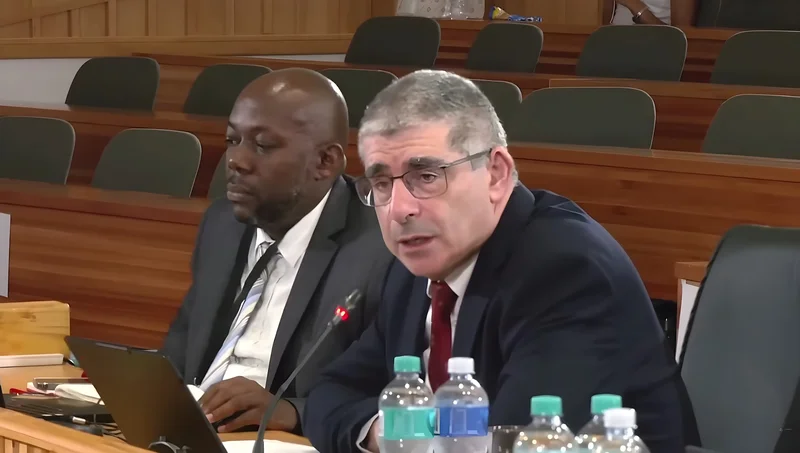
Evidence leader Matthew Chaskalson detailed WhatsApp exchanges involving taxi boss Jotham “King Mswazi” Msibi and Sergeant Fannie Nkosi in which they discussed an alleged plan to acquire and sell cellphone-interception devices, commonly known as “grabbers”.
The devices can be used to eavesdrop on phone calls and extract information from mobile devices.
Reviewing WhatsApp messages before the Madlanga Commission of Inquiry, Chaskalson said Msibi, Nkosi, Katiso “KT” Molefe and Steven Motsumi appeared to be involved in a plan to acquire the devices from a Czech Republic company using the South African Police Service as a front.
The devices were allegedly intended for sale in eSwatini.
Chaskalson referred to a planned demonstration involving phone expert Shaun Jacobs, during which the devices would be showcased.
“What will emerge is that Mr Msibi, Sergeant Nkosi and quite possibly Mr Motsumi and Mr Molefe … have a plan to sell grabber technology to the Kingdom of eSwatini,” Chaskalson said.
“Of course, that is not what the Czech Republic has been told at all. The Czech Republic has been told that this is a demonstration for the South African Police Service.”
The commission was shown correspondence relating to the proposed deal with the Czech company. Some of the documents contained official SAPS stamps.
Chaskalson said one of the WhatsApp exchanges from January 2023 involved a supplier saved on Nkosi’s phone as “Sean Jacobs — phone expert”, who had asked whether the “Swazi deal” was still on the table.
Nkosi had forwarded the message to Msibi, who replied: “It’s on the table but they have to display. We don’t want to become fools.”
Chaskalson said Nkosi had allegedly placed a SAPS stamp on a procurement document to facilitate the deal, which the evidence leader characterised as fraudulent conduct.
The commission also examined WhatsApp exchanges between Msibi and Kyle Phillips, a director of tobacco company Carnilinx.
The messages allegedly show Phillips seeking Msibi’s assistance after several thefts and hijackings involving cigarette consignments.
In one of the exchanges, a person identified as “Ali”, whom Chaskalson described as a suspected robber, communicated with Phillips about the return of stolen cigarette stock.
In another exchange, Phillips allegedly offered Msibi “red water”, a substance used in illicit gold processing.
Molefe has been implicated in allegations surrounding the murders of musicians DJ Sumbody and DJ Vintos. He is a co-accused with Vusimuzi “Cat” Matlala in a case that is before the Johannesburg High Court.
Further evidence shows Motsumi and Msibi planning a trip to Paris and Hamburg for a procurement meeting. They planned to buy an active monitoring system and tactical equipment to the tune of R1.16 million. Msibi was listed as owner of Themy Styles, a security company and Molefe as director.
“Again we have a situation where a European dealer in high-tech security surveillance security equipment and the like is being told Mr Motsumi was a representative of the state,” Chaskalson said.
“If we can take a step back and take stock of what we are looking at here because it is quite alarming … Mr Msibi, Mr Motsumi, Mr Molefe and possibly Sergeant Nkosi are involved in a commercial project which involves the selling of high-tech surveillance systems and jamming technology.”
Chaskalson said Crime Intelligence head Dumisani Khumalo had described Msibi as the former leader of the Big Five cartel, while Molefe was on trial for murder. Molefe’s firearms has been linked to more than 30 murder scenes in Gauteng in the past five years.
He said Motsumi was an individual whom the former head of Hawks, Lesetja Senona, had been afraid to mention during his testimony at the commission.
“These three men are dealing with foreign companies to get access to grabber technology purporting to represent the state,” Chaskalson said.
“They didn't manage in the first case to sell to the eSwatini government [but] they may well have managed in this instance; we don't know,” he said.
He said the group had been able to represent the South African state as civilians, allegedly due to their association with Nkosi.