[Today’s Iran war post launched before complete because I had to run out. It should be done by 8:00 AM EDT. Please return or refresh this page then for the final version]
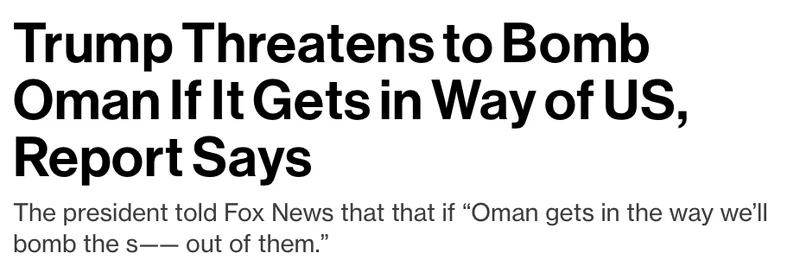
As the MOU expires, Trump is doubling down on his bad form of needing to dominate at any price. He made a threat against Oman for what appears to be “just because” reasons, like the stereotypical beta male who had a bad day at the office and kicks the dog when he gets home to vent his frustration. One has to guess what Oman’s sins are. Presumably they consist of daring to talk to Iran about the operation of the Strait of Hormuz even though the MOU clearly contemplated that.1 Perhaps Oman is also deemed to be somehow too helpful to Iran on the shipping front, as in undermining the corridor the US has set up on the Oman side of the Strait of Hormuz. That of course would contradict the US claims of the great success it is having in sneaking oil out under Iran’s nose (which we will also cover in due course).
In a telling contrast, the Wall Street Journal published a lead story which gives a surprisingly fair-minded account (by Western MSM standards) of why and how Iran is setting about to escalate.
As we will discuss soon, Marjorie Taylor Greene has also reported that Trump is considering the use of nuclear weapons.2 While I may be unduly hopeful, if Trump gets insistent, this may produce the military soft coup scenario we had discussed even before the war began, that the armed services start refusing to execute his commands. Keep in mind that all of the UN prohibitions against committing war crimes are also enshrined in US law, so there are clear formal grounds for rejecting illegal orders. Note we had also raised the possibility of a Trump analogue to Nixon’s Saturday Massacre, where Nixon fired Special Prosecutor Archibald Cox after first having Attorney General Elliot Richardson and Deputy Attorney General William Ruckelshaus refuse to remove Cox and resigned instead.
On the economic front, Scott Bessent oddly has not announced what his sanctions version of reducing Iran to the Stone Age plan. One of the bright ideas was secondary sanctions, as in targeting entities that did business with Iran. Perhaps China informed the Trump Administration that they could kiss the upcoming summit with Xi and/or all sorts of Chinese critical materials goodbye if the US tried anything cute, and Bessent is having to recalibrate? He has apparently moved his big shock and awe announcement back to next week:
🇺🇸🇮🇷 Sec. Bessent laid out how the U.S. is trying to financially dismantle the Iranian regime.
He said they’ve been going after Iranian bank accounts, crypto wallets and assets around the world.
One of the country’s largest banks already collapsed, forcing the central bank to…
— Mario Nawfal (@MarioNawfal) August 18, 2026
First to Trump’s hissy over Oman. From Bloomberg’s landing page:
Trump told Fox News in a phone interview that a US naval blockade on Iranian ports is putting pressure on the country and he has no timeline for resolving the conflict.
He also warned that if “Oman gets in the way we’ll bomb the s—— out of them,” without give any further details. He made a similar threat in May. Oman is negotiating with Iran on how the Strait of Hormuz should be managed, but the US isn’t part of those discussions….
Intensive talks are continuing, but reaching a deal has been time consuming because of security complexities and the “obstructionist behavior of destructive elements,” Iran’s Foreign Ministry spokesman Esmail Baghaei told reporters on Monday.
More detail from the Wall Street Journal in Trump Threatens to Bomb Oman if It ‘Gets in the Way’ of Iran Conflict:
Iranian negotiators have held talks with Oman in recent weeks over a provisional arrangement to manage shipping through the strait. Those talks are continuing, and yet to yield any tangible results.
Iran’s military has continued to fire at ships transiting the waterway without its permission, seeking to maintain its grip on commercial traffic. Unlike earlier in the conflict, when the U.S. retaliated against such attacks by striking Iranian targets along the strait, the U.S. has so far stood down, frustrating some Gulf allies….
Muscat’s efforts to act as a neutral broker in the Gulf has rankled U.S. officials who are increasingly interpreting the Omani approach as hostile to American interests.
Iran has launched a series of strikes on Omani sites since the start of the war, including drone attacks on ports used by the U.S.
In June, The Wall Street Journal reported that the Trump administration had threatened to sanction and bomb Oman after intelligence assessments concluded that Muscat was planning to join Iran in tolling vessels in the strategic strait. Oman has repeatedly denied such plans.
Iran is rubbing Trump’s nose in the US’ military shortcomings. Even if Trump never sees stories like this, many in the region and international community will. From PressTV in Source: Pentagon concedes no military plan can secure Strait of Hormuz as Trump seeks scapegoats:
Pentagon has concluded that no existing military plan can guarantee the safe passage of shipping through the Strait of Hormuz or ensure energy stability in the region, according to a regional intelligence source speaking to Press TV.
The assessment, shared by an intelligence official familiar with US military deliberations, paints a stark picture of Washington’s strategic deadlock in the Persian Gulf…
“The Pentagon’s assessment is that, at present, no military plan has the political and security capacity to guarantee the Strait of Hormuz remains open, ensure safe passage, and maintain energy stability,” the informed regional source told Press TV.
What is pretty sure to get some notice by Trump is a lead story at the Wall Street Journal, Wall Street Journal Iran’s Secret Plan to Escalate the War. Obviously, this plan s not a secret if it is the lead story in the Journal particularly since Iran has been saying for weeks that it intends to adopt a more aggressive posture. This article is nevertheless important in that, contrary to Administration regular invocations that Iran’s military has been destroyed and its economy is about to go tits up, it depicts the Iran fighting forces as effective and becoming more so:
Iran’s hard-line leaders huddled in Tehran and came up with a different plan [than seeing the MOU as a path to resolution], according to Iranian and Arab officials. In their view the pact was likely just an attempt by the U.S. and Israel to take pressure off the global economy and buy time for a bigger attack down the road. Instead of putting faith in talks, they took the past two months to prepare for a bigger fight.
Their efforts include giving the powerful Islamic Revolutionary Guard Corps more control of the country’s regular army, appointing hardened veterans of the war with Iraq and past internal crackdowns to key posts, expanding domestic counterintelligence operations and ramping up production of missiles and drones. The leadership quickly seized the initiative, attacking ships to tighten Iran’s grip on Hormuz and expanding the battlefield to the Red Sea, which Saudi Arabia has used to get around Iran’s chokehold on the Persian Gulf.
Arab intelligence officials have picked up evidence—including communications between Iran and militia allies in countries such as Yemen and Iraq—of a strategic shift inside the country’s hard-line leadership to get their forces ready to widen the war and raise the costs for the U.S., officials familiar with the findings say. Alarming weaker Gulf countries like Kuwait, Iran’s leaders are increasingly talking about offensive operations on enemy territory.
Their overriding goal is to inflict enough pain to ensure the kind of attacks Iran has endured with the 12-day war last year and the continuing conflict aren’t repeated.
“There is also a widespread view in Iran that the main war has not yet begun,” said Mohammad Hassan Sangtarash, a Tehran-based defense analyst close to the Iranian government. “What we have seen so far is increasingly interpreted through the lens of ‘salami-slicing’ tactics—limited, incremental escalation designed to weaken capabilities before a larger confrontation.”
The Iranian preparations point to an enormous gulf between how Washington and Tehran are perceiving this stage of the war. The divergence has driven a hard-line negotiating stance and reluctance to close deals by Iran’s leaders that has persistently flummoxed Trump, who has called them crazy and accused them of lying.
Iran’s readiness to fight also highlights a deep lack of trust that is likely to keep the two sides from reaching a durable deal to end the conflict any time soon.
Iran’s proclamations include plenty of bravado. The country’s military and economic base have been battered by U.S. and Israeli airstrikes. More pragmatic members of the leadership including Iranian President Masoud Pezeshkian have repeatedly warned Iran needs to negotiate a deal to end the war that brings sanctions relief or face the collapse of its economy.
But Iran is rebuilding its infrastructure and restoring access to missile bases much more quickly than expected, a concern to Israeli officials who are familiar with the progress. It also has successfully targeted U.S. bases and retains enough firepower to threaten ships and Gulf energy infrastructure. Arab officials are bracing for continued fighting and an extended disruption of energy supplies.
For the regime, “the baseline is war,” said Alan Eyre, a former senior U.S. diplomat and nuclear negotiator with Iran. “Iran will remain on a wartime footing, preparing for a subsequent attack.”
The normally negotiations-optimist Trita Parsi also sees the odds of a new hot phase as high:
Contrast these claims, which inherently cannot be verified with this section of a fresh discussion between Alastair Crooke and Judge Napolitano:
From Crooke via a lightly edited machine transcript:
They [the realists in the inner circle] tell Trump that this was the risk, that they would simply run out of weapons. Now it’s all shifted to an economic war and Bessent is producing these figures which really, I mean there’s no evidence of them at all.
He said the other day that there are 20 million barrels on one day were leaving the Hormuz Strait. Well, we can look at it. It and he suggested they had their transponders off and they went through American corridor. Come on.
This is ridiculous. The Hormuz Strait is 21 kilometers across. Do you think that you know that Iran with its radar systems and with its drones operating is not aware of which ships are are moving, Of course, they’ve been turning them back or or in fact hitting them during this period. I mean there are perhaps a few who have managed to slip through but you know the figures he’s suggesting what he’s doing is the same thing, a happy picture:
No, no, don’t worry about the oil situation. Oh, we can manage that. We’ll manipulate the market. We’ll keep it down at 87-97 dollars per barrel of Brent oil. We’ll keep it down so they won’t worry about gasoline prices going up. will manipulate the markets and we will also say, you know, suggest there’s no real energy crisis coming. It’s not really a crisis.
He said inflation will go down very soon because as soon as this crisis is over, inflation will be gone. And none of that is true. It’s just not borne out by any of the evidence. The really the real picture is the crisis in diesel and other elements of the middle distillates is here now. That is getting a shortage and of course it’s going to affect the prices of everything.
Now admittedly, Crooke’s views align with my priors. But I do find it very hard to believe that a whole passel of ships could be transiting on the Oman side without Iran knowing very well about most if not all of that activity.
The sunny picture of so many vessels getting through on the Oman side also seems inconsistent with the ongoing level of Iran attacks:
Iran has attacked a ship every single day for the last 16 days.
— HFI Research (@HFI_Research) August 18, 2026
It seems unlikely that so many vessels are successfully hiding from Iran. In addition, one would think a lot of ship operators and crews would be deterred. So that means the more likely state of play is some combination of fewer than the oil touts are hyping are making the passage, and/or Iran is electing to let some go through. Iran could want to avoid being overly aggressive with Oman given that they are trying to work out a scheme for operating the Strait of Hormuz. Another motive could be Iran not wanting to apply the oil and supplies tourniquet too hard right now so as to somewhat reduce harm to badly exposed nations.
The Ansar Allah-Saudi front continues to heat up. From CBS yesterday late morning Eastern time:
Yemen’s Houthi rebels claim attack on Saudi military ship in Red SeaYemen’s Iranian-backed Houthis claimed Monday to have targeted a Saudi military vessel and four accompanying military vessels off the coast of Mokha, Saudi Arabia, in the Red Sea.
Houthi forces “managed to target a military landing ship belonging to the Saudi enemy, along with four accompanying military boats in the Red Sea off the coast of Mokha, using a number of ballistic missiles,” Houthi military spokesperson Yehya Saree said in a post on X.
“The strike was accurate and direct, resulting in the complete burning of the ship, the sinking of a number of the boats, and the burning of the remainder,” he added.
The Houthis said several weeks ago that they would enforce a maritime blockade of Saudi Arabia’s Red Sea ports. The two sides have been at war since 2015, when Saudi Arabia intervened in Yemen’s civil war on the side of the Western-backed government, against the Houthis.
A ceasefire had been holding until last month, when the Houthis opened a new front in the regional war in support of their benefactor, Iran. Saudi forces last month joined with U.S. forces in airstrikes on Iranian-backed militias in Iraq.
Risk of ‘full-scale conflict’ in Yemen: UN
The UN rights chief voiced alarm Monday at the rising civilian toll of escalating hostilities in Yemen, and called for efforts to avoid plunging the country back into full-scale war.
“I call on all parties to de-escalate tensions and spare the Yemeni people from further misery. The Yemeni people have already suffered way too much from the devastating legacy of years of conflict, displacement and humanitarian crisis,” Volker Turk said.
“I urge all parties to halt immediately any actions that risk returning Yemen to full-scale conflict.”
The civil war in Yemen, which dates back to 2014, created one of the world’s worst humanitarian crises in the Arabian Peninsula’s poorest country.
Some important sightings. Iran was accused yesterday of attacking the office of the prime minister of Iraqi Kurdistan. A typical account from Agence France-Presse:
Iranian drones attack Iraqi Kurdistan PM’s officeTwo Iranian drones targeted the Iraqi Kurdistan prime minister’s office and the home of the autonomous region’s intelligence chief overnight, authorities said on Monday.
Masrour Barzani said that an investigation by the region’s counter-terrorism unit found that his “personal office and the home of the head of the Security and Intelligence Agency were targeted by Iranian drone attacks earlier today”.
“This is a dangerous escalation and a direct threat to the security and stability of the Kurdistan region.”
There were no reported casualties in the attack.
Iran has denied the claim:
Iranian FM Araghchi denies any Iranian attack on Kurdish PM office, says Kurdish friends should be vigilant against false-flag ploys. https://t.co/AeFc4ii2YX
— MenchOsint (@MenchOsint) August 17, 2026
The West hates Iran because Iran opposes this. Literally. pic.twitter.com/YVN6ShNcjh
— Seyed Mohammad Marandi (@s_m_marandi) August 17, 2026
5 — Upon the signing of this MOU, the Islamic Republic of Iran will make arrangements using its best efforts for the safe passage of commercial vessels with no charge, for 60 days only, from the Persian Gulf to the Sea of Oman and vice versa. The traffic of commercial vessels will immediately start, and considering the need for removing the technical and military obstacles, and demining by the Islamic Republic of Iran will be instated within 30 days. The Islamic Republic of Iran will conduct dialog with the Sultanate of Oman to define the future administration and maritime services in the Strait of Hormuz in discussion with other Persian Gulf littoral states in line with the applicable international law and the sovereign rights of coastal states of the Strait of Hormuz.
2 Apologies for not including this development in yesterday’s update. I had seen tweets with what were purported to be an MTG tweet….in lurid, non Twitter colors. At the time, I could find no such tweet on her account. About 10 hours after I had looked unsuccessfully on her account, I did then see it….timestamped 21 hours earlier. Had Twitter tried blocking that tweet initially?