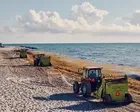
Dealing with seaweed is the bulk of Chris Bumpus’s job during the summer. As chief of conservation for Miami-Dade county’s parks, recreation and open spaces department, Bumpus is in charge of cleaning sargassum off 17 miles (27km) of county beaches. But some days, the odds are stacked against him and his team.
More and more sargassum, a kind of floating brown algae, has been washing up on the beaches of south Florida, west Africa, the Gulf of Mexico and the Caribbean.
Most mornings this time of year, a member of Bumpus’s seaweed crew walks on to South Beach around 7am to take pictures of piles of the stemmy, spicy-mustard-colored seaweed before a dozen tractors and specialized beach combing vehicles are put to work trying to integrate the sargassum into the sand or rake it out to be hauled away. “Back in July, the beach looked clean for about an hour,” Bumpus said. That month alone, 9,000 tons of seaweed were removed from Miami-Dade county beaches, more than ever removed in a single month before.
“Hopefully, by October it will die down,” he said. “July is always the worst. It’s been a heavy season.”
Before the cleanup begins, a crew has already marked any new sea turtle nests so they aren’t harmed by the sargassum removal. The county holds a permit with the Florida department of environmental protection for its employment of heavy equipment to corral the seaweed. The permit prohibits that equipment during turtle nesting hours, from 30 minutes before sunset until sunrise. So far this nesting season, about 700 sea turtles have built nests on county beaches.
Miami-Dade county spends $3m per year on sargassum removal, more than any other county in Florida, Bumpus said. The Florida Keys, however, can see heavier accumulations of sargassum because of the inlet-like shape of their beaches, he said. For centuries, sargassum has grown in the Sargasso Sea, a region of the north Atlantic encircled by ocean currents that keep the seaweed concentrated there. But in 2011, scientists saw the Great Atlantic Sargassum Belt form for the first time, stretching from west Africa to the Gulf of Mexico. Scientists say several factors contribute to the blooms, including nitrogen and phosphorus from rivers – such as the Amazon, Congo, and Mississippi – warmer water temperatures and ocean circulation.
Since 2011, the amount of sargassum has doubled every five years, as a result, larger and denser mats of sargassum have been washing up in Mexico, Florida and the Caribbean. This summer, satellite imagery showed the second highest amount of sargassum in the Great Atlantic Sargassum Belt at a whopping 33.5m tons, slightly behind 2025 when the seaweed biomass reached 38m tons.
The climate crisis has also played a role in the proliferation of sargassum, said Brian LaPointe, a research professor at Florida Atlantic University Harbor Branch, who has been studying sargassum since 1982. “As we see more ocean warming, we get more evaporation and that drives these extreme rain events that essentially flush more nutrients from land into the ocean,” he said. “So that’s an indirect effect that can increase nutrient supply to sargassum.”
Miami-Dade county first began efforts to address its seaweed problem in 2019. The county’s annual seaweed removal budget is funded by tourist development taxes paid by visitors who stay at hotels and short-term rentals. In July, Miami-Dade county commissioners voted to petition the state to allow the county more flexibility to use beach raking equipment in more areas.
“I think this year has been kind of a gamechanger in that we’ve seen major inundations here in south Florida, more than we’ve ever really seen in past years, and comparable to what’s been happening in the Caribbean, Mexico and the Dominican Republic,” LaPointe said.
In Mexico, President Claudia Sheinbaum announced a $115m national plan to combat sargassum, including employing ships that scoop the seaweed out the water. But federal and state agencies in the US prohibit sargassum removal in open-water because of concerns for the sea life that lives in the floating seaweed mats. But LaPointe said that could eventually change, as research in his lab is showing that sargassum loses much of its marine life as it deteriorates and approaches the beach.
Sargassum serves as a critical habitat in the open ocean, but that changes as it gets close to and comes ashore. “What we’re seeing is that as this excessive amount of sargassum comes ashore it’s affecting coral reefs and seagrass beds and creating dead zones, which strips the oxygen out of the water,” LaPointe said. “That’s why we’re getting these odors of hydrogen sulfide, which presents a human health risk.”
More aggressive seaweed removal efforts might be necessary, but these measures won’t address the underlying causes of increasingly massive blooms in the ocean, LaPointe said. “People are realizing this isn’t going away. It’s getting worse. It’s the new normal. It’s not only treating the symptoms but doing more research on the land-based nutrient sources that we can do something about,” he said.