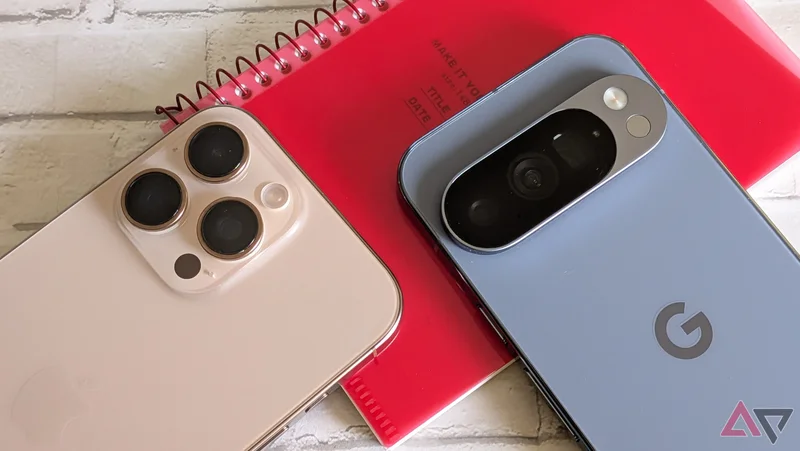
Ask an iPhone user why they'd never switch, and you'll likely get the same three answers. Texting is a mess. File sharing is a mess. And the magnet thing.
Those answers made sense if you stopped paying attention to phones sometime around 2023. We're well into 2026, and much of the smartphone discourse is reciting Android's flaws from an expired checklist.
Some of the loudest complaints were patched out while everyone was busy repeating them. So let's take them one at a time and see what's left.
The blue bubble war is over
Peace, with a few skirmishes left
This is the complaint that triggered a thousand group chat exclusions. Blue bubbles got high-resolution video, typing indicators, and encryption.
Green bubbles got whatever SMS could compress down to. But most of that complaint is over now, because Apple adopted RCS in iOS 18, and high-quality video and typing dots cross the platform line.
Even encryption, the last big asterisk, started rolling out to cross-platform chats this year, though it depends on both carriers playing along.
However, some spots are still patchy. For example, message editing and Tapback-style reactions haven't fully landed yet.
The AirDrop wall came down
And it stayed down
Someone at dinner wants to share a video. The iPhone people beam it to each other in two seconds, and nobody wants to be the one who figures out how to send it to the Android people.
Well, not anymore. This gap is closed, and it stayed closed. Google stopped maintaining three sharing systems that half-worked and shipped one that does.
Quick Share is standard on modern Android phones and is no longer a Samsung-only trick.
Then Google did what nobody expected and wired an AirDrop bridge into Quick Share. It debuted on the Google Pixel 10 and is now expanding to other Android phones.
Magnetic charging is available if your manufacturer bothered
Pixel said 'yes,' Samsung said 'sort of'
Wireless charging on Android used to take patience and fine motor work on a flat pad, all while Apple had MagSafe.
Qi2 brought magnetic alignment to the wider Android ecosystem, and Qi2.2 raised wireless speeds to 25W.
The difference is that Apple ships it across the lineup while Android manufacturers each decide for themselves.
Google put magnets in the Pixel 10 series for up to 25W magnetic charging out of the box, depending on the model.
Samsung went the other way with the Galaxy, supporting up to 25W wireless charging speeds but leaving the magnets out to keep the phone thin. You supply your own via a case.
So as you can see, it depends on your handset, which is a very Android thing. Still, calling it an iPhone advantage doesn't hold up anymore.
Find Hub answers AirTag but with conditions
Scale was never the problem
An AirTag can borrow a billion iPhones to find your keys, wherever they've ended up.
Google rebuilt its tracking network as Find Hub to answer it, running on a crowdsourced relay of roughly three billion Android devices.
But even though the raw numbers favor Android, the experience still doesn't. Apple opts users into Find My by default. Google makes you find out the setting to get the widest coverage.
Google also builds in anti-stalking delays and aggregates location pings, which is defensible but makes Find Hub noticeably worse at tracking.
For most people in most places, the gap has narrowed to the point of irrelevance.
Backups are still a sore spot
Developers decide your backup policy
Restore from iCloud and the new iPhone comes back as the old one. Logins survive, saves survive, and you don't spend an evening rebuilding your setup.
Android runs a restore that looks identical and then drops you onto a home screen full of apps that want to know who you are.
Android backup covers call history, SMS, contacts, device settings, and photos, and setting up a new phone reinstalls your apps from the Play Store.
Whether the data inside those apps comes with them is still up to individual developers.
Seamless desktop handoff is still Apple's crown jewel
Android's missing half
Apple writes both ends of the Mac-to-iOS connection, so Handoff and Universal Clipboard have nothing to negotiate. Copy on the phone, paste on the Mac, done.
Android can't match that without a desktop OS of its own, so everything ends up being a bridge.
Microsoft's Phone Link connects your phone to a PC, Google has deep ChromeOS hooks, and both work fine right up until they don't.
They're workarounds sitting on operating systems that were never built with each other in mind.
Time to update the talking points
If you live on a Mac, buy an iPhone and don't think twice about it. That gap is structural, and no bridge is going to close it.
The only fix is Google owning a desktop OS. It's working on that, though whether Aluminium OS turns out any good is anyone's guess.
Everything else on the envy list has either been solved or is close enough that it shouldn't drive a thousand-dollar decision.