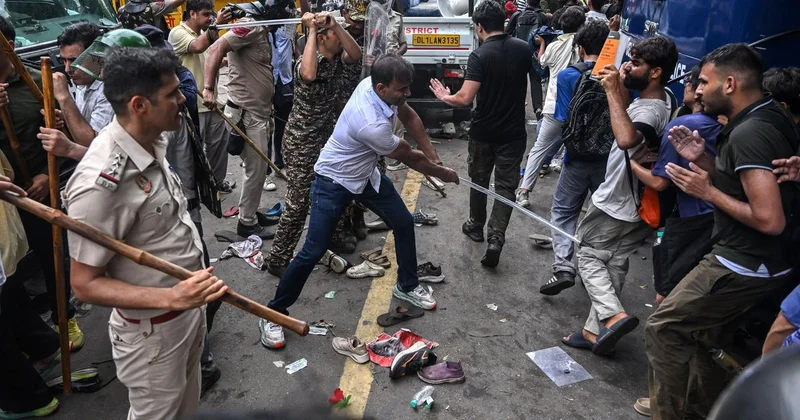
The Supreme Court on Tuesday said that it will set up a committee to look into alleged police excesses during last month’s youth protests and violence against security forces, Bar and Bench reported.
The committee will comprise a former judge of the Supreme Court, a former chief justice of a High Court and a senior retired police officer.
A bench of Chief Justice Surya Kant and Justices Joymalya Bagchi and V Mohana said that it will pass the order on Wednesday once it receives suggestions from different parties on other members to be included in the panel, PTI reported.
The court said it will order that videos and security camera footage of the violence during the July 20 march to Parliament be handed over to the committee.
“Whosoever is responsible, there can be no excuse and no justification,” Kant was quoted as saying by Bar and Bench. “It must be taken seriously and taken to its logical conclusion.”
The bench said that the committee would also look into allegations that female protesters faced sexual assault and online harassment.
The Supreme Court also said that it will consider using its extraordinary powers to quash first information reports against protesting students, but clarified that cases involving persons with criminal antecedents could be dealt with separately.
The court was on Tuesday hearing a batch of petitions alleging that the police used excessive____ ____force against protesters marching to Parliament in Delhi on July 20.
During the protest, several demonstrators were injured after the security personnel used lathis, fired tear gas and pellet guns to disperse the crowd.
The petitioners also pointed out instances of the police in Bihar using allegedly excessive force against protesters who were demonstrating in solidarity with the youth agitation in Delhi.
Delhi Police deny ‘mass surveillance’ allegations
The Delhi Police, in an affidavit before the Supreme Court, denied that it carried out mass surveillance with facial recognition technology at the Jantar Mantar protest site, The Indian Express reported.
The police maintained that their facial recognition system only captures individuals with prior criminal records and does not profile every person present at a gathering.
The affidavit was further quoted as saying by The Indian Express: “No actions are taken solely based upon the result of the facial recognition system, which is only the first step to identify a person in the crowd who has a criminal record.”
The police said that after facial recognition, field verification is conducted and action is taken if it is found that the individual was present at the protest site.
Solicitor General Tushar Mehta, representing the Union government, said that the police had identified more than 2,800 “anti-social elements” who had allegedly infiltrated the protests, PTI reported.
The Supreme Court had on July 28 directed that minors who had been detained during the agitation should be released and no coercive action should be taken against protesting students as long as they did not have any “criminal antecedents”. On August 3, it clarified that the term “criminal antecedents” in the order referred only to “grave and heinous offences”.
Edited by Nachiket Deuskar.
We welcome your comments at letters@scroll.in.