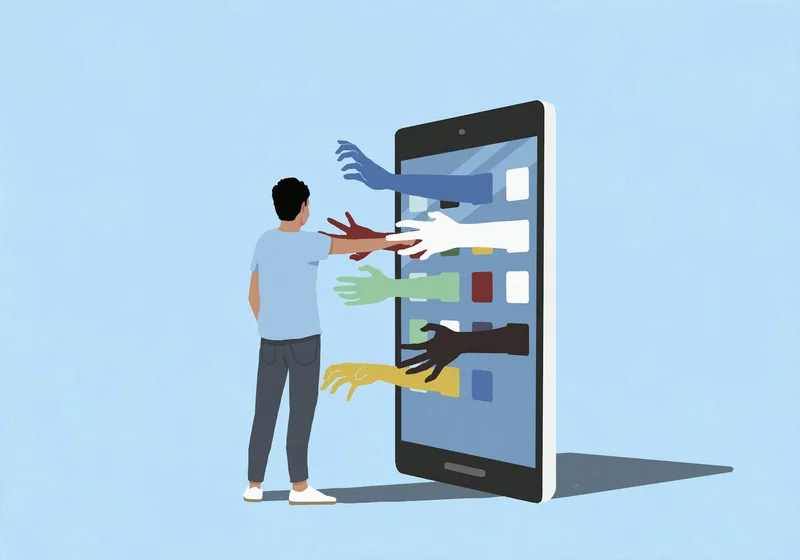
If given the chance to gain thousands of admirers for your work, would you take it?
The artists who my colleagues and I interviewed as part of our research on content creators did – and many went on to question whether it was worth it.
Mark, an illustrator with millions of followers, revealed a deep sense of dread about what was once his dream: to make a living creating art and sharing it online. (We used pseudonyms to protect the privacy of the people we interviewed.)
“The thing that I got right, that I loved for the longest time and now has almost become the bane of my existence, is creating relatable comics,” he told us. “Now, I’m stuck … I would rather die than make relatable comics, but I’ve built an empire of relatable comics. So what the (heck) am I supposed to do with my life?”
Ironically, the very thing that Mark felt he needed to fulfill his dream – a large, admiring audience for his illustrations – began to feel like a prison. No longer a distant or abstract entity, he now felt inextricably linked to his followers and their reactions to his work.
As an organizational psychologist, I’m convinced that Mark’s existential angst is not unique, nor is it relegated to content creators. Rather, it has profound implications for anyone who cares about the future of work.
Although the strange oppressiveness of collective adulation isn’t new, it is becoming far more ubiquitous – and insidious – in the attention economy.
A ‘chamber of despair’
The pursuit of fame for fame’s sake has become an almost banal pursuit in the attention economy. Content creation is, according to some estimates, a US$300 billion industry. Goldman Sachs projects it to grow to half a trillion dollars within the next few years.
Becoming a content creator has officially {elbowed out old standbys like doctor and astronaut as the job that Gen Z and Gen Alpha most aspire to have. Countless online courses now promise to teach the ropes of content creation, while Arizona State University will be offering a new content creation major.
And yet, the realization of this goal often comes with unanticipated psychological costs.
The 54 creators we interviewed as part of our multiyear research project – visual artists and musicians with massive online followings – repeatedly described the unrelenting sense they had of being oppressed or restricted by their audiences, using phrases that involved contorting themselves into two-dimensional versions of themselves.
One artist bemoaned that she had to “flatten and suppress her real self” to engage her audience. An illustrator revealed that she had felt like a “crumpled-up ball of paper” for years. An otherwise chipper cartoonist likened her audience to a “chamber of despair” that nobody else understands.
Over time, we came to think of this condition as “audience entanglement.” It’s a state in which creators become so psychologically intertwined with their followers that the audience begins shaping not just what they make – a phenomenon that has been referred to as “audience capture” – but also the meaning they derive from their work and how they understand themselves.
Audience entanglement plagued creators from all walks of life, regardless of age, gender or nationality. It struck musicians and illustrators, YouTubers and Instagrammers, self-proclaimed anxious wrecks and the freest of spirits. No single personality type or demographic was immune to the experience of a deep enmeshment with one’s audience, and to its profound consequences for their creativity and well-being.
Suffocated by a pressure to perform
Becoming entangled with one’s audience meant that followers’ reactions – whether positive or negative – often started to feel like a burden.
Creators described feeling hypersensitive to how their posts performed, and spending more and more time each day monitoring them.
Then there were the comments. As Selena, an illustrator, put it, a single mean message “would ruin” their week. While they recognized that they needed an audience to do the work they loved, managing it began to feel like a job in and of itself – and not one they signed up for.
At their lowest points, the creators we spoke to were not disrupted merely by the errant hostile comment. They described being unable to take in even the most effusive messages from their audience – the types of affirmations that had initially pushed them to begin creating in the first place.
One wildly successful creator, Maya, recalled receiving direct messages from fans that her art was the only thing getting them through death, divorce and other catastrophic life events. Maya experienced this profoundly positive feedback as being harder to handle than critique:
“I didn’t know how to really hold people’s pain in a meaningful way, and I was also getting really deep criticism – and, in a way, I could almost deal with that better than praise. It’s just a lot for a person to take on.”
As a result, many creators began to view this creative path they had once wanted more than anything as totally unsustainable. There was a tragic irony to this pain. The very thing that made their creative work possible – a large, mostly admiring audience – was also its biggest threat. The audience that allowed them to monetize their creations in the first place had now led to creative paralysis.
Healthy boundaries, intentional engagement
Not everyone we spoke to remained forever imprisoned by their so-called fans. For some, the intense enmeshment they experienced eventually morphed into something healthier.
The creators who shifted toward this dynamic did not stop caring about their audiences. Instead, they learned to develop clear boundaries around audience interactions and clarity on who they wanted to be online – what we called “entanglement management strategies.” By limiting time and energy engaging with the platform, they were able to escape the prison of their fans and once again find meaning and a sense of authenticity online.
As Charlie, an illustrator, explained:
“There is something about hitting this true internal place where, it’s kind of a mystical thing, but some balance between being yourself internally and being yourself externally. There’s some sweet spot there where you know what your audience is and what they expect, and you know where you as a person or creative person overlaps.”
Having spent the better part of two decades researching the psychology of work, I believe that audience entanglement doesn’t just happen to full-time influencers.
The ability to cultivate and manage an online audience has become an essential skill in more traditional professions, like journalism, politics and higher education, with large followings sometimes becoming a prerequisite for, versus a consequence of, success.
Most people will never have a thousand – let alone millions – of followers. But they’ve probably felt some hints of audience entanglement in their relatively banal online lives: the addictive siren’s call of rechecking a post as the “likes” roll in, or an idyllic afternoon with your kid ruined by a snarky comment from an internet stranger.
While countless influencers offer tips for growing online audiences, little training exists for how to actually deal with managing the stress of having large followings.
Previously, only the truly famous – actors, rock stars, pro athletes – were at risk of experiencing the anxiety of public scrutiny.
Now, many of us are just one viral post away from its grasp.