CASABLANCA, Morocco (AP) — Ayoub Akbili needed money for his mother’s surgery. Hamza Haibouri wanted a shot at a professional soccer career. Abdelouahed Iken was chasing the glossy life a friend posted about on Facebook from Italy.
So when they heard rumors that Morocco’s border with Spain was open, they decided to join the rush to try to reach Europe.
All three died attempting to cross, becoming victims of the deadliest migration crisis between Morocco and Spain.
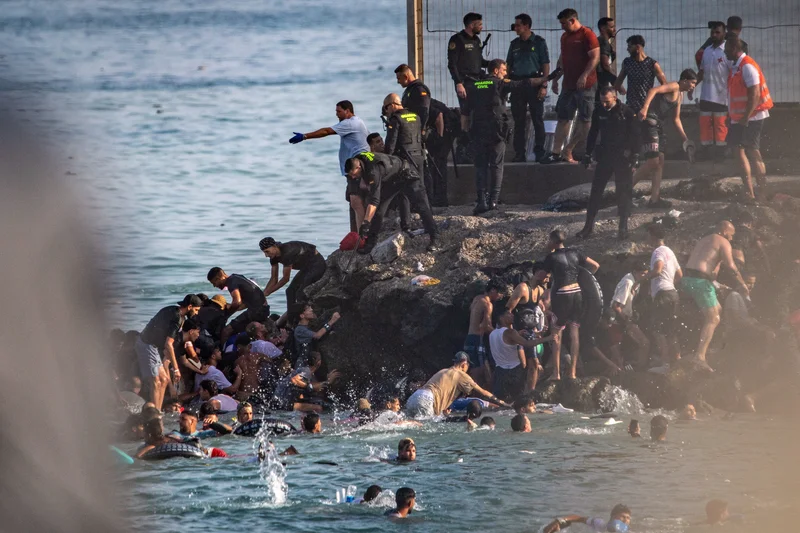
Fueled by misinformation, poverty and lack of opportunities, more than 70,000 would-be migrants from Morocco and beyond swam or climbed over a breakwater last month to try to reach Ceuta, a Spanish territory on the North African coast. At least 90 people died attempting to cross the border, according to official figures; rights groups reported a much higher toll. Many families still haven’t been able to retrieve the bodies.
Nearly all the survivors have returned to Morocco, and both countries have intensified security measures. Moroccan and Spanish authorities blamed social media rumors and human smuggling networks for the surge, while migrants cited unemployment and low wages as major factors.
The pull of the crowd
Akbili, 31, lived in Tangier, about an hour from the coastal Moroccan town of Fnideq. Migration had been on his mind for some time, but friends and family said he had never considered crossing illegally.
He held a college degree in physics, but couldn’t find a job in his field and worked at a car parts factory. He earned about $421 a month, slightly above the median salary in the North African country.
Buoyed by ambitions to become a regional hub for the auto industry, Morocco’s economy is expected to grow by 4.5% this year. But policymakers face a persistent challenge: turning that growth into jobs that offer higher wages.
Akbili was working the 2 p.m. to 10 p.m. shift when he saw Facebook posts about people crossing into Ceuta. He wanted to try his luck in hopes of finding a job that could help his mother pay for hernia surgery.
“His mind changed completely. He went from someone who wasn’t thinking about illegal migration to wanting to go by all means,” Abdelhakim Saadaoui, a relative and Akbili’s apartment mate, told The Associated Press.
Akbili persuaded Saadaoui to go with him. On July 31, they paid a driver $129 to take them near the border with Ceuta — the equivalent of two months’ rent.
When they arrived, Saadaoui said, there was complete chaos. From a distance, the crowds looked like ants, he said, as streets filled with people heading toward the frontier. Police fired stun grenades and tear gas in an attempt to disperse them, he said.
Saadaoui decided not to continue. Akbili went on. The two remained in contact by phone.
Then Akbili stopped answering.
A Moroccan Interior Ministry document obtained by the AP says Akbili died at midnight on July 31. His death was classified as “unnatural,” attributed to “severe head trauma.” He was buried in his hometown of Khenifra.
His family was told he died after falling from a cliff. The Interior Ministry said one of the 11 deaths recorded on the Moroccan side was caused by a cliff fall.
But a cousin suspects foul play and wants further investigation.
“His phone and wallet stayed intact. How is it possible for someone who fell from a cliff?” Zakaria Akbili told the AP.
Hamza Haibouri, who played soccer for Morocco’s second-division Kenitra Athletic Club, was buoyed by dreams of making it big playing in Europe, said his childhood friend Bilal Ratib.
The 28-year-old Haibouri was vacationing in Martil, a Moroccan beach town about 25 miles (40 kilometers) from Ceuta, when he saw people heading there and decided to join them. His death in the frenzied attempt to cross was announced by the soccer team’s fan club.
Ratib said Haibouri visited France when he was young and had always wanted to return.
“He always had this idea of living abroad and going to France, to get better soccer and a better life,” Ratib said.
“He was a great man, even when we were young and reckless, he would always go to the mosque early for the first prayer,” Ratib said. “He was deeply religious.”
Haibouri, whose income came entirely from soccer, earned around $540 a month when he played, but he hadn’t played at all this year, Ratib said.
Families learn of deaths through Facebook
Abdelouahed Iken, 19, was finishing high school in the southern city of Agadir. He regularly admired photos on Facebook posted by a friend who had migrated to Italy.
When he heard rumors the Ceuta border was open, he asked his mother for money to travel to his home village.
But instead of going home, Iken traveled more than 530 miles (850 kilometers) north to Ceuta with friends, according to family member Housine Zligui. Zligui said he learned about Iken’s death on Facebook, and the family is now working to bring his body home.
Iken could not swim, so he bought a life jacket for the crossing. Friends who returned told the family they saw him struggling in the water before he drowned, Zligui said.
For many Moroccans, Europe represents the possibility of work, stability and a better future. Those who make it abroad often return home with designer clothes, cars and euros, becoming symbols of success — and envy.
Money sent home by Moroccans living overseas reached $6.6 billion in the first six months of this year, according to government figures, equivalent to more than 3% of the country’s GDP.
Families asked to pay huge repatriation costs
Families were asked to pay some 2,500 euros ($2,900) in repatriation costs to bring the bodies of their loved ones home from Ceuta, according to Ratib and Zligui.
The AP was unable to confirm the cost. But repatriating a body from Spain to Morocco generally requires authorization from the Moroccan Consulate and a Spanish mortuary transit document. Moroccan rules typically call for a sealed coffin and a certificate confirming the death wasn’t caused by a contagious disease.
A spokesperson for Ceuta’s government said Friday the paperwork to repatriate the bodies of those who died in the crossing was complete, but Morocco’s government had not accepted it. The Moroccan government did not respond to an AP email with detailed questions about what was holding up repatriation, who was responsible for covering the costs and whether the Moroccan government would assist families in paying to have their loved ones returned.
Autopsies on 82 migrants brought ashore in Spain have been completed, said Manuel Aparcero, director of Ceuta’s forensic team.
Haibouri’s sister underwent DNA testing so that Ceuta authorities could confirm her brother’s identity. Authorities in Ceuta gave Haibouri’s sister his identification card and driver’s license but did not allow her to see his body, Ratib said.
“It will take around 20 days or more” for the body to be returned, he said. “You can’t imagine the families’ suffering.”
The Trade Union Network for Migration in Morocco called on Morocco and Spain to cover the costs of returning the dead to their families.
Back in Tangier, Saadaoui moved in with co-workers. He couldn’t bear living without Akbili.
“He was telling me at the border, ‘I will never come back,’” Saadaoui said. “And indeed, he will never come back.”
Associated Press journalist Suman Naishadham in Madrid contributed.