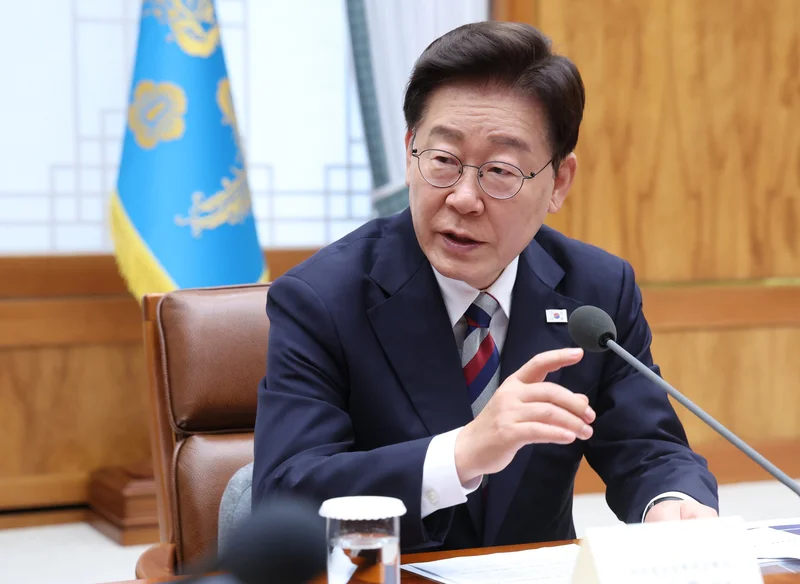
South Korean President Lee Jae-myung will host Chinese Foreign Minister Wang Yi in Seoul this week, his office confirmed Tuesday, as Washington steps up overtures to a key Beijing ally, North Korea.
The meeting is set to take place after U.S. President Donald Trump claimed North Korean leader Kim Jong Un had responded to his recent overtures, praising his relationship with Kim.
China, Washington's chief geopolitical rival, is a key diplomatic and economic backer of North Korea, while also remaining the South's largest trading partner.
"President Lee will discuss the future direction of South Korea-China relations and the regional situation and convey his greetings to Chinese President Xi Jinping," Seoul's presidential Blue House said in a statement, adding the meeting will take place Thursday.
Wang will also hold talks and have lunch with National Security Adviser Wi Sung-lac and meet Foreign Minister Cho Hyun, the statement said.
Wang and Wi will discuss South Korea-China ties and regional and global issues, including "the situation on the Korean Peninsula," it added.
Asked by reporters about the visit, China's Foreign Ministry declined to confirm any plans.
Trump abruptly announced Sunday that he had ordered the Pentagon to scale back "inappropriate and hostile" military drills with South Korea, alarming U.S. allies in the region.
North Korea's Kim has recently sought to enhance his standing with his allies, sending troops and munitions to aid Russia's war against Ukraine.
Earlier this year, he also hosted China's President Xi Jinping in Pyongyang, soon after Xi had held back-to-back summits in Beijing with Trump and Russian leader Vladimir Putin.
Neither Pyongyang's nor Beijing's official statements following those meetings mentioned the issue of North Korean denuclearization – an outcome experts interpreted as tacit acceptance from China.
Lee at the weekend proposed talks with the North to formally end the Korean War and in July Seoul's unification minister said it had shifted from prioritizing denuclearization to halting the expansion of Pyongyang's nuclear activities.