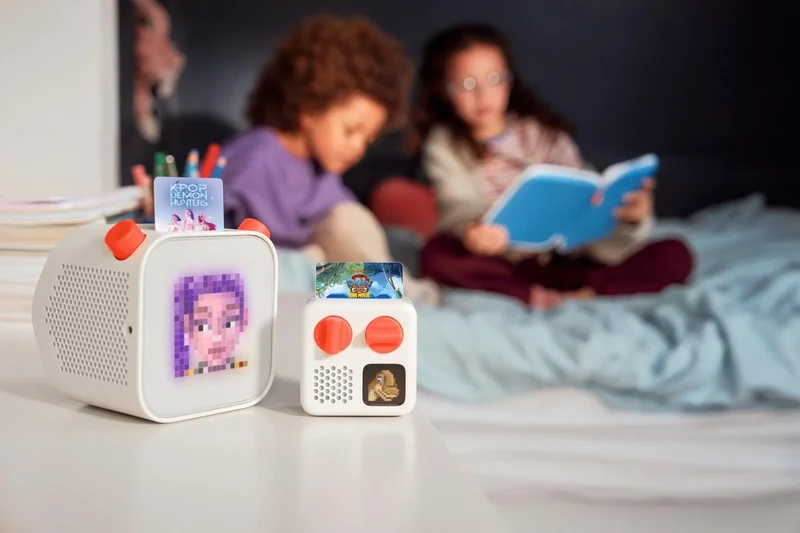
Yoto, the audio platform that lets kids explore stories, music and learning, is expanding its footprint at Target Corp. and moving from the electronics aisle into Target’s Play section nationwide. It’s a significant move, considering families shop for enriching kids activities in the Play area. Yoto will have live demo units and an expanded card assortment at the retailer.
Yoto early this year went live on Walmart.com. Ben Drury, Yoto’s cofounder and CEO, said the brand will continue to expand its relationship with Walmart. It also launched this month at Indigo in Canada. In the U.K., Yoto is sold at Tesco and Sainsbury’s.
The company’s five core markets are the U.S., Canada, the U.K., France and Australia. “We’re seeing people using Yoto in lots of countries around the world,” said Drury. “We would love to be in other markets like Asia and the Middle East, but it’s not so simple as just launching, we need local contacts, licenses and distributors.”
Breaking Into Retail And Scaling
The brand in 2020 came to the U.S. during the height of the COVID 19 pandemic. “Because we launched during COVID, we were a little late to the retail party,” said Drury. “Now, it seems like we’re getting a little traction. Yoto is starting to be demanded in stores. There’s many more retailers we can work with.”
The company’s financial performance underscores its momentum. Yoto posted $127 million in revenue in 2024, EBITDA positive for the past three years, including 2025. It’s had significant double-digit growth in 2025.
With more than 1,000 audio cards and counting, Yoto users logged over 22 billion minutes of listening time last year. To meet demand, Yoto has almost doubled its card assortment at Target, adding best-selling IP such as K-Pop Demon Hunters, Frozen and Minecraft.
Capitalizing On Adverse Response to Screens for Kids
Yoto is riding a wave of backlash against screen use by children. Families are redefining what counts as a childhood essential product compared with just another gadget and a major retailer is validating that shift commercially by expanding Yoto’s space in-store just as it heads into the holiday season, its biggest shopping stretch of the year. Back-to-school is a key season for Yoto and of course, Target.
“What’s happening overall is positive for us,” said Drury, who is betting on restraint in a category where most consumer technology is built around screens and engagement loops. “There’s been this debate around delaying smart phones for kids. People say, ‘Don’t get a kid a smart phone until they’re 16.’ They’re banned in [some] schools."
**Double-Digit Expansion Estimated For Market **
The global kids audio player market reached $1.43 billion in 2024, reflecting robust growth driven by increasing demand for child-friendly audio solutions. The market is projected to grow at a compound annual rate of 11.2 percent to $3.73 billion by 2033, according to Growth Market Reports.
One of the main factors sparking growth in the children’s audio player market is the intensive focus on early childhood development. Parents and teachers are increasingly understanding the significance of cognitive and linguistic development in a child’s early years.
The significant expansion of the market over the next seven years is also attributed to technological advancements, increasing parental awareness about the harmful effects of screens and the incorporation of educationational content into players or audio cards.
Drury’s Own Kids Inspired The Concept
To trace Yoto’s origins, Drury goes back to his own kids, now aged 11 and 12. “They really were behind the inspiration originally,” he said. “My cofounder and I were working together at my previous startup, Seven Digital, a B2B digital music company that we took it public with a small IPO in the U.K.
“At around the same time, I had kids,” he continued. “We were just so passionate about audio and listening to music and audio books. We were just riffing on this idea of giving our kids access to this wonderful world of audio, but without having to put them in front of an iPad or a bright screen or even an Alexa-type device. We didn’t think that was suitable for a one-year old.”
“We’re an audio-based device so you can listen while you’re doing something else,” Drury added. “We get a lot of listening at mealtimes, at bedtimes and a lot of listening in the morning.
Focusing On Original Content And Human Talent
“One thing that makes us really popular is that you can create your own content, so families, it could be parents or grandparents, create content to help a kid learn a musical in instrument, for example, or learn their part in a school play,” Drury said.
Yoto invests millions of dollars a year in original content, using human translators and real orchestras – sometimes as many as four at once – original scores and full cast recordings. “We can’t just throw AI at it,” Drury said. “We’ll continue to do this. Even as AI becomes increasingly prevalent, we’re actually doubling down on original and human-based content."
“It’s a race to the bottom the other way,” he added. “It’s like commoditizing content. It just becomes generic. Hopefully we have the right strategy.”