U.S., Iran each dig in on Strait of Hormuz positions as their tenuous pact officially expires
While the warring sides haven't launched new strikes, a ship in the Hormuz was reportedly struck
President Donald Trump on Tuesday said the U.S. has no planned talks with Iran, and none were scheduled, as Iran's top negotiator said the Strait of Hormuz will remain shut until the U.S. meets the conditions of an interim deal inked in June.
The June deal, known as the memorandum of understanding, called for a halt to all military operations and set a 60-day deadline for an agreement to permanently end the war and resolve the longstanding dispute over Iran's nuclear activities. That period lapsed on Monday.
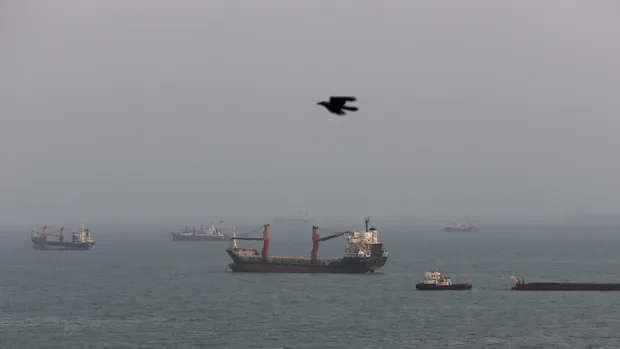
The two sides offered differing versions of reality on Tuesday, with Trump asserting on Truth Social that the strait was "open and operating," with all Iranian mines in the body of water "removed or detonated." Commercial traffic in the Hormuz has slowed to a trickle compared to activity before the U.S. and Israel launched strikes on Iran to begin the war on Feb. 28.
In an earlier post, Trump posted an image of a manufactured map that showed the Strait of Hormuz as "New U.S. Territory." Last month, as hostilities picked up again, the U.S. reinstated a naval blockade it first implemented in April, restricting all maritime shipping to and from Iranian ports in mid-July.
Iran's parliamentary Speaker and negotiator in previous talks with the U.S., Mohammad Bagher Qalibaf, reiterated Tuesday that Tehran plans to maintain its grip on shipping traffic until Washington meet Iran's conditions.
"Until the United States fulfils its commitments under the agreement, including lifting the blockade, releasing frozen assets, lifting oil sanctions, ending threats and military operations on all fronts and implementing the other conditions to which it committed, the Strait of Hormuz will not reopen," he said in comments published by state media.
Ship struck in the Hormuz
The June memorandum called for the Strait of Hormuz to be reopened but gave Iran a vaguely defined role in facilitating traffic, leaving open the possibility it could charge fees after the 60-day deadline. Iran has seized on that clause to claim control over the waterway, through which about one-fifth of the global oil and liquefied natural gas supply flowed before the war.
Each side accused the other of violating the terms of the June pact within a few weeks, with Iran firing on vessels along a route near the coast of Oman, and the U.S. striking inside of Iran. Tehran responded to those attacks by firing drones at Arab countries hosting American forces, like Jordan, Kuwait and Bahrain.
The U.S. cancelled waivers issued as part of the deal that had allowed Iran to sell its oil internationally and Trump restored a blockade of Iran's ports.
Trump has rejected Iran's demands, saying it's Tehran that should pay war reparations and claiming the U.S. controls the strait, while hoping to outlast Iran with economic pressure in the form of the blockade and longstanding sanctions.
WATCH | Trump threatens to bomb Oman:On Tuesday, a projectile hit a ship as it sailed out of the Strait of Hormuz, according to the British military's U.K. Maritime Trade Operations centre.
There was no immediate claim of responsibility but the attack highlights the danger of attempting to transit the strait as Iran throttles shipping traffic, even as it finalizes negotiations with Oman on a plan to manage the passage that's critical to global supplies of oil and natural gas.
With negotiations between the U.S. and Iran stalled, Iran has been holding separate talks with Oman on a plan to manage ships transiting the strait, and said Monday it was finalizing details for a joint statement.
- Trump says Iran should pay compensation, including for past actions
- Despite the war, the U.S. and Iran are working together to deport asylum seekers, lawsuit says
Trump reacted angrily, using an expletive to warn that the U.S. would bomb Oman if it "gets in the way." It was the second time since the war began that the president has threatened the country, a longtime strategic partner of Washington.
"I think Iran is a critical negotiator with Iran, so it doesn't make a ton of sense. It looks like he's just trying to make more enemies and that's not a strategy," Arizona Sen. Mark Kelly, a Democrat and retired naval officer, told CNN.
Following a meeting between Egyptian Foreign Minister Badr Abdelatty and Omani counterpart Badr al-Busaidi, the Egyptian Foreign Ministry said Tuesday that the Iranian-Omani deal could pave the way for Washington and Tehran to return to negotiations for a "comprehensive and permanent deal that addresses all concerns and enhances regional security and stability."
Six commodity ships transited the strait on Monday, of which three were exiting the Gulf and three were entering, Kpler ship-tracking data showed, compared with the 10-day average of 11 ships. On average, 125 vessels were crossing per day in February before the war started.
At the chokepoint of Bab el-Mandeb on the other side of the Arabian Peninsula, 19 commodity vessels transited on Monday, Kpler data showed, lower than a 10-day moving average of 26 and Sunday's 33 crossings. Those figures are slightly below the averages seen between January and June.
With files from CBC News and Reuters