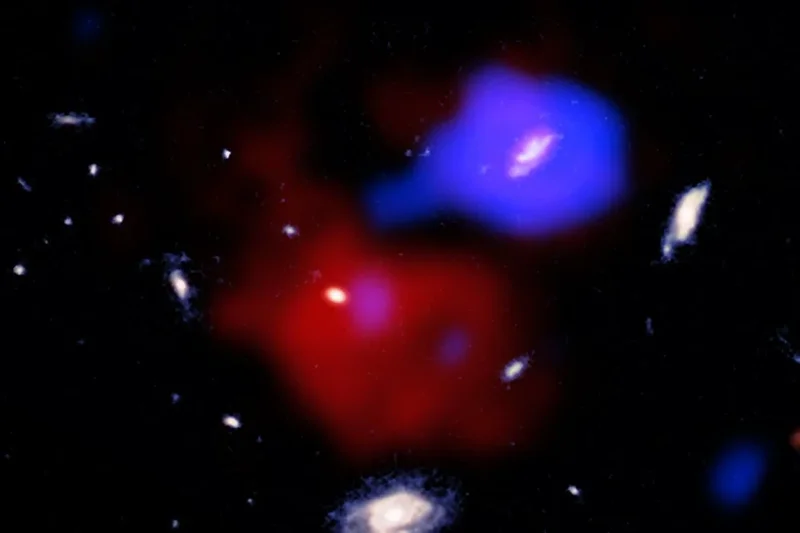
Galaxies surrounded by reservoirs of cold gas draw that gas into themselves and convert it into new stars. Astronomers find this throughout the Universe, including in the Milky Way. But there are exceptions, and the JWST has found plenty of queiscent galaxies in the early Universe. Astrophysicists want to know why.
Astronomers have used NASA's Chandra X-ray Observatory to look at one ancient galaxy that's at the intersection between the gigantic web-like large scale structure of the Universe and gas beyond the boundaries of any galaxy. The JWST has also probed this region because it's packed with galaxies and growing supermassive black holes (SMBH).
One of the galaxies in this densely-packed region is named MQN01 J004131.9-493704, but its nickname is the 'Red Potato' because of how it appears in JWST images. New research shows that despite being surrounded by cold gas, the Red Potato is not converting it into new stars and is instead quiescent.
New research in Astronomy and Astrophysics explains why. It's titled "A quiescent galaxy in a gas-rich cosmic web node at z â¼ 3," and the lead author is Weichen Wang. Wang is from the Department of Physics in the Universita degli Studi di Milano-Bicocca, in Milan, Italy.
"Recent JWST observations have unveiled a large number of quiescent galaxies at zââ³â3, bringing potential challenges to current galaxy formation models," the researchers write. "Since star formation is expected to be fed by external gas accretion, knowledge about the circumgalactic media (CGM) of these galaxies is essential to understanding how they quench."
The Red Potato is found in one of the largest over-densities of galaxies and active galactic nuclei (AGN) we know of. Its star formation is well below what it should be for a main sequence galaxy, and it contains no detectable molecular gas. "Surprisingly, it is located at the center of a large cool gas reservoir, as traced by bright Lyα and Hα emission," the authors write.
The region has been observed deeply across multiple wavelengths, and those observations suggest that some external mechanism is making the reservoir of gas warm and turbulent, and warmth and turbulence are the enemies of star formation. Turbulence prevents gas from falling into the galaxy, and warmth prevents gas from collapsing into stars. "If sustained over a sufficiently long time, this turbulence in the CGM surrounding the Red Potato could help prevent the gas from efficiently accumulating within the galaxy, thus removing one of the necessary conditions for possibly further condensation and efficient star formation," the authors explain.
This image shows Lyman Alpha contours, which illustrate the gas surrounding the Red Potato and its neighbour, the x-ray bright AGN-ID2. Image Credit: Wang et al. 2026. A&A.
âStars are not forming like we thought they would, so we went searching for the reason why,â said lead author Wang in a press release. âWe found there may be a cook in this cosmic kitchen.â
When an SMBH is actively accreting material, it's called an active galactic nuclei (AGN). As material is drawn to the SMBH, it forms a rotating accretion disk. Disk in the material is heated and emits x-rays, which is what NASA's Chandra Observatory sees. About 10% of the AGN are what's called radio-loud AGN, and they're the ones that produce the x-ray jets.
This artist's illustration shows a supermassive black hole and its active galactic nucleus emitting a powerful jet. Image Credit: NASA/Goddard Space Flight Center Conceptual Image Lab
Chandra observations showed that an x-ray jet from the Red Potato's neighbour could be responsible for the Red Potato's quiescence.
âIf the black holeâs jet is stirring up the gas around the red potato it could greatly slow down how quickly the galaxy can acquire new, fresh material to form stars,â said co-author Sebastiano Cantalupo, also of the University of Milan-Bicocca. âWith the energy from the stirring, the galaxy will starve and not be able to produce new stars at the rate expected for similar galaxies at the same cosmic epoch.â
The Red Potato appears red in optical and infrared images because it lacks newer stars. The galaxy that emits the jet is about 200,000 light years from the red potato. It appears blue because it's still forming hot, young stars.
This image shows the Red Potato and its surroundings in optical, infrared, and radio. The Red Potato galaxy appears red because it lacks hot young stars. Image Credit: X-ray: NASA/CXC/Univ. Milano-Bicocca/W. Wang et al.; Infrared: NASA/ESA/CSA/STScI; Radio: ESO/NRAO/NAOJ/ALMA; Image processing: NASA/CXC/SAO/N. Wolk & P. Edmonds
It's shocking to find a passive, quiescent galaxy at the heart of a massive reservoir of gas. While the researchers think that the jet from the Red Potato's neighbour is most likely responsible, there are other possibilities.
"One possibility could be linked to the previous history of the Red Potato itself, including ejective feedback episodes related to starbursts or AGN activity within the Red Potato which could have depleted its molecular gas reservoir and, at the same time, produced a turbulent CGM," the authors write.
But both Chandra observations and ALMA observations show no evidence of an active AGN in the Red Potato. There's also no evidence of strong outflows of any kind from the Red Potato. The authors say that though they can't rule out than ejective episode initiated the quenching, "... there is currently no clear evidence that they can maintain the continuous suppression of the Red Potatoâs star formation with the presence of the cool-gas-rich CGM, over the observed timescales of a few hundred Myrs," they explain.
This figure shows the analysis of radio and X-ray emissions near the Red Potato galaxy. Diffuse X-ray emission around the AGN neighbor ID2 is detected and marked by the pink box, indicating the presence of an X-ray jet which most likely emanates from AGN-ID2. Image Credit: Wang et al. 2026. A&A.
"Instead, a more plausible culprit of the turbulence is the AGN jet," the authors write. "The presence of a jet and its association with AGN-ID2 (the neighbouring galaxy) thus suggest that this external cause could be a probable agent currently maintaining an increased turbulence level in the Red Potato CGM."
This work adds to a growing body of evidence showing how galaxies can have far more powerful and far-reaching effects on their neighbours.