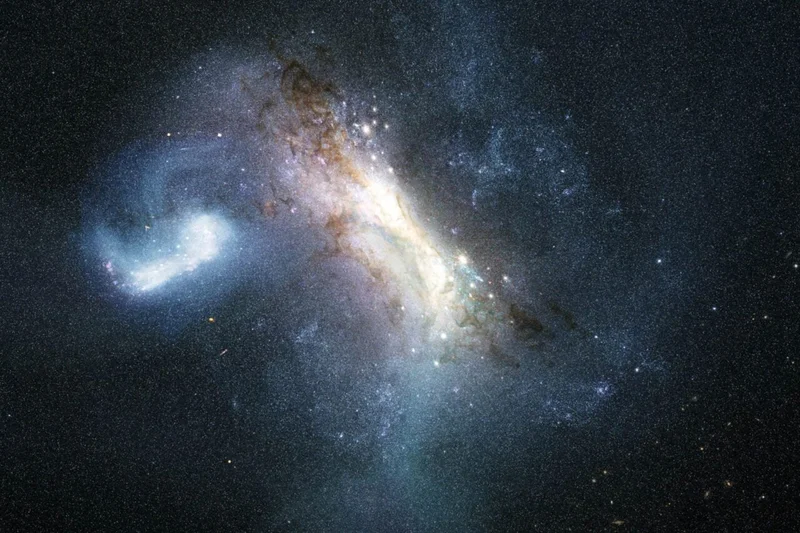
The Milky Way has a long history of devouring smaller galaxies, a process that has helped it grow to its current size, but scientists previously thought that process dated back roughly 10 billion years. A new study suggests, however, that our galaxy was feeding for significantly longer than that.
The findings, published Monday in the journal Nature Astronomy, reveal that a dwarf galaxy merged with the Milky Way 11.8 billion years ago, just 2 billion years after the Big Bang. Previous studies had suggested a merger might have occurred earlier than 10 billion years ago, but this is the first to find direct evidence of such an event.
âOur home is the Milky Way galaxy, but we do not know how our house was built,â lead author Davide Massari, a researcher at the Astrophysics and Space Science Observatory of Bologna in Italy, said in a statement. âIn this paper we discover where the first significant batch of bricks came from: a dwarf galaxy that we call LKH.â
A tangled history of galaxy mergers
Massari and his co-authors explain that, according to our current understanding of cosmology, large galaxies like the Milky Way have grown in large part through mergers with smaller galaxies. Although the smaller galaxy may disappear in the sense that it is no longer a distinct system, its stars retain clues about their origins. Thus, the Milky Way contains a “fossil record” of past mergers.
By studying these clues, researchers found evidence of two major mergers in the Milky Way’s history. The most recent is the one with the Sagittarius dwarf galaxy, which began about 6 billion years ago and is still ongoing. Roughly 4 billion years before that, our galaxy merged with another dwarf galaxy called Gaia-Sausage-Enceladus.
That unification heavily influenced the structure of the Milky Way’s galactic disk.
Previous studies have shown that a few smaller mergers took place between these two events, but Milky Way’s earlier evolutionary history has remained murky. Observations and simulations suggested another large merger preceded the Sagittarius and Gaia-Sausage-Enceladus events, but looking back that far proved difficult, until now.
Looking back in time
Massari’s team used NASA’s Hubble Space Telescope to study 39 globular clusters in a 20,000-light-year wide slice of our inner galaxy. These tightly bound groups of tens of thousands to a few million stars contain some of the oldest stars in the Milky Way, offering a window into its distant past.
âThanks to the high resolution and depth of Hubble imaging, we could measure the age and the metal content of these clusters with unprecedented precision,â said co-author Chiara Zerbinati, a PhD student at the University of Bologna in Italy.
The researchers combined Hubble’s observations with measurements from the European Space Agency’s Gaia mission, which made more than 3 trillion observations of 2 billion stars and other objects throughout the Milky Way. This allowed them to identify a population of globular clusters that are different from the others.
“These are the clusters that were born in LKH, and they tell us when that galaxy was devoured by ours, and how massive it was,” Zerbinati explained.
The researchers determined that the LKH, or Low-energy-Kraken-Heracles, was a dwarf galaxy with a total stellar mass roughly 500 million times the mass of the Sun. According to their findings, it merged with the Milky Way approximately 11.8 billion years ago, making this event the earliest known merger in our galaxy’s history.
âSome past studies have argued that the earliest phases of our galaxyâs evolution were defined by stars born only in our galaxy,â Massari said. âHere, we have shown that stars born in external galaxies also need to be considered.â
He and his colleagues plan to keep studying the Milky Way’s globular clusters to gain a full picture of how mergers shaped its evolution. Thanks to missions like Hubble and Gaia, our view of the galaxy’s ancient past has never been sharper.