- Pet owners across the UK have been 'biohacking' their pets
- READ MORE: You’re taking care of your cat wrong! Scientists claim you SHOULD let your pet roam outside – because it makes them less destructive
- See more Daily Mail on Google - save us as a Preferred Source
Owners are treating their pets to red light therapy, chiropractor massages and specialised supplements in hopes they can 'biohack' their 'fur babies' to live longer - but vets have warned that 'just jumping on the trend' may not be the right thing to do.
These days, a walk in the park and a game of catch around the back garden isn't enough for animal enthusiasts hoping to keep their beloved cats and dogs in tip top shape.
Now, social media is awash with furry faces being sculpted by 'gua sha' tools, adorned with acupuncture pins and on the receiving end of 'hydrotherapy' treatments.
A simple bowl of puppy chow is no good anymore, either.
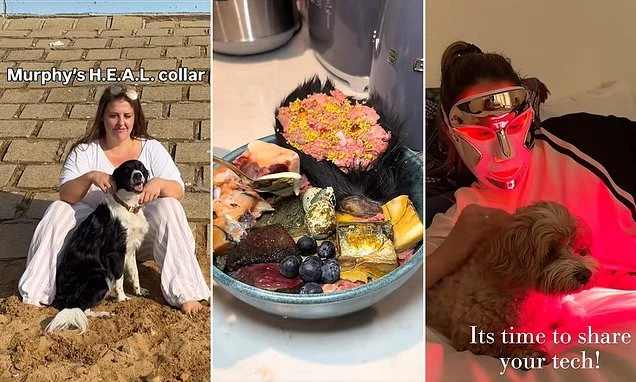
Owners are stocking up on a variety of powders, oils and supplements to add into bowls - and many are taking it a step farther by curating daily 'carnivore platters' with the finest cuts of raw meat, fruit, veg and egg shell for their pups.
Even collars can be 'biohacking' tools today, as many have touted versions costing upwards of £50, which feature 'advanced quantum energy technology designed to support your dog’s overall wellness levels'.
Speaking to the Daily Mail, veterinary experts have warned that while additional wellness hacks may certainly put a spring in your pet's step they can't be relied on to ensure longevity.
Sometimes 'what could be right for one dog might not be right for another so whilst it is very good to help them live their best life, it should be done so responsibly and for the right reasons', explained the vets.
Even collars can be 'biohacking' tools today, as many have touted versions costing upwards of £50, which feature 'advanced quantum energy technology designed to support your dog’s overall wellness levels'
Owners are treating their pets to red light therapy, chiropractor massages and specialised supplements in hopes they can 'biohack' their 'fur babies' to live longer - but vets have warned that 'just jumping on the trend may not be the thing to do
Petfluencer account and brand Paw Well even markets 'longevity kits' which promise 'elevated wellness for your dog'.
'We're increasingly seeing treatments like red light therapy, laser therapy, organic diets, hydrotherapy, acupuncture, and chiropractic care cross over from human wellness into the animal health world,' said Dr Charlotte Inness, founder of online veterinary pharmacy, VetMedi.
'Many of these approaches can genuinely benefit animals, but their effectiveness relies on proper use, scientific grounding, and guidance from qualified veterinary professionals.
'Adding extra 'wellness' steps to a pet's routine can certainly be valuable, but it's important to keep that in perspective.
'The foundation of a long, healthy life for any animal is still very simple: good nutrition, regular exercise, mental stimulation, routine veterinary care, and a safe, low-stress environment. Those basics do far more for overall health than any add-on treatment.'
She said that in some instances, such therapies could help with underlying conditions.
Dr Inness shared: 'Targeted wellness modalities like hydrotherapy, acupuncture, red light therapy, chiropractic care, or massage can offer meaningful benefits for certain pets, especially those who are aging, recovering from injury, or living with chronic conditions such as arthritis.
'In these cases, wellness therapies can improve comfort, mobility, and day-to-day quality of life in ways that go beyond what 'just a nice life' provides.
'The most important thing is a thoughtful, individualised approach based on what actually benefits the animal, not simply doing more for the sake of it.'
Red light therapy for example, has 'become common in veterinary rehabilitation because they can help reduce inflammation, support tissue repair, and ease pain'.
She added: 'They're especially valuable for animals recovering from surgery, managing arthritis, or healing soft-tissue injuries.
'Red light therapy shows promise as a supportive tool for improving comfort and mobility in animals, which can indirectly contribute to longevity. It isn't a 'life-extending' treatment on its own, but it can help manage chronic inflammation, support joint health, and improve recovery from injury - factors that often influence an animal's quality of life as they age.
When used correctly and under veterinary guidance, red light therapy can help aging animals stay more active and mobile for longer, which is a meaningful component of longevity.
Owners are stocking up on a variety of powders, oils and supplements to add into bowls - and many are taking it a step father by curating daily 'carnivore platters' with the finest cuts of raw meat, fruit, veg and egg shell for their pups
Red light therapy for example, has 'become common in veterinary rehabilitation because they can help reduce inflammation, support tissue repair, and ease pain'
And with food, Dr Inness stressed that 'organic' diets are 'not automatically healthier for animals'
'Chiropractic care is also gaining traction for its role in maintaining long-term musculoskeletal health. Regular assessments can help identify subtle joint restrictions or movement abnormalities before they develop into more noticeable pain or mobility problems.
'When performed by appropriately trained veterinary chiropractors, these adjustments may help animals stay more mobile, comfortable, and active as they age, and may assist in early detection of musculoskeletal issues that might otherwise go unnoticed.'
And with food, Dr Inness stressed that 'organic' diets are 'not automatically healthier for animals'.
'While organic ingredients may reduce exposure to certain pesticides or additives, the most critical factor is whether the diet is nutritionally complete and balanced for the species and life stage,' she explained.
'Organic labelling alone doesn't guarantee better nutrition, but some owners feel more confident choosing diets with simpler or cleaner ingredient profiles.'
Elsewhere, Fatima Maktari, Oxford-trained food scientist and founder of Tribal Pet Foods said that while preparing all raw meals 'can work well for some pet owners, whether it is a good or bad option depends entirely on how the meal has been formulated and prepared'.
She warned: 'Raw doesn't automatically mean the best nutritionally for the pet. As a food scientist, I'd want to know whether the recipe has been properly calculated to provide the right balance of protein, fats, vitamins, and minerals for that individual pet and at their exact life stage.
'A homemade raw diet can easily become unbalanced if those ratios aren't carefully considered, and uncooked meat also brings additional handling and bacterial considerations.
'I'm a big advocate for fresh, high-quality, minimally processed ingredients, which is one of the reasons I'm such a believer in cold-pressed food.
'It can offer many of the qualities owners are looking for - fresh, high-quality meat, recognisable ingredients, and gentle processing - while giving them the reassurance of a complete, carefully formulated diet with greater consistency from meal to meal.'