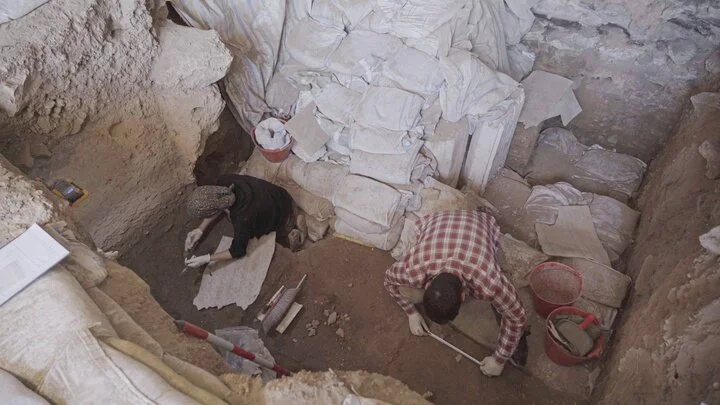
Archaeologists resume excavations at Qal-e Kord Cave, a key Paleolithic site
TEHRAN - The seventh season of archaeological excavations at Qal-e Kord Cave in Avaj County, Qazvin province, has begun, as researchers seek to reconstruct more precisely the sequence of human occupation and the formation of cultural layers at the prehistoric site.
Maryam Mahdavi, director general of Qazvin’s Cultural Heritage, Tourism and Handicrafts Department, announced the start of the new excavation season on Wednesday, Miras Aria reported.
She said the seventh season is being conducted under a permit from the Research Institute of Cultural Heritage and Tourism, with financial support from the provincial Cultural Heritage, Tourism and Handicrafts Department and in coordination with the Archaeological Research Institute.
The project is led by Milad Hashemi Sarvandi, a faculty member of the Archaeology Department at Tarbiat Modares University.
According to Mahdavi, the current season includes continued excavation in parts of previously opened trenches as well as the opening of new areas. The main objective is to establish a more precise reconstruction of the sequence of human occupations at the cave and to better understand the processes that led to the formation of its cultural layers.
Previous excavations have identified the cave as one of Iran’s oldest known archaeological sites and have opened new avenues for research into the country’s Paleolithic period.
Archaeological evidence from the cave indicates repeated human occupation extending back more than 400,000 years. Stone tools recovered from the site have been associated with early human species, including Homo heidelbergensis and possibly Homo erectus, while later evidence points to Neanderthal occupation.
Researchers have also recovered animal remains, including those of extinct prehistoric horses, deer, brown bears and rhinoceroses, providing clues about the environment and subsistence practices of the cave’s prehistoric inhabitants.
The first season of joint Iranian-French excavations at Qal-e Kord in November 2018 resulted in the discovery of more than 6,000 cultural artefacts, along with animal bones and numerous stone tools attributed to the Middle Paleolithic period.
Research on the cave has contributed to a broader understanding of human occupation in the Zagros region, including the presence and activities of Neanderthals in the mountainous areas of Iran.
The Paleolithic Period, or Old Stone Age, was an ancient stage of human development characterized by the use of rudimentary chipped-stone tools. The popular Paleo diet, also known as the Stone Age diet, is based on foods that humans are presumed to have consumed during this period.
The Paleolithic Period is generally divided into three phases: Lower, Middle, and Upper Paleolithic. However, anthropologists avoid assigning rigid chronological boundaries to these divisions because technological developments emerged at different times and in different regions. There was also considerable overlap between phases, as new technologies took time to spread, meaning some human groups adopted more advanced tools and techniques earlier than others.
AM