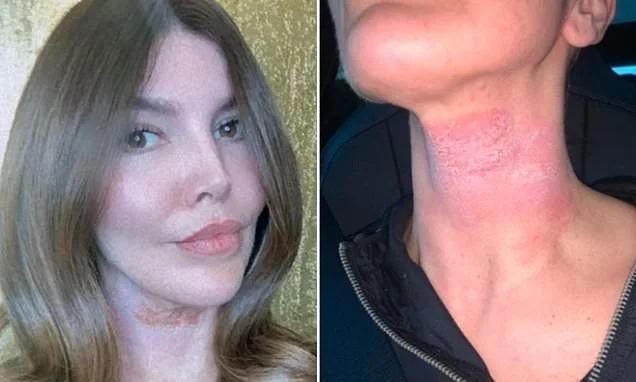
For years, Amy Newsham used topical steroid creams to manage her eczema. Unaware of potential side-effects and long-term issues, she applied the creams to manage breakouts and contain flare-ups.
What the nurse, 33, didn’t realise was that with every application she was actually making her sensitive skin conditions worse.
And when she finally stopped using the creams, she was left with inflammation and other symptoms that went far beyond the original condition she had been treating.
Amy says: ‘I had lived with eczema for many years and used topical steroid creams to manage it. At the time, I saw them as something that helped control a flare-up and didn’t fully understand the potential issues associated with repeated or prolonged use.
‘But when I stopped, every symptom was exacerbated, and for the next nine months I was in a living nightmare.
‘Something as simple as having a shower, getting dressed, applying skincare or experiencing temperature changes could cause irritation. Eventually, after researching my symptoms and reflecting on how they had developed, I realised I was experiencing topical steroid withdrawal (TSW).’
TSW is a severe rebound reaction that can occur when the skin adapts to topical corticosteroids but is then deprived of them.
Like millions living with eczema, Amy had relied on steroid creams to manage occasional flare-ups. She saw them as a tool to control her symptoms but did not fully understand the potential consequences of repeated or prolonged use.
When Amy Newsham, a nurse from Merseyside, stopped using topical steroid creams to treat her eczema, she was met with painful inflammation and skin deterioration
When a patch of eczema flared on her neck, she treated it with prescribed topical steroids for just over three months. The creams initially cleared the area, but a troubling pattern quickly emerged: each time she stopped applying them, the symptoms returned with greater intensity. And what followed after cutting out the creams was even worse.
Amy says it was due to a lack of understanding of TSW, a condition that remains widely unrecognised and poorly understood within conventional medicine. There have been calls for a traffic light system on topical steroid creams to prevent users from suffering harsh reactions, but little has been done.
Amy, from the village of Lydiate in Merseyside, says when she initially sought professional help for the TSW, her GP repeatedly attributed her severe symptoms to severe eczema. On one occasion, after scratching her neck so badly that a frightening green fluid started seeping out, she went to A&E, terrified of getting an infection.
She says she explicitly asked for a treatment that didn't involve another steroid cream but the nurse treating her dismissed her concerns, saying it was ‘just eczema’ and advising her ‘not to read too much into anything else’.
Even a private consultation with a dermatologist yielded no new insights. Amy says: ‘I was at a loss. I was deeply frustrated and felt isolated. Having lived with eczema for years, I knew my own skin, and what I was experiencing after steroid creams felt entirely different.’
For nine agonising months, TSW dictated every aspect of Amy’s life. The physical discomfort was constant but she says that the emotional fatigue and unpredictability were equally brutal.
Her skin could appear to be healing one day, only to flare violently the next. Working as a nurse prescriber in medical aesthetics, Amy found herself in the agonising position of helping clients build skin confidence while privately struggling with a raw, weeping face and neck, which she constantly tried to conceal behind high polo-neck tops.
She gradually withdrew from social life, skipping work Christmas parties and avoiding gatherings with friends to escape the exhausting process of explaining her skin or feeling like the centre of attention.
She says: ‘It affected my whole life – my mood, confidence and social life. I began avoiding going out with friends because I didn’t want my skin to become the focus of conversation. I also found it exhausting having to explain what TSW was whenever somebody asked about my skin.
‘My family could see how much I was struggling. My mum says she could always tell when my skin was particularly bad because I wasn’t myself. I started avoiding going out with friends and became exhausted from constantly explaining what I was going through.’
Despite asking for treatment, Amy's symptoms and concerned were dismissed as 'just eczema'
Amy's TSW dictated every aspect of her life for nine months, affecting her mood, confidence and social life
Using a medical red and near-infrared light device helped to soothe Amy's skin and reduce inflammation
Amy would spend hours researching products that might help and would impulsively buy products she had read about online. She says: ‘My mum says it was difficult to watch someone who was normally so confident and sociable begin changing her life because of her skin.’
The emotional strain rippled through Amy’s home life, too. The hardest moments came when her young son, Louie, now aged six, would look frightened when he saw her raw neck and open wounds. But balancing the reality of TSW while raising two young boys, continuing her clinical work and running businesses meant she couldn't simply put life on hold, and Amy forced herself to push through even on the days she wanted to hide away.
In the early stages of her withdrawal, Amy fell into the common trap of trying product after product, hoping for a quick fix. But she quickly realised that constantly introducing new active ingredients was further compromising her fragile skin barrier.
Stripping her routine back to absolute basics, she finally decided to discontinue the creams altogether. She says: ‘There was a great deal of trial and error, and I bought various products after reading about other people’s experiences online.
‘Eventually, I realised that constantly introducing new products wasn’t helping, so I simplified my routine and focused on protecting and supporting my skin barrier. I also began using a medical red and near-infrared light device. It was gentle to use and helped soothe my skin, reduce the appearance of inflammation and make it feel more comfortable.’
Amy says the non-invasive light therapy proved gentle enough for her hyper-sensitive skin, helping to soothe raw tissue, reduce visible inflammation and provide consistent comfort without requiring another topical product. She went on to create her own red light therapy system, CHROMA, with her cousin Laura and aunt Amanda, whose support she says was ‘invaluable’ during her hardest times.
Today, Amy's skin has recovered but the ordeal permanently reshaped her perspective as both a patient and a medical professional. While she acknowledges that topical steroids serve an important clinical purpose when appropriately prescribed, monitored and reviewed, she strongly advocates for clearer guidance and better patient education regarding their long-term use.
She says her own experience has transformed her approach to aesthetics, shifting her focus away from quick fixes and toward non-invasive technologies, skin barrier support, and regenerative health.
Looking back, Amy views those nine months as her very own, extraordinarily difficult, masterclass. One that taught her to be patient with her body, to recognise that skin health isn't always linear and, above all, she says, to accept that ‘my skin does not define who I am’.