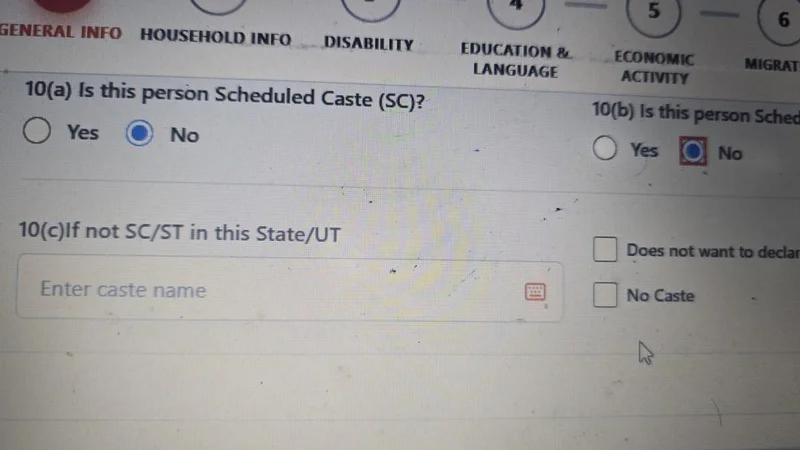
The questionnaire or the schedule for the population enumeration phase of Census 2027, which has gone live in Ladakh and snow-bound areas of three other States ahead of the rest of the country, seeks information on religion, date of birth and place of birth up to the village level of both the father and mother, according to the questions seen by The Hindu.
Under the data head “Family Particulars,” the questionnaire also has an option to record the place of birth of the father and mother if they were born outside India. Other than the six religions—Hindu, Christian, Sikh, Buddhist, Muslim and Jain—respondents can record “other religion” in a separate column.
Caste enumeration
Scheduled Caste and Scheduled Tribe respondents can choose their caste from a predetermined drop-down menu, while all others will have to type the caste name in an open field. This is Independent India’s first caste enumeration. Question 10 (C) says: “If not SC/ST in this State/UT-Enter Caste name.” There are two other options besides the caste field: “Does not want to declare Caste” and “No Caste.” The data fields are marked “mandatory.”
Only the Union Government can issue the SC/ST list after being ratified by Parliament.
New questions
The Registrar General and Census Commissioner of India (RG&CCI) on August 14 notified a set of 40 questions to be asked during the population enumeration phase, or the second phase of the Census, adding 13 new questions or data fields that were not part of the Census 2011 questionnaire., which had 29 questions.
The questions added for the first time include spouse’s name, nationality, father’s particulars and mother’s particulars, digital literacy, permanent residential address, place of COVID-19 vaccination, number of bank accounts, passport number, driving licence availability and mobile, Aadhaar and voter ID numbers, if available.
NPR overlap
Some of the additional questions, such as particulars of mother and father, Aadhaar, mobile, voter ID and driving license details, mirror those asked in the rehearsal form for the National Population Register (NPR) in 2019. The NPR, which was initially proposed to be updated with the first phase of the Census, has been put on the back burner amid opposition from political parties and civil society members, over concerns that the data can be used to create a countrywide National Register of Citizens (NRC).
The NPR, first prepared in 2011 and updated in 2015, already has a family-wise database of 119 crore residents.
Unlike Census data, which can only be released in an aggregate form up to the village level, the NPR database can be shared with States and other government departments.
The Census schedule, which was made available to respondents in Ladakh, parts of Jammu and Kashmir, Uttarakhand and Himachal Pradesh on August 17 through a self-enumeration portal, ahead of the rest of the country, further expands the data fields notified in the Gazette of India.
Door-to-door enumeration
Door-to-door enumeration in these States will begin on September 1, and conclude on September 30. In the rest of the country, the second phase will be conducted in February 2027.
The question on the place of COVID-19 vaccination gives two options—within India or outside India. The names of the State and district where the vaccination was administered are to be provided if the jab was taken in India.
The open-field methodology to record caste has been questioned by the Congress. On Tuesday, Congress leader Jairam Ramesh, in a post on X, accused the government of sabotaging the caste Census. “The conclusion is clear: the Modi Govt wants to simply sabotage the caste census. The PM had made a complete U-turn on April 30, 2025 and announced that a caste census - which he had earlier attacked as an “urban naxal” idea - would take place. Now he has done another U-turn on his earlier U-turn and without saying so has buried the idea of a caste census. He is an U-turn ustad,” Mr. Ramesh said.
He said that on September 21, 2021, the Union Government had filed an affidavit in the Supreme Court categorically rejecting the plea for a caste census.
“However, Para 12 (d) in the affidavit says the following: ‘There was no registry of caste prepared prior to the conduct of 2011 Census. It would have been ideal for the Registry of Castes that there should have been given a drop-down menu for selection of the castes which could have made some consistent data available which can be relied upon.' The question now is this: why does Census 2027 NOT have this drop-down menu that the Modi Government recommended in the affidavit it submitted to the Supreme Court in Sept 2021? Such a menu had, in fact, been prepared prior to the caste surveys both in Bihar and Telangana. Such a menu had also been suggested by the Congress President in his letter to the PM of May 5, 2025,” he said.
The open-field method had resulted in the 2011 Socio-Economic Caste Census (SECC) returning over 46 lakh different “caste names”, largely owing to the differences in what people understood by caste. Significantly, the government has consistently maintained over the last decade that the 2011 SECC’s caste data were unreliable because of “errors” in data collection.
The total number of castes recorded during the 1931 Census was 4,147. The SECC was conducted as a survey outside the purview of the Census Act, 1948 and had no statutory backing. The data have never been released by the government.
Published - August 18, 2026 10:27 pm IST