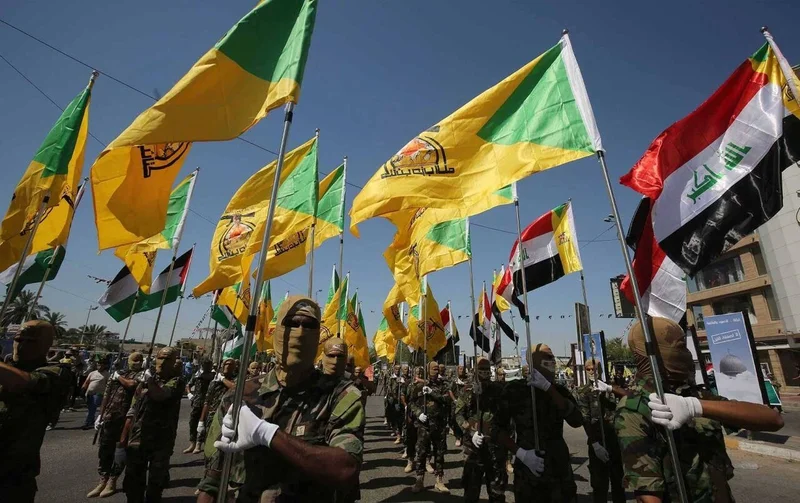
Iraqi resistance group sets conditions over weapons
Kataeb Hezbollah demands full exit of US forces, dissolution of Peshmerga and expulsion of Turkish forces in northern Iraq
TEHRAN – An official from the Iraqi resistance group Kataeb Hezbollah has issued a sharply worded statement setting out conditions for any future cooperation with the Iraqi government over the question of weapons held by the resistance forces.
Abu Mujahid al-Assaf, a security official for Kataeb Hezbollah, said the Islamic Resistance would only consider rapprochement with a government prepared to fundamentally alter Iraq’s security and political landscape.
His demands included the complete withdrawal of American forces from Iraqi territory, airspace, and waters, guarantees that they would not return, and an end to U.S. influence over Iraq’s political and economic decisions.
The demands come amid a broader and longstanding dispute in Iraq over the future of armed groups outside the conventional military and security structures of the state. Kataeb Hezbollah is widely considered an anti-American resistance movement and one of the most powerful in Iraq.
The question of how, or whether, groups similar to Kataeb Hezbollah should surrender, integrate, or retain their weapons has remained one of the most politically sensitive issues in the country.
In his statement, al-Assaf presented the issue not simply as a question of disarmament but as a test of Iraqi sovereignty. The resistance movement, he argued, would not discuss its weapons while American forces remained in Iraq or while Baghdad’s political and economic decisions were subject to U.S. influence.
“The complete and real withdrawal of the American enemy forces from Iraqi land, sky, and waters” was the first condition listed by al-Assaf. He added that Baghdad must ensure the occupying forces “do not return”, while also freeing Iraq’s political and economic decision-making from “American dominance”.
Amid broad public anger, the future roles of U.S. forces in Iraq have been the subject of negotiations between consecutive governments in Baghdad and Washington.
Al-Assaf’s second demand was directed at Turkey. He called for the “expulsion of Turkish forces occupying northern Iraq”, echoing longstanding objections from the Iraqi governments to Turkish military operations and bases in northern Iraq.
Turkey has maintained a military presence in northern Iraq for years as part of operations against the Kurdistan Workers’ Party, or PKK, which Ankara considers a terrorist organization.
The issue has repeatedly complicated relations between Baghdad and Ankara. Iraqi officials have objected to Turkish military activity on Iraqi territory while Turkey argues that its operations are necessary to counter the PKK.
The statement went further in its criticism of Iraq’s Kurdish forces. Al-Assaf demanded the dissolution of the Peshmerga forces, saying they are “the most armed and dangerous militia to the unity of Iraq, in addition to their suspicious ties with the Zionist-American enemy.”
The statement then turned directly towards the Iraqi prime minister.
Al-Assaf said Kataeb Hezbollah had spent more than 100 days tolerating Prime Minister Ali al-Zaidi’s “empty posturing”, hoping that the “young” leader would come to understand the domestic, regional, and international forces shaping Iraq. He said the movement had also expected the prime minister to heed the advice of experienced politicians.
Instead, al-Assaf argued, there had been no meaningful change.
“We have not seen any development from him in understanding the complex circumstances passing through Iraq and the region,” he said, accusing al-Zaidi of listening instead to people hostile to Iraq and to the U.S. special presidential envoy Tom Barrack to Syria and Iraq, whom the statement labelled as “the pickpocket”.
The personal nature of the criticism marks a significant escalation in the statement. Rather than limiting its objections to government policy, Kataeb Hezbollah accused the prime minister of failing to understand the balance of forces inside Iraq and of aligning himself with figures the movement considers hostile to the Iraqi resistance.
The most eye-catching language appeared in the statement’s third section, where al-Assaf accused the government of “storming homes and terrifying the families of martyrs, the wounded, resistance fighters, and elders, with direct supervision from the American enemy.”
“Our patience has begun to run out,” he said, describing the actions as “provocative and irresponsible”.
He then invoked a proverb: “The sister’s son has seven stabs at his uncle’s chest,” saying that the government’s actions had ultimately “ended up in our chests, which are filled with the scars of wounds from Iraq’s enemies.
This was followed by an explicit warning. “We have begun working on the principle of: An eye for an eye, and the initiator is the more unjust,” al-Assaf said.
The warning was directed particularly at the attacks on the families of those who had fought and died for Iraq. Such families, he said, should not be targeted or intimidated, arguing that the consequences of such actions would extend beyond the immediate confrontation.
The official also contrasted the lives of the prime minister and members of the armed resistance, accusing al-Zaidi of having enjoyed wealth and security while members of Kataeb Hezbollah and other resistance fighters had shed blood defending Iraq.
“You were engaging in trade, enjoying safety and luxury, and filling your safes with billions, while our blood was bleeding to preserve the country’s sovereignty, statehood, and sacred sites,” al-Assaf said.
He concluded the reminder with a reference to men who were prepared to act regardless of political pressure: “You are facing men who do not fear the blame of any blamer for the sake of God.”
The statement stopped short of announcing a specific military action against the government. But its language suggests that Kataeb Hezbollah is attempting to establish political and security red lines while simultaneously warning that continued pressure on its members could provoke retaliation.
The final section of the statement shifted to an appeal to senior political figures. Al-Assaf called on “senior brothers and their wise leaders” to intervene and correct the prime minister’s mistakes.
The objective, he said, should be to restore stability, preserve Iraq’s dignity, and prevent the country from being drawn into actions that serve its enemies.
That appeal illustrates the complicated position facing the Iraqi government amid efforts by the United States to dissolve the Popular Mobilization Forces (PMF). The PMF was formally incorporated into Iraq’s security apparatus after the rise of Daesh, with its soldiers playing a major role in the campaign against the terrorist organization.
Kataeb Hezbollah is demanding changes to Iraq’s relationship with foreign powers before it will contemplate cooperation with the government on disarmament. Its conditions are sweeping: American forces must leave; U.S. influence over Iraqi decision-making must end; Turkish troops must be expelled; and the Peshmerga must be dissolved.
At the same time, the increasingly personal criticism of the prime minister and the warnings of retaliation suggest that the dispute is no longer confined to questions of long-term state policy.
For now, Kataeb Hezbollah has made clear that it does not regard the weapons question as a simple matter of surrendering arms. In al-Assaf’s formulation, the issue is inseparable from Iraqi sovereignty, resistance to foreign military forces, and the political balance inside the country.