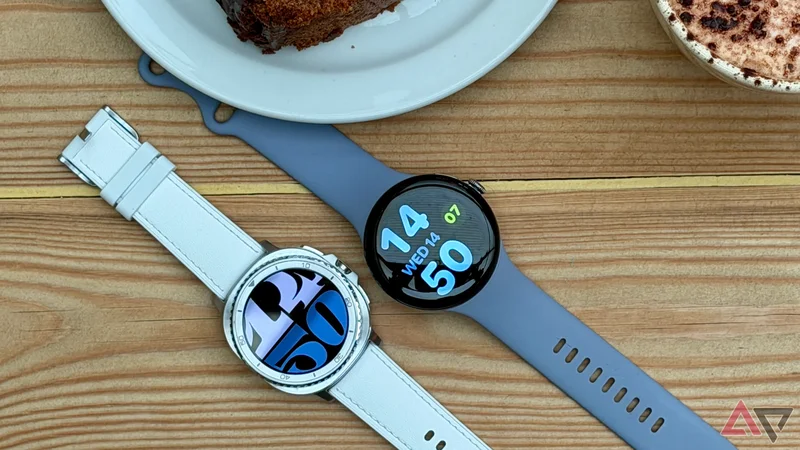
Is the Samsung Galaxy Watch 8 Classic worth the extra cost over the Google Pixel Watch 4?
I've worn both to find out whether you really need a Google or Samsung phone to go with them.
Both are excellent, but a few differences are worth understanding before you splash out on either.
Materials and design
Simple or complex
The Galaxy Watch 8 Classic's design blends the Classic shapes of old, the Galaxy Watch Ultra, and the newly adopted cushion case shape, which looks fantastic on the Galaxy Watch 8.
It's made of stainless steel with a sapphire crystal over the screen, with the only letdown being the plastic caseback.
The Watch 8 Classic's short lugs and oversized crown guard give it a gawky look that won't appeal to everyone.
However, at least the Galaxy Watch 8 Classic has character, something the Pixel Watch 4 lacks due to its simple, circular shape and integrated strap. The case is aluminum, and the case back is glass.
The Pixel Watch 4 is let down by not using sapphire crystal over the screen, giving it a warm, almost plastic feel under your finger.
The Galaxy Watch 8 Classic feels far more expensive, and the rotating bezel is a tactile joy. The Pixel Watch 4's rotating crown can't compete.
The Pixel wins back some points with the thin bezel around the screen, and when you choose the right watch face, it takes on a cool all-display look.
The proprietary band attachment system is also superior to the Galaxy Watch 8 Classic's, which may matter if you plan to swap them out.
Despite its oddball looks, the Galaxy Watch 8 Classic justifies its price tag with better-quality materials and a well-engineered rotating bezel.
The Pixel Watch 4's simple shape, quick-release band attachment, and thin screen bezel are the standout positives.
What they're like on your wrist
Very different wear experiences
There's a considerable difference between wearing the Galaxy Watch 8 Classic and the Pixel Watch 4, with Google's smartwatch being by far the most comfortable.
It all comes down to dimensions and weight distribution. The Pixel Watch 4's simple shape may not do the design many favors, but it really works for all-day comfort.
I've been wearing the 45mm version, and most of the time I forget it's on my wrist. It sits under my cuff, doesn't slip around, and rarely gets sweaty.
The Galaxy Watch 8 Classic comes only in one size: 46mm. The rotating bezel aids with navigation, but it does little for balance.
The Galaxy Watch 8 Classic is oddly top-heavy, and I notice it slipping around on my wrist unless the strap is fastened very tightly. It's also less likely to fit comfortably under a cuff.
I'd choose the Pixel Watch 4 over the Watch 8 Classic for a fuss-free, lightweight, easy-to-live-with wearing experience.
Control systems
Crowns and bezels
The Galaxy Watch 8 Classic's rotating bezel is superb, but you probably already know that, so let's talk about the rest of the controls, which aren't quite as good.
There are three buttons on the side—the two flanking the crown, Back and Home —which can be configured to different functions.
The crown is the issue, as it's a repeat of the Action Button on the Galaxy Watch Ultra. It opens the workout mode and can also act as a shortcut to features like the flashlight and water ejection mode.
I find muscle memory makes me press it expecting to go to Home, and not being able to configure it to do that seems like a missed opportunity, since the other buttons can be altered.
The Pixel Watch 4 doesn't suffer from the same issue, but the single crown means there's less functionality outside of using the touchscreen.
There is a small shortcut button alongside the crown, but the flush fitment makes it a pain to locate and press.
I much prefer the feel of the Galaxy Watch 8 Classic's sapphire glass, and it makes using the Samsung smartwatch more pleasant.
Both have tactile and noticeable haptic feedback, but the Galaxy Watch 8 Classic's stands out more, with an uncanny ability to play "tunes" on your wrist. I really like it.
Software and performance
Almost too close to call
Both smartwatches use Google's Wear OS 6, but present it differently. Samsung promises four years of software support, a year longer than Google and the Pixel Watch 4.
Each smartwatch uses a combination of swipable Tiles and vertically scrolling lists and menus.
The Galaxy Watch 8 Classic's Exynos W1000 makes One UI Watch 8 snappier and smoother than the Qualcomm Snapdragon W5 Gen 2 in the Pixel Watch 4.
I really like the One UI Watch 8's multi-button Tiles, which present a lot of information neatly on a single screen, but they can't quite match the Pixel Watch 4's clever buttons that adapt to the screen's shape, use space logically, and keep text easy to read.
Samsung's software is bright and colorful, but not as customizable as the Pixel Watch 4's, especially with its new Color Theme option, which lets you quickly match the color scheme to your phone, the smartwatch's strap, or even your clothing.
I haven't noticed any difference in screen performance, sharpness, or brightness.
However, the 1.4-inch Pixel Watch 4 screen is easier to swipe across because it lacks a bezel, and you will notice a slight size increase over the Watch 8 Classic's 1.34-inch screen.
It's a hard choice between them here. The Watch 8 Classic's performance is smoother than the Pixel Watch 4, but I prefer Google's software to Samsung's, although it's a very tough call.
Health tracking
It may depend on what phone you own
Samsung and Google would rather you use one of their phones with their smartwatch, but not everyone will.
I've been using these two smartwatches with the Honor Magic8 Pro, so I'm far outside both ecosystems.
The Galaxy Watch 8 Classic was easy to set up, and both Samsung's Galaxy Wearable and Health apps installed and worked without a problem.
In Health, sleep tracking, activity, heart rate, blood oxygen, stress, vascular load, AGEs Index, Body Composition, and the Antioxidant Index all operate normally.
What you don't get without a Samsung phone is the ECG or blood pressure measurement feature, or any related feature like atrial fibrillation, but ask yourself whether these apply to your own health and lifestyle before getting too concerned.
If you decide the ECG is important and don't have a Samsung phone, the feature is present and operational on the Pixel Watch 4, even though it was connected to the Honor Magic8 Pro.
The Fitbit app isn't as feature-packed as Health, and doesn't include features like Body Composition or Antioxidant Index.
Another thing to note is that Fitbit has a premium version, which costs $10 per month and provides extra insights, a few features, and workout plans.
Health is entirely free and includes all the data points you could want, along with exercise plans.
You don't miss out on any hardware features with the Pixel Watch 4, regardless of what phone you own, but you will need a Samsung phone to get the most from the Galaxy Watch 8 Classic.
However, the ECG and blood pressure features are quite niche, and the Health app is free, so your choice will come down to your personal preferences and phone choice.
Battery life and charging
Strong performance from both
The biggest difference between the two smartwatches when it comes to charging is the attachment system.
The Pixel Watch 4 has a handy dock that turns the display into a bedside clock, while the Galaxy Watch 8 Classic uses a magnetic plinth, just like the Galaxy Watch 8.
Both charge the smartwatch, but only the Pixel Watch 4 retains some usefulness when doing so.
The downside is that the Pixel Watch 4's charging connection is on the side of the case rather than the back, giving the Galaxy Watch 8 Classic's case a cleaner look.
The Google Pixel Watch 4's battery life continues to impress. The 415mAh cell delivers three days of use with sleep tracking and a couple of short workouts, which is strong performance. It takes an hour to charge.
The Galaxy Watch 8 Classic's 450mAh battery comes close to the Pixel Watch 4's performance but falls short of three days of use by a few hours when all health features are active. It takes about 90 minutes to charge.
For charging convenience and long battery life, the Google Pixel Watch 4 beats the Samsung Galaxy Watch 8 Classic.
Which smartwatch to buy?
When I compared the Pixel Watch 4 to the Galaxy Watch 8, it was pretty easy to decide the cheaper, more characterful Watch 8 was the one to buy.
I preferred the TAG Heuer Connected Calibre E5 too, but the high price made it difficult to recommend over the Watch 8 Classic.
I've never been taken by the Pixel Watch 4's simple, plain design, but it is preferable over the Galaxy Watch 8 Classic's gawky style.
Everyone will feel differently about the shape and how it sits on the wrist, but I can't get on with it.
The Pixel Watch 4 is also the better buy if you own a non-Samsung phone, as it doesn't miss out on any health features, but to get the most from Fitbit, you'll probably need to pay monthly for Fitbit Premium.
Google Pixel Watch 4
-
**Case Material** - Aluminum
-
**Case size** - 41mm / 45mm
-
**Display** - AMOLED
The newest Pixel Watch sports an eye-catching new look, up to 40 hours of battery life, and 6 months of Fitbit Premium for free.
Perhaps the one deciding factor is that the Pixel Watch 4 comes in either 41mm or 45mm case sizes, but the Watch 8 Classic is only available in a large 46mm case.
That makes it more versatile, even if the materials aren't as premium.
Samsung Galaxy Watch 8 Classic
-
**Case Material** - Stainless steel
-
**Case size** - 46mm
-
**Colors** - Black, White
-
**Display** - 1.34" Super AMOLED
-
**CPU** - Exynos W1000
-
**RAM** - 2 GB
The Samsung Watch 8 Classic packs lots of new features along with the rotating bezel missing from the Watch 6 series.
I'd choose the Pixel Watch 4, and the $100 I saved by buying it instead of the Watch 8 Classic would make me feel better about its plain design.